We, at cbseinsights.com, have framed the latest Agriculture For Class-10 Geography-MCQ Questions as per the latest CBSE syllabus. Besides, giving an overview of the chapter, these MCQs will enhance the logical and competitive aptitude of the students.
Agriculture For Class-10 Geography-MCQ Questions
Q 1 – Which of the following types of economic activity is agriculture?
(a) Primary activity
(b) Secondary activity
(c) Tertiary activity
(d) All the above
Q 2 – Which one of the following is not a food crop
(a) Rice
(b) wheat
(c) Cotton
(d) Maize
Q 3 – Rice is a subsistence crop in Orissa. In which of the following states, is rice a commercial crop?
(a) West Bengal and Bihar
(b) Jammu and Kashmir
(c) Punjab and Haryana
(d) Tamil Nadu and Kerala
Q 4 – Landholdings are uneconomical in intensive farming because: :
(a) Fragmentation of landholdings
(b) Dealing on landholdings
(c) Zamindari system
(d) Use of inputs in farming.
Q 5 – Muskmelon grows in
(a) rabi season
(b) kharif season
(c) Zaid season
(d) all the three seasons
Q 6 – Which of the following crops is produced during Zaid cropping season?
(a) Sugarcane
(b) Muskmelon
(c) Groundnut
(d) Moong
Agriculture For Class-10 Geography-MCQ Questions
Q 7 – It takes almost a year to grow.
(a) Rice
(b) Sugarcane
(c) Maize
(d) Bajra
Q 8 – Which of the following are known as coarse grains?
(a) Wheat and Rice
(b) Millets—Jowar, Bajra, and Ragi
(c) Pulses—urad, Arhar, gram
(d) Oilseeds
Q 9 – How many crops of paddy are grown in a year in the states like Assam, West Bengal, and Orissa and they are termed as which
of the following?
(a) Once-Arabica
(b) Two-Rabi and Zaid
(c) Three-Aus, Aman, Boro
(d) Three-Kumar, Valre, Waltre
Q 10 – One of the following pulses which do not help in restoring soil fertility.
(a) Moong
(b) Gram
(c) Peas
(d) Arhar
Q 11 – Which one of the following is a leguminous crop?
(a) Pulses
(b) Millets
(c) Jowar
(d) Sesame.
Q 12 – Which of the following is a Kharif crop and accounts for about half of the major oilseeds produced in the country?
(a) Mustard
(b) Coconut
(c) Groundnut
(d) Soyabean
Q 13 – The second-largest producer of groundnut is
(a) Gujarat
(b) Andhra Pradesh
(c) Tamil Nadu
(d) Kerala
Agriculture For Class-10 Geography-MCQ Questions
Q 14 – Which one of the following prices is announced by the government in support of a crop?
(a) Maximum support price
(b) Minimum support price
(c) Moderate support price
(d) Influential support price
Q 15 – Tea cultivation is an example of which of the following types of agriculture?
(a) Horticulture
(b) Plantation
(c) Beverage cultivation
(d) Intensive agriculture
Q 16 – Which of the following is known as golden fiber?
(a) Cotton
(b) Jute
(c) Hemp
(d) Silk
Q 17 – Which of the following is the primary objective of India’s food security policy?
(a) To ensure the availability of food grains to the common people at an affordable price.
(b) To diversify crop production to increase the income of the farmers.
(c) To provide insurance against crop failures.
(d) To shift from food grain production to commercial crops.
Q 18 – Coffee cultivation was first introduced in:
(a) the Himalayas
(b) Aravalli Hills
(c) Garo Hills
(d) Baba Budan Hills
Food and Non-Food crops
[/showhide] Q 19 – White Revolution involves improvement in the production of which of the following products?
Q 20 – Which of the following countries is the largest producer of oilseeds?
Ans – (c) India
Ans – (d) Pulses require intensive irrigation facilities Q 22 – Which one of the following is the feature of plantation agriculture?
Ans – (d) All of the above Q 23 – In which of the following states of India rice is considered a commercial crop?
Ans – (d) Punjab Q 24 – Which of the following is the example of Kharif crops?
Ans – (a) Rice Q 25 – Which of the following crops are grown with the onset of monsoons and are harvested in the month of September and October?
Ans – (b) Kharif
Ans – (b) Plantation agriculture Q 27 – Which of the following about pulses is not true?
Ans – (d) A major export item.
Ans – (a) Winter Q 29 – In which type of soil does maize grow well?
Ans – (d) None of these Q 30 – Which one of the following crops is a beverage crop?
Ans – (a) Tea Q 31 – The variety of coffee grown in India and known for its flavor
Ans – (c) Arabica Q 32 – Which country is the largest producer of fruits and vegetables in the world?
Ans – (d) India Q 33 – Cultivation of coffee is confined to which of the following hills?
Ans – (a) Nilgiri Q 34 – Punjab-Haryana are rice surplus states because
Ans – (b) It is not the staple diet of people Q 35 – Arabica variety of coffee was initially brought to India from which of the following countries?
Ans – (a) Yemen Q 36 – Which of the following crops grows well in the Black soil?
Ans – (c) Cotton Q 37 – Which country is the largest producer of oilseeds in the world?
Ans – (b) India Q 38 – Which of the following is not correct about plantation farming?
Ans – (d) Farmers clear a patch of land by felling trees and burning them, to produce cereals and other food crops.
Ans – (c) Chinese Q 40 – In which type of soil does maize grow well?
Ans – (d) None of these Q 41 – The three major cropping seasons of India are:
Ans – (b) Rabi, Kharif and Zaid Q 42 – Which of the following crops is not a millet?
Ans – (b) Maize Q 43 – A short season between the rabi and Kharif season is known as:
Ans – (c) Zaid Q 44 – The two main wheat-growing regions are:
Ans – (a) The Ganga-Sutlej plains and the Deccan Trap Q 45 – Of which one of the following beverage crops, India is the leading producer as well as exporter in the world?
Ans – (c) Tea Q 46 – Wheat requires annual rainfall between:
Ans – (a) 50 and 75 cm Q 47 – Which one is an important rabi crop?
Ans – (c) Wheat Q 48 – Which State is the largest producer of Bajra?
Ans – (a) Rajasthan Q 49 – Which among the following is a fiber crop?
Ans – (b) Jute
Ans – (a) Temperature between 21 °C to 27°C and old alluvial soil Q 51 – Which of the following crops is used both as food and as fodder?
Ans – (c) Maize Q 52 – Which one of the following is not true for pulses?
Ans – (d) Pulses require intensive irrigation facilities Q 53 – Which of the following types of farming is practiced in areas with a high population
Q 54 – Which is the ideal condition for the growth of sugarcane?
Q 55 – Which of the following is the most important occupation of the people of India? (b) Agriculture (c) Manufacturing (d) Services
Ans – (b) Agriculture Q 56 – What percentage of our cropped area is covered by oilseeds?
Ans – (b) 12 % Q 57 – Which of the following is the principal crop grown in areas of Intensive Subsistence Farming?
Ans – (c) Rice Q 58 – Which of the following conditions can spoil the tea crop?
Ans – (d) Clayey soil which has a high water-holding capacity Q 59 – What is Primitive Subsistence Farming known as in north-eastern states like Assam, Meghalaya, Mizoram, and Nagaland?
Ans – (c) Jhumming Q 60 – Which of the following is a Kharif crop?
Ans – (c) Bajra Q 61 –Which of the following is an annual crop? (a) Sugarcane (b) Cotton (c) Jute (d) Cucumber
Ans – (a) Sugarcane Q 62 – In spite of the increased usage of the inputs for Agriculture, the land holdings are becoming uneconomical. How can we overcome this problem? (a) By using more Modern methods of Agriculture. (b) By the political support of the respective state governments. (c) By mobilizing the support for Collective Farming. (d) By using excessive irrigation and excessive labor.
Ans – (c) By mobilizing the support for Collective Farming. Q 63 – The Blood Less revolution was initiated by Vinobha Bhave which meant (a) The might government will torture the large landowners to redistribute their lands. (b) The Large landowners and Zamindars will happily offer their lands to the Landless laborers. (c) The Landowners and the Landless laborers will collectively cultivate the lands and share the profits among themselves. (d) Following the ideals of Mahatma Gandhi, Vinoba Bhave started the Padhyatra, and Zamindars and Large Landowners started to redistribute their lands to the landless laborers.
Ans – (d) Following the ideals of Mahatma Gandhi, Vinoba Bhave started the Padhyatra, and Zamindars and Large Landowners started to redistribute their lands to the landless laborers. Q 64 – The ‘slash and burn ‘ agriculture is known as ‘Milpa’ in ____________________ and ‘Ray’ in ___________________ . (a) Brazil & United States of America. (b) South Africa & Myanmar. (c) Mexico & Vietnam . (d) Cambodia & Venezuela.
Ans – (c) Mexico & Vietnam . Q 65 – The Ideal Soil for Maize production is (a) Bangar (b) Alluvial Soil (c) Khadar (d) Black Soil
Ans – (a) Bangar Q 66 – Name the crop which is grown in some states as Kharif as well as Rabi crops? (a) Rice and Wheat. (b) Maize and Castor Seeds. (c) Ragi and Maize. (d) Bajra and Castor Seeds.
Ans – (b) Maize and Castor Seeds. Q 67–Two-thirds of India’s population is engaged in:
Ans. (b) Agricultural activities From ancient days India’s population has engaged in agricultural activities Q 68 –The farming depends upon monsoon, natural fertility of the soil, and suitability of other
Ans. (d) Primitive subsistence farming Q 69 –The ‘slash and burn agriculture is known in Mexico as:
Ans. (a) Milpa Q 70 –The ‘slash and burn agriculture in Venezuela is known as:
Ans. (b) Conuco Q 71 –The ‘slash and bum’ agriculture in Vietnam is known as:
Ans. (a) Ray Q 72 –In India, a primitive form of cultivation is called ‘Beware in:
Ans. (d) Madhya Pradesh Q 73 –In India, a primitive form of cultivation is called ‘Podu’ in:
Ans. (а) Andhra Pradesh Q 74 –In Jharkhand, the primitive form of cultivation is called:
Ans. (d) Kuruwa Q 75 –In the north-eastern region primitive form of cultivation is called:
Ans. (d) Jhumming Q 76 –In south-eastern Rajasthan, a primitive form of cultivation is called:
Ans. (d) Valre or ‘Waltre’ Q 77–The type of farming in which high doses of biochemical inputs and irrigation are used for obtaining
Ans (c) Intensive subsistence farming Q 78 –The type of farming in which high doses of modern inputs, chemical fertilizers, insecticides,
Ans. (a) Commercial farming Q 79 –Rice is a commercial crop in:
Ans. (a) Haryana and Punjab Q 80 –Rice is a subsistence crop in:
Ans. (d) Orissa Q 81 –A type of farming in which a single crop is grown on a large area is called:
Ans. (c) Plantation Q 82–Rabi crops are sown from:
Ans. (c) October to December Q 83 –Kharif crops are harvested in:
Ans. (c) September – October Q 84 – Write true (T) or false (F) Rice is the staple food of a majority of the people in India. True Rice is a rabi crop that requires high temperature and high humidity False Wheat is the main crop, in the north northwestern part of the country. True Millets are known as coarse grains and have very high nutritional value. True Bajra grows well on alluvial soil shallow black soil. False Pulses are the major source of protein in a vegetarian diet. True Sugarcane is a tropical as well as a subtropical crop. True India is the second-largest producer of oilseeds in the world. False Groundnut is a rabi crop and accounts for about half of the major oilseeds produced in the country False Tea cultivation is an example of plantation agriculture. True Q 85 –Match the following
Ans. Fill in the blanks 1. Farming varies from subsistence to ……………………… type.
Ans. commercial 2. The ‘slash and burn agriculture is known as ……………………… in central Africa.
Ans. Masoli
Ans. Plantation 4. Rabi crops are harvested in summer from ……………………… to June.
Ans. April 5. Kharif crops are grown with the onset of ……………………….
Ans. monsoon 6. Rice is grown in the plains of north and north-eastern India coastal areas and the ……………………… regions.
Ans. deltaic 7. The second most important cereal crop is ……………………….
Ans. wheat 8. Maharashtra is the largest producer of Jowar followed by ………………………, Andhra Pradesh and Madhya Pradesh.
Ans. Karnataka 9. Pulses are the major sources of ……………………… in a vegetarian diet.
Ans. protein 10. ……………………… is a labor-intensive industry.
Ans Tea 11. The ……………………… variety of coffee initially brought from Yemen is produced in the country.
Ans. Arabica 12. India produces about ……………………… percent of the world’s vegetables.
Ans. 13 13. For the growth of the jute plant ……………………… temperature is required.
Ans. high 14. The ……………………… procures food grain from the farmers at the government announced minimum support price
Ans. FCI 15. Creation of necessary ……………………… like irrigation facilities, availability of electricity, etc. may also attract private investments in agriculture
Ans. Infrastructure .Agriculture For Class-10 Geography-MCQ Questions
(a) Cotton
(b) Wheat
(c) Maize or corn
(d) Milk
Ans – (d) Milk
(a) China
(b) Brazil
(c) India
(d) Yemen
Q 21 – Which one of the following is not true for pulses?
(a) Pulses are grown in both rabi and Kharif season
(b) Pulses are leguminous crops
(c) They are grown in rotation with other crops
(d) Pulses require intensive irrigation facilities
(a) Single crop
(b) Large area
(c) Produce raw material for industries
(d) All of the above
(a) West Bengal
(b) Orissa
(c) Bihar
(d) PunjabAgriculture For Class-10 Geography-MCQ Questions
(a) Rice
(b) Wheat
(c) Gram
(d) Peas
(a) Rabi
(b) Kharif
(c) Zadi
(d) None of the above
Q 26 – Which of the following describes a system of agriculture, where a single crop is grown on a large area?
(a) Shifting agriculture
(b) Plantation agriculture
(c) Horticulture
(d) Intensive agriculture
(a) Help to fix nitrogen in the soil
(b) Protein-rich
(c) Restores soil fertility
(d) A major export item.
Q 28 – Which one of the following is not a cropping season?
(a) Winter
(b) Kharif
(c) Rabi
(d) Zaid
(a) Black
(b) Light domat
(c) Old alluvial
(d) None of theseAgriculture Class 10 – MCQ 1 Marks questions……
(a) Tea
(b) Cotton
(c) Wheat
(d) Bajra
(a) Robusta
(b) Madrasi
(c) Arabica
(d) Deccan
(a) Canada
(b) USA
(c) Pakistan
(d) India
(a) Nilgiri
(b) Aravali
(c) Shivalik
(d) None of these
(a) Rainfall is more than 100 cm
(b) It is not the staple diet of people
(c) They are the leading producers
(d) They only grow rice throughout the year.Agriculture For Class-10 Geography-MCQ Questions
(a) Yemen
(b) Vietnam
(c) Japan
(d) Korea
(a) Jute
(b) Rice
(c) Cotton
(d) Wheat
(a) China
(b) India
(c) USA
(d) Pakistan
(a) In this type of farming, a single crop is grown on a large area.
(b) The plantation has an interface of agriculture and industry.
(c) Plantations cover large tracts of land called estates.
(d) Farmers clear a patch of land by felling trees and burning them, to produce cereals and other food crops.
Q 39 – Plantation agriculture was introduced in Indian by:
(a) Multinational companies
(b) Industrialists
(c) Chinese
(d) Colonial powers
(a) Black
(b) Light domat
(c) Old alluvial
(d) None of these
(a) Aus, Aman, and Boro
(b) Rabi, Kharif and Zaid
(c) Baisakh, Paus and Chait
(d) None of the aboveClass 10 Agriculture MCQ as per latest CBSE Pattern
(a) Jowar
(b) Maize
(c) Ragi
(d) Bajra
(a) Aus
(b) Boro
(c) Zaid
(d) None of the above
(a) The Ganga-Sutlej plains and the Deccan Trap
(b) North-eastern part and eastern-coastal plains
(c) Deccan plateau and Konkan coast
(d) None of the above
(a) Coffee
(b) Pulses
(c) Tea
(d) Curd
(a) 50 and 75 cm
(b) about 200 cm
(c) 200 and 300 cm
(d) less than 20 cmAgriculture For Class-10 Geography-MCQ Questions
(a) Paddy
(b) Watermelon
(c) Wheat
(d) Maize
(a) Rajasthan
(b) Maharashtra
(c) Gujarat
(d) Haryana
(a) Rubber
(b) Jute
(c) Tomato
(d) Coffee
Q 50 – Which is the right condition for the growth of maize?
(a) Temperature between 21 °C to 27°C and old alluvial soil
(b) Temperature below 17°C and shallow black soil
(c) Temperature of 25°C and 200 cm of rainfall
(d) None of the above
(a) Jowar
(b) Wheat
(c) Maize
(d) TeaAgriculture For Class-10 Geography-MCQ Questions
(a) Pulses are grown in both rabi and Kharif season
(b) Pulses are leguminous crops
(c) They are grown in rotation with other crops
(d) Pulses require intensive irrigation facilities
pressure on land?
(a) Primitive Subsistence Farming
(b) Intensive Subsistence Farming
(c) Commercial Farming
(d) Plantations
Ans – (b) Intensive Subsistence Farming
(a) Temperature of 21°C to 27°C and annual rainfall between 75 cm and 100 cm
(b) Temperature below 17°C and 50 to 75 cm rainfall
(c) Temperature of 25°C and 200 cm of rainfall
(d) none of the above
Ans – (a) Temperature of 21°C to 27°C and annual rainfall between 75 cm and 100 cm
(a) Food gatheringAgriculture For Class-10 Geography-MCQ Questions
(a) 21 %
(b) 12 %
(c) 2 %
(d) 4 %
(a) Yams and Sweet Potato
(b) Wheat
(c) Rice
(d) Cotton
(a) Frequent showers evenly distributed over the year
(b) Frost free climate
(c) Deep fertile well-drained soil
(d) Clayey soil which has a high water-holding capacity
(a) Horticulture
(b) Penda
(c) Jhumming
(d) Milpa
(a) Barley
(b) Peas
(c) Bajra
(d) Mustard
(a) Secondary activities
(b) Agricultural activities
(c) Tertiary activities
(d) None of the above
environmental conditions to the crops grown are called:
(а) Intensive subsistence farming
(b) Commercial farming
(c) Modern farming
(d) Primitive subsistence farming
Primitive subsistence farming depends upon monsoons, natural fertility of the soil, suitability of other environmental conditions.
(a) Milpa
(b) Contact
(c) Roca
(d) Masoli
It is known as Milpa
(a) Milpa
(b) Conuco
(c) Roca
(d) Ray
(a) Ray
(b) Roca
(c) Milpa
(d) Conoco
(a) Orissa
(b) West Bengal
(c) Andhra Pradesh
(d) Madhya Pradesh
(а) Andhra Pradesh
(b) Orissa
(c) Madhya Pradesh
(d) West Bengal
(a) Podu
(6) Bring
(c) Value
(d) Kuruwa
It is called Kuruwa in Jharkhand, Podu in Andhra Pradesh Bringa in Orissa, and Value in southeastern Rajasthan.
(a) Podu
(b) Bring
(c) Value
(d) Jhumming
(a) Khet
(6) Kuruwa
(c) Jhumming
(d) Valre or ‘Waltre’
higher production is called:
(a) Commercial farming
(b) Primitive subsistence farming
(c) Intensive subsistence farming
(d) none of the above
Intensive means ‘more’ and thus in intensive subsistence farming high doses of biochemical inputs and irrigation are used for obtaining higher yield
pesticides, etc. are used to obtain higher productivity is called:
(a) Commercial farming
(b) Primitive subsistence farming
(c) Intensive subsistence farming
(d) none of the above
Commercial means to sell and thus in this type of farming high doses of modern inputs, chemical fertilizers, etc. are used.
(a) Haryana and Punjab
(b) Jammu and Kashmir
(c) Orissa and West Bengal
(d) none of the above
Rice is a commercial crop in Haryana and Punjab.
(a) Haryana
(b) Punjab
(c) Gujarat
(d) Orissa
Rice is a subsistence crop in Orissa.
(a) Primitive
(6) Commercial
(c) Plantation
(d) Intensive
The plantation is a type of farming in which a single crop is grown in a large area.
(a) April to June
(b) March to May
(c) October to December
(d) January to March
Rabi crops are sown from October to December and harvested from April to June.
(a) April–June
(b) March–May
(c) September–October
(d) October–December
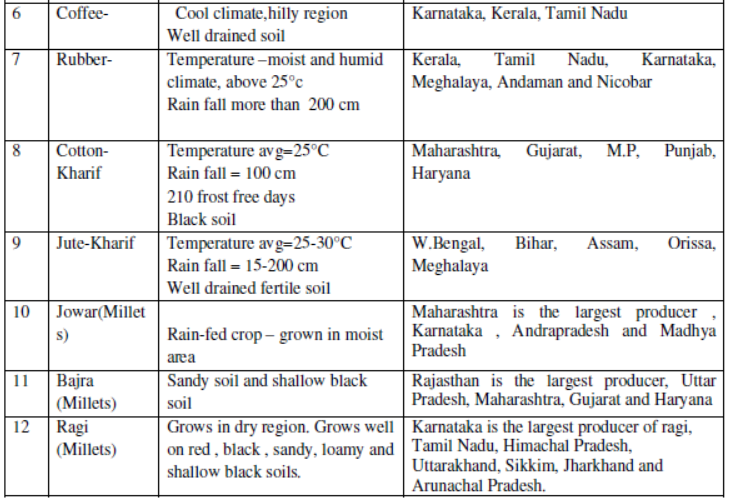
Kharif crops are grown with the onset of monsoon and harvested in September – October.Column-I Column-II Column-III 1. Cotton grows well in drier
parts(a) drained (A) the Deccan plateau 2. Jute grows well on well (b) Kerala, Tamil Nadu (B) Assam and Orissa 3. Rubber is mainly grown in (c) West Bengal, Bihar (C) Madhya Pradesh,
Tamil Nadu, etc.4. Jute is mainly grown in (d) of the black soil of (D) Karnataka and
Andaman5. Cotton is mainly grown in (e) Gujarat,
Maharashtra(E) fertile soils Column-I Column-II Column-III 1. Cotton grows well in drier
parts(a) drained (A) the Deccan plateau 2. Jute grows well on well (b) Kerala, Tamil Nadu (B) Assam and Orissa 3. Rubber is mainly grown in (c) West Bengal, Bihar (C) Madhya Pradesh,
Tamil Nadu, etc.4. Jute is mainly grown in (d) of the black soil of (D) Karnataka and
Andaman5. Cotton is mainly grown in (e) Gujarat,
Maharashtra(E) fertile soils
3. ……………………… is also a type of commercial farming.