Motion of Class 9 Physics Important Questions

Q 1 – What type of motion is exhibited by a freely falling body ?

a) Uniform Motion and Non uniform acceleration

b) Non uniform Motion and Non uniform acceleration

c) Non uniform Motion and Uniform acceleration

d) Uniform Motion and Uniform acceleration

c) Non uniform Motion and Uniform acceleration

Q 2 – A particle is moving in a circular path of radius r.
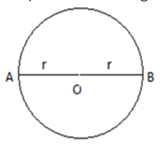
The displacement after half a circle would be:
(a) Zero                                                                (b) πr
(c) 2r                                                                     (d) 2πr
(c) 2r

Q 3 – Which of the following statement is correct regarding velocity and speed of a  moving body?                                                                                                                           
(a) Velocity of a moving body is always higher than its speed
(b) Speed of a moving body is always higher than its velocity
(c) Speed of a moving body is its velocity in a given direction
(d) Velocity of a moving body is its speed in a given direction

(d) Velocity of a moving body is its speed in a given direction

Q 4 – When a car driver travelling at a speed of 10 m/s applies brakes and brings the  car to rest in 20 s, then the retardation will be:

(a) + 2 m/s2

(b) – 2 m/s2

(c) – 0.5 m/s2

(d) + 0.5 m/s2

(d) + 0.5 m/s2

 Given:

u = 10 m/s, v = 0, t = 20 s

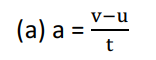
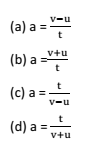
a= v-u / t

a = (0 − 10) / 20 = – 0.5 m/s²

Retardation = − (acceleration)

Q 5 – The numerical ratio of distance to displacement for a moving object is :

a) Always less than 1

b) Equal to 1 or more than 1

c) Equal to 1 or less than 1

d) Always more than 1

b) Equal to 1 or more than 1

Q 6 – In which of the following cases of motions, the distance moved and the magnitude of the displacement are equal?
i. If the car is moving on a straight road
ii. If the car is moving in circular path
iii. The pendulum is moving to and fro
iv. The earth is moving around the sun
(a) only (ii)

(b) (i) and (iii)

(c) (ii) and (iv)

(d) only (i)

(d) only (i)

Distance = displacement only in straight line motion

Q 7 – If the velocity of an object changes from an initial value u to the final value v in  time t, the acceleration a will be:

Q 8 – Which of the following can sometimes be ‘zero’ for a moving body?

a) Average velocity

b) Distance travelled

c) Average speed

d) Displacement

a) Only (i)

b) (i) and (ii)

c) (i) and (iv)

d) Only (iv)

c) (i) and (iv)

Average velocity & displacement can be zero

Q 9 – Fill in the blanks.

a) Displacement is a ……………. Quantity whereas distance is a ……………… quantity

b) Acceleration is the rate of change of ………………. . It is measured in ………..

c) The Physical quantity which gives both, the speed and direction of motion of a body is called its ……………….

d) A car has steady ……………….. of 3 m/s2 . This means that every ……………….. its speed increases by ……………

a) Displacement → Vector, Distance → Scalar
b) Acceleration → rate of change of velocity, unit → m/s²
c) → Velocity
d) steady acceleration, every second, increases by 3 m/s

Q 10 – State whether distance is a scalar or a vector quantity and What name is given to the speed in a specified direction ?

Distance → Scalar quantity
Speed in a given direction → Velocity

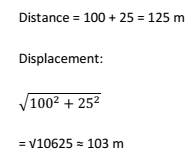
Q 11 – A car moves 100 m due east and then 25 m due north, find:

(a) distance covered by the car

(b) final position of the car.

Answer

Q 12 – Under which condition can a body travel a certain distance and yet its resultant displacement be zero ?

When object comes back to starting point
 Example: circular motion

Q 13 – What is the acceleration of a body moving with uniform velocity ?

A body moving with uniform velocity has zero acceleration.

When a body moves with uniform velocity, it means:

  • Its speed is constant
  • Its direction is also constant

Since acceleration = rate of change of velocity, and there is no change in velocity,

Acceleration = 0 m/s²

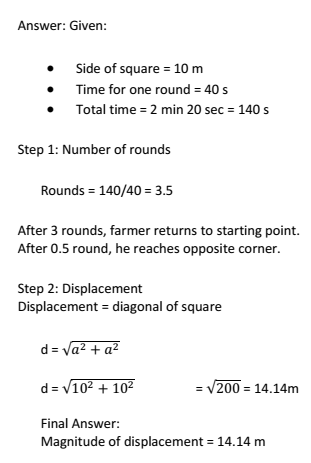
Q 14 – A farmer moves along the boundary of a square field of side 10 m in 40 s starting from one corner of square.  What will be the magnitude of displacement of the farmer at the end of 2 minutes 20 seconds from his initial position?

Q 15 – (a) What term is used to denote the change of velocity with time ?

(a) Term for change of velocity with time

Acceleration

 (b) Give one word which means the same as ‘moving with a negative acceleration’.

(b) One word for negative acceleration

Retardation (or Deceleration)

.

(c) The displacement of a moving object in a given interval of time is zero. Would the distance travelled by the object also be zero ? Give reason for your answer.         

(c) If displacement = 0, is distance also zero?

No

Reason:
Distance is total path travelled, while displacement depends only on initial and final position.

Example:
If a person goes from home and returns back →

  • Displacement = 0
  • Distance ≠ 0

Final Answer:
Distance is not zero, because the object has moved along a path.

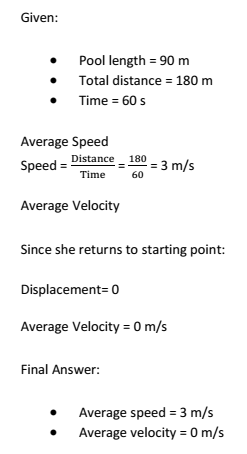
Q 16 – Usha swims in a 90 m long pool. She covers 180 m in one minute by swimming From one end to the other and back along the same straight path. Find the average speed and average velocity of Usha.

Q 17 – State which of the following situations are possible and give an example for each of these:
(a) an object with a constant acceleration but with zero velocity.

Constant acceleration but zero velocity

Yes, possible

Example:
When a ball is thrown vertically upwards:

  • At highest point → velocity = 0
  • But acceleration due to gravity still acts downward

Final Answer:
Yes, an object can have zero velocity but constant acceleration (e.g., ball at highest point).

Q 18 – What is meant by the term ‘acceleration’ ? State the SI unit of acceleration.

Acceleration is defined as:
The rate of change of velocity with time

This means:

  • It tells how fast velocity is changing
  • It can be due to change in speed, direction, or both

SI Unit:
m/s² (metre per second squared)

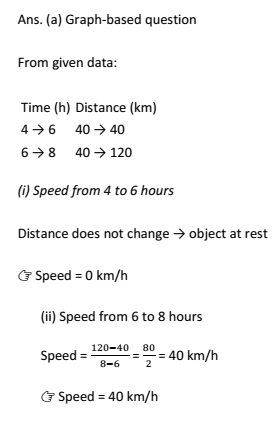
Q 19 – (a) Plot the given data of the motion of a car. Calculate the following using graph:
(i) speed of the car from 4 to 6 hours.
(ii) speed of the car 6 to 8 hours.

Distance (Km)

0

20

40

40

40

100

120

Time (h)

2

3

4

5

6

7

8

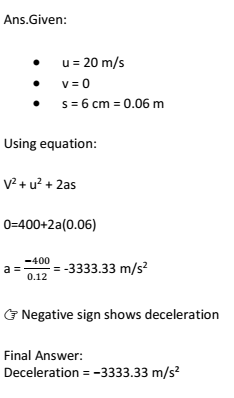
(b) A bullet hits a Sand box with a velocity of 20 m/s and penetrates it up to a distance of 6 cm. Find the deceleration of the bullet in the sand box.

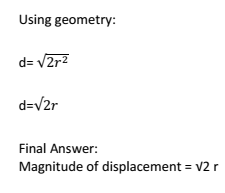
(c) A particle moves over three quarters of a circle of radius ‘r’. Calculate its magnitude of displacement.