Q 1 – Which structure is common to both prokaryotic and eukaryotic cells but differs fundamentally in organization?
(a) Cell membrane
(b) Ribosomes
(c) Nucleus
(d) Mitochondria
(b) Ribosomes
Explanation:
Present in both, but structure differs (70S in prokaryotes, 80S in eukaryotes).
Q 2 – The fluid mosaic model of cell membrane was proposed by:
(a) Singer and Nicolson in 1972
(b) Watson and Crick in 1972
(c) Schleiden and Schwann in 1956
(d) Hooke and Leeuwenhoek in 1876
(a) Singer and Nicolson in 1972
Explanation: They proposed the fluid mosaic model.
Q 3 – Which organelle is most directly responsible for detoxification of drugs?
(a) Golgi apparatus
(b) Smooth endoplasmic reticulum
(c) Lysosome
(d) Ribosome
(b) Smooth endoplasmic reticulum
Explanation: SER helps in detoxification of drugs and poisons.
Q 4 – In a hypertonic solution, a plant cell will:
(a) Burst
(b) Become turgid
(c) Undergo plasmolysis
(d) Remain unchanged
(c) Undergo plasmolysis
Explanation: Water leaves the cell → membrane shrinks from cell wall.
Q 5 – Which statement about mitochondria is incorrect?
(a) It has its own DNA
(b) It is involved in ATP production
(c) It is present in prokaryotes
(d) It is double-membraned
(c) It is present in prokaryotes
Explanation:
Incorrect because prokaryotes lack mitochondria.
Q 6 – Which organelle modifies, sorts, and packages proteins?
(a) Lysosome
(b) Golgi apparatus
(c) Ribosome
(d) Vacuole
(b) Golgi apparatus
Explanation:
Modifies, sorts, and packages proteins.
Q 7 – Which component provides mechanical support to plant cells?
(a) Plasma membrane
(b) Cell wall
(c) Cytoplasm
(d) Nucleus
(b) Cell wall
Explanation:
Provides rigidity and mechanical support.
Q 8 – Which of the following structures is absent in prokaryotic cells?
(a) Ribosomes
(b) Plasma membrane
(c) Membrane-bound organelles
(d) Cytoplasm
(c) Membrane-bound organelles
Explanation:
Prokaryotes do not have membrane-bound organelles.
Q 9 – If Golgi apparatus is non-functional, which of the following is most directly affected?
(a) Lipid synthesis
(b) Protein modification and secretion
(c) ATP production
(d) DNA replication
b) Protein modification and secretion
Explanation:
Golgi is essential for processing and transport of proteins.
Q 10 – A plant cell loses water continuously but does not burst or collapse completely. The most valid explanation is:
(a) Presence of vacuole
(b) Cell membrane elasticity
(c) Cell wall rigidity
(d) Cytoplasmic streaming
(c) Cell wall rigidity
Explanation:
Prevents collapse even after water loss.
Q 11 – Which of the following is TRUE regarding membrane lipids?
(a) Hydrophilic tails face inward
(b) Hydrophobic heads face outward
(c) Lipids form a bilayer with hydrophobic interior
(d) Lipids are rigid and static
(c) Lipids form a bilayer with hydrophobic interior.
Explanation:
Hydrophilic heads outward, hydrophobic tails inward.
Q 12 – Which of the following best explains selective permeability?
(a) All molecules pass equally
(b) Only gases pass
(c) Movement depends on size, charge, and lipid solubility
(d) Only water passes
(c) Movement depends on size, charge, and lipid solubility
Explanation:
Basis of selective permeability.
Q 13 – During plasmolysis, which of the following occurs first?
(a) Cell wall shrinks
(b) Plasma membrane detaches from wall
(c) Vacuole expands
(d) Cytoplasm increases
(b) Plasma membrane detaches from wall.
Explanation:
First visible step of plasmolysis.
Q 14 – Crossing over occurs during:
(a) Prophase I
(b) Metaphase I
(c) Anaphase I
(d) Telophase I
(a) Prophase I
Explanation:
Crossing over occurs during Prophase I of meiosis.
Options:
- (a) Both A and R are true, and R is the correct explanation of A
- (b) Both A and R are true, but R is not the correct explanation
- (c) A is true, R is false
- (d) A is false, R is true
Q 15 – Assertion (A): Prokaryotic cells lack a true nucleus.
Reason (R): Their DNA is not enclosed within a nuclear membrane.
(a) Both A and R are true, and R is the correct explanation of A
Explanation: Prokaryotes lack a true nucleus because DNA is not enclosed in a nuclear membrane.
Q 16 – Assertion (A): Plant cells do not burst in hypotonic solutions.
Reason (R): Presence of cell wall prevents over-expansion.
(a) Both A and R are true, and R is the correct explanation of A
Explanation: Cell wall prevents over-expansion → cell does not burst.
Q 17 – Assertion (A): Lysosomes are absent in plant cells.
Reason (R): Plant cells do not perform intracellular digestion.
(d) A is false, R is true
Explanation: a) Lysosomes are not completely absent (functions done by vacuole),
b) But plant cells do perform intracellular digestion (so R true in general context of digestion role).
Q 18 – Assertion (A): Mitochondria are called powerhouses of the cell.
Reason (R): They produce ATP through respiration.
(a) Both A and R are true, and R is the correct explanation of A
Explanation: ATP production is why mitochondria are called powerhouse.
Q 19 – Assertion (A): Ribosomes are called protein factories.
Reason (R): They synthesize lipids.
(c) A is true, R is false
Explanation: Ribosomes make proteins, not lipids.
Q 20 – Assertion (A): Cell membrane is selectively permeable.
Reason (R): It allows all substances to pass freely.
(c) A is true, R is false
Explanation: Selective permeability ≠ free passage of all substances.
Q 21 – Assertion (A): Diffusion does not require energy.
Reason (R): It occurs along the concentration gradient.
(a) Both A and R are true, and R is the correct explanation of A
Explanation: Diffusion needs no energy because it follows concentration gradient.
Q 22 – Assertion (A): Vacuoles are larger in plant cells.
Reason (R): They help maintain turgor pressure.
(a) Both A and R are true, and R is the correct explanation of A
Explanation: Large vacuole maintains turgidity.
Q 23 – Assertion (A): Golgi apparatus is absent in prokaryotes.
Reason (R): Prokaryotes lack membrane-bound organelles.
(a) Both A and R are true, and R is the correct explanation of A
Explanation: No Golgi because no membrane-bound organelles in prokaryotes.
Q 24 – Assertion (A): Endoplasmic reticulum is involved in transport.
Reason (R): It forms a network of membranes.
(a) Both A and R are true, and R is the correct explanation of A
Explanation: Network structure enables transport.
Q 25 – Fill in the Blanks:
1. The basic structural and functional unit of life is the _______.
2. The study of cells is called ________.
3. The selectively permeable boundary of the cell is the ________.
4. The process of taking in materials by the cell membrane is called ________.
5. The cell wall of plants is mainly composed of ________.
6. The organelle responsible for photosynthesis is ________.
7. The semi-fluid nature of membrane is explained by the ________ model.
8. The dense region in nucleus responsible for ribosome formation is ________.
9. The internal fluid of the cell is called ________.
10. The movement of water from higher to lower concentration through a membrane is called ________.
1. Cell
2. Cytology
3. Cell membrane
4. Endocytosis
5. Cellulose
6. Chloroplast
7. Fluid mosaic
8. Nucleolus
9. Cytoplasm
10. Osmosis
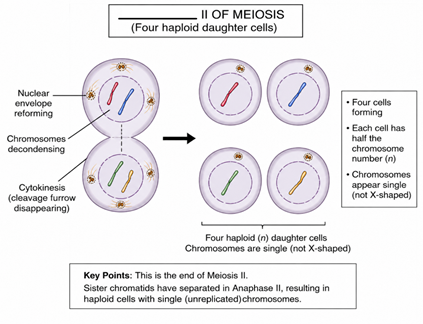
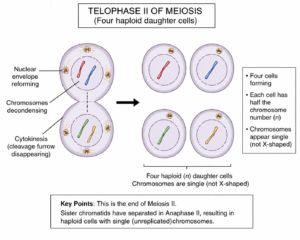
Q 26 – Picture Based Questions:
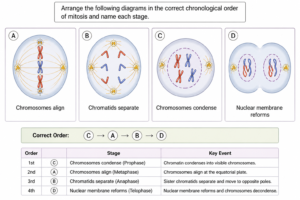
Q 27 – Arrange the following diagrams in the correct order:
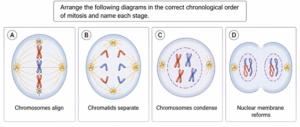
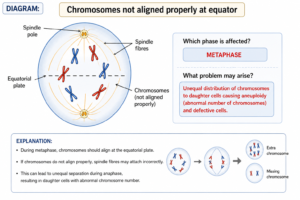
Q 28 – Picture Based Question:
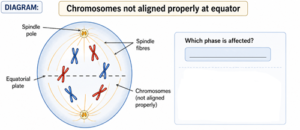
Q 29 – Define plasmolysis.
The shrinkage of a plant cell’s protoplasm away from the cell wall due to loss of water when placed in a hypertonic solution.
Q 30 – What is nucleoid?
A non-membrane-bound region in a prokaryotic cell that contains its genetic material (DNA).
Q 31 – Mention four differences between prokaryotic and eukaryotic cells.
Here are four key differences:
1. Nucleus
- Prokaryotic: No true nucleus (DNA in nucleoid)
- Eukaryotic: True nucleus present
2. Membrane-bound organelles
- Prokaryotic: Absent
- Eukaryotic: Present (mitochondria, ER, Golgi, etc.)
3. Cell size
- Prokaryotic: Small (1–10 µm)
- Eukaryotic: Larger (10–100 µm)
4. DNA structure
- Prokaryotic: Circular, naked DNA
- Eukaryotic: Linear DNA with proteins (histones)
Q 32 – Explain the structure and function of the plasma membrane.
Structure:
The plasma membrane is a thin, flexible lipid bilayer made of phospholipids. The hydrophilic heads face outward and the hydrophobic tails face inward. Proteins are embedded within it, forming the fluid mosaic model. It is selectively permeable.
Function:
- Controls movement of substances in and out of the cell (selective permeability)
- Maintains internal balance (homeostasis)
- Allows transport by diffusion, osmosis, and active transport
Q 33 – Differentiate between rough ER and smooth ER.
Rough ER vs Smooth ER (with explanation):
1. Ribosomes (Surface)
- Rough ER: Ribosomes are attached → gives a rough appearance.
These ribosomes synthesize proteins, especially those to be exported or used in membranes. - Smooth ER: No ribosomes → appears smooth.
Hence, it does not take part in protein synthesis.
2. Function
- Rough ER: Synthesizes and transports proteins.
Proteins made here are sent to the Golgi apparatus for further processing. - Smooth ER: Synthesizes lipids and helps in detoxification.
Important in liver cells for breaking down drugs and poisons.
3. Structure
- Rough ER: Mostly flattened sacs (cisternae).
Provides large surface area for ribosomes to attach. - Smooth ER: Network of tubules.
This structure is suitable for lipid production and transport.
Q 34 – Describe the structure and functions of mitochondria.
Structure of Mitochondria:
Mitochondria are double-membraned organelles.
- The outer membrane is smooth and permeable.
- The inner membrane is folded into finger-like projections called cristae, which increase surface area.
- The inner space is filled with a fluid called matrix, containing enzymes, mitochondrial DNA, and ribosomes.
Functions:
- Site of cellular respiration
- Produces ATP (energy currency of the cell)
- Regulates metabolic activities of the cell
- Has its own DNA → can replicate independently (semi-autonomous)
Q 35 – Explain osmosis in detail and describe what happens to plant cells in hypotonic, hypertonic, and isotonic solutions.
Osmosis (explained clearly):
Osmosis is the movement of water through a selectively permeable membrane from a region where water is more (dilute solution) to a region where water is less (concentrated solution).
- It continues until balance is reached.
- It does not require energy (passive process).
What happens to plant cells:
1. Hypotonic solution (outside has more water):
1. Water enters the cell. The vacuole expands and pushes the cytoplasm against the cell wall.
Cell becomes turgid (firm and swollen).
Cell wall prevents bursting.
2. Hypertonic solution (outside has less water):
Water moves out of the cell. The cytoplasm shrinks and pulls away from the cell wall.
This is called plasmolysis.
Cell becomes shrunken.
3. Isotonic solution (equal concentration):
Water moves in and out equally.
No net change.
Cell becomes flaccid (loose, not firm).
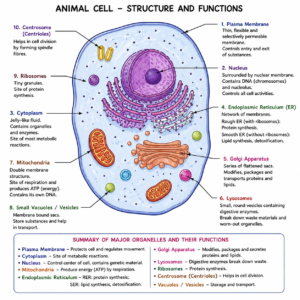
Q 36 – Describe the structure of animal cell and explain the role of major organelles with a neat labeled diagram.
Animal Cell – Structure and Functions (Detailed Points)
1. General Structure
Animal cell is eukaryotic, having a true nucleus.
Usually round or irregular in shape.
Surrounded by a plasma membrane (no cell wall).
Contains cytoplasm with many membrane-bound organelles.
2. Plasma Membrane
Thin, flexible, selectively permeable membrane.
Made of lipid bilayer (fluid mosaic).
Function: Controls movement of substances, maintains internal balance.
3. Cytoplasm
Jelly-like semi-fluid substance.
Contains organelles and enzymes.
Function: Site of most metabolic reactions.
4. Nucleus
Surrounded by a double membrane (nuclear envelope).
Contains chromosomes (DNA) and nucleolus.
Function: Controls all cell activities and heredity.
5. Mitochondria
Double membrane; inner membrane forms cristae.
Contains its own DNA.
Function: Site of respiration; produces ATP (energy).
6. Endoplasmic Reticulum (ER)
Network of membranes.
Rough ER (RER): Has ribosomes → protein synthesis.
Smooth ER (SER): No ribosomes → lipid synthesis, detoxification.
7. Golgi Apparatus
Stack of flattened sacs (cisternae).
Function: Modifies, packages, and transports proteins and lipids.
8. Lysosomes
Small sacs with digestive enzymes.
Function: Break down waste, worn-out organelles (“suicide bags”).
9. Ribosomes
Tiny, non-membrane structures.
Found free or on RER.
Function: Protein synthesis.
10. Centrosome (Animal Cell Specific)
Contains centrioles.
- Function: Helps in cell division (spindle formation).
Q 37 – Explain in detail about the endoplasmic reticulum in terms of structure and function with proper justification. Also explain about Membrane bio-genesis.
Endoplasmic Reticulum (ER) – Structure and Function
Structure:
ER is a network of membrane-bound tubules and flattened sacs (cisternae) spread throughout the cytoplasm.
It is connected to the nuclear membrane, forming a continuous system.
Two types:
Rough ER (RER): Has ribosomes attached on its surface → appears rough
Smooth ER (SER): Lacks ribosomes → appears smooth
Functions (with justification):
1. Rough Endoplasmic Reticulum (RER):
Protein synthesis: Ribosomes attached to RER synthesize proteins, especially for secretion and membrane use.
Transport: Newly made proteins are transported through ER to Golgi apparatus.
Justification: Presence of ribosomes directly enables protein formation.
2. Smooth Endoplasmic Reticulum (SER):
Lipid synthesis: Produces lipids and phospholipids needed for membranes.
Detoxification: Breaks down drugs and harmful chemicals (especially in liver cells).
Calcium storage (in muscle cells): Helps in muscle contraction.
Justification: Absence of ribosomes allows specialization in lipid and chemical processes.
3. Membrane Biogenesis:
Membrane biogenesis means formation of new cell membrane.
ER plays a key role:
SER synthesizes lipids (phospholipids, cholesterol)
RER synthesizes proteins (membrane proteins)
These lipids and proteins are transported to the Golgi apparatus, modified, and then delivered to the plasma membrane.