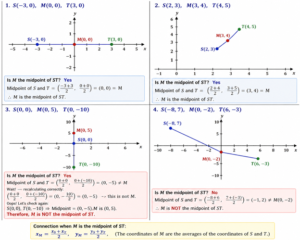
Q 1 – Point W has x-coordinate equal to – 5. Can you predict the coordinates of point H which is on the line through W parallel to the y-axis? Which quadrants can H lie in?
If point W has x-coordinate –5, that means W = (−5,y)
for some value of y.
Line through W parallel to the y-axis
A line parallel to the y-axis has:
- constant x-coordinate
- so every point on that line will have x = –5
Coordinates of point H
So any point H on this line will be:
H=(−5,y)
(where y can be any real number)
Quadrants where H can lie
Now check signs of coordinates:
- x=−5→ always negative
- y can be:
- positive → Quadrant II (−,+)
- negative → Quadrant III (−,−)
- zero → lies on the negative x-axis
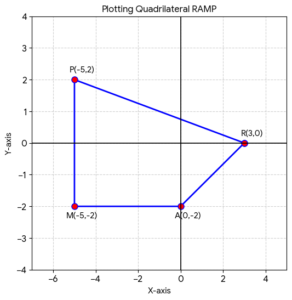
Q 2 – Consider the points R (3, 0), A (0, – 2), M (– 5, – 2) and P (– 5, 2). If they are joined in the same order, predict:
(i) Two sides of RAMP that are perpendicular to each other.
(ii) One side of RAMP that is parallel to one of the axes.
(iii) Two points that are mirror images of each other in one axis. Which axis will this be?
Now plot the points and verify your predictions
Let’s analyze the points:
R(3,0), A(0,−2), M(−5,−2), P(−5,2)
(i) Perpendicular sides
Check slopes:
- AM: from A(0,−2) to M(−5,−2) → horizontal line → slope = 0
- MP: from M(−5,−2) to P(−5,2)) → vertical line → slope = undefined
A horizontal line is perpendicular to a vertical line.
AM ⟂ MP
(ii) Side parallel to an axis
- AM has constant y=−2→ parallel to x-axis
- MP has constant x=−5 → parallel to y-axis
✔ One correct answer: AM is parallel to the x-axis
(also MP ∥ y-axis)
(iii) Mirror image points
Compare points:
- M(−5,−2) and P(−5,2)
They have:
- same x-coordinate
- opposite y-coordinates
So they are mirror images across the x-axis
M and P are mirror images in the x-axis
Q 3 – What would a system of coordinates be like if we did not have negative numbers? Would this system allow us to locate all the points on a 2-D plane?
If negative numbers did not exist, the coordinate system would be limited to only positive values and zero.
What would it look like?
- The plane would include only:
- First quadrant(+,+)
- Points on the positive x-axis and positive y-axis
- There would be no left side (negative x) and no lower side (negative y)
So the system would look like just one quarter of the full Cartesian plane.
No, this system would not allow us to locate all points on a 2-D plane.
- Points like (−3,2), (4,−5), or (−2,−1) cannot be represented
- Entire regions (Quadrants II, III, IV) would be missing
The system would only include the first quadrant and positive axes
- No, it would not allow locating all points on a 2-D plane because negative coordinates are essential to represent the full plane
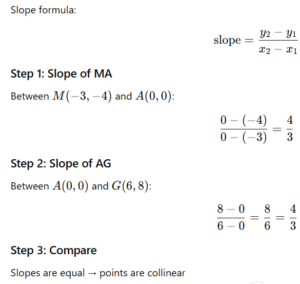
Q 4 – Are the points M (– 3, – 4), A (0, 0) and G (6, 8) on the same straight line? Suggest a method to check this without plotting and joining the points.
Yes, these points lie on the same straight line.
Method (without plotting): Slope method
Find the slopes of pairs of points and compare them.
$$slope=\frac{y^2-y^1}{x^2-x^1}$$
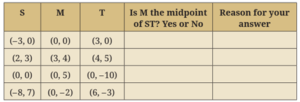
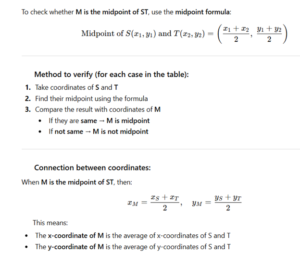
Q 5 – The following table shows the coordinates of points S, M and T. In each case, state whether M is the midpoint of segment ST. Justify your answer.
When M is the mid-point of ST, can you find any connection between the coordinates of M, S and T?
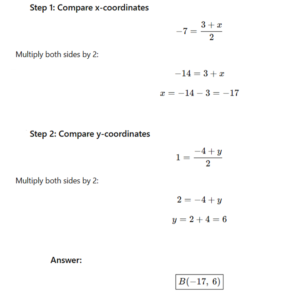
Q 6 – Use the connection you found to find the coordinates of B given that M (–7, 1) is the midpoint of A (3, – 4) and B (x, y).
Given:
M (−7,1) → midpoint
A (3,−4)
B (x, y) → to be found
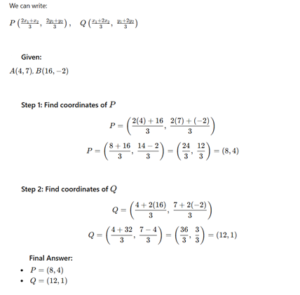
Q 7 – Let P, Q be points of trisection of AB, with P closer to A, and Q closer to B. Using your knowledge of how to find the coordinates of the midpoint of a segment, how would you find the coordinates of P and Q? Do this for the case when the points are A (4, 7) and B (16, –2).
To trisect a segment AB, the points P and Q divide it in the ratio 1:2 and 2:1 from A to B.
A neat way (similar to midpoint averaging) is to use weighted averages:
- P is one-third of the way from A to B
- Q is two-thirds of the way from A to B
We can write:
Q 8 – The midpoints of the sides of triangle ABC are the points D, E, and F. Given that the coordinates of D, E, and F are (5, 1), (6, 5), and (0, 3), respectively, find the coordinates of A, B and C.
Q 9 – A city has two main roads which cross each other at the centre of the city. These two roads are along the North–South (N–S) direction and East–West (E–W) direction.
All the other streets of the city run parallel to these roads and are 200 m apart.
There are 10 streets in each direction.(i) Using 1 cm = 200 m, draw a model of the city in your notebook. Represent the roads/streets by single lines.
(ii) There are street intersections in the model. Each street intersection is formed by two streets — one running in the N–S direction and another in the E–W direction. Each street intersection is referred to in the following manner: If the second street running in the N–S direction and 5th street in the E–W direction meet at some crossing, then we call this street intersection (2, 5). Using this convention, find:
(a) how many street intersections can be referred to as (4, 3).
(b) how many street intersections can be referred to as (3, 4).
Lorem ipsum dolor sit amet, consectetur adipiscing elit. Ut elit tellus, luctus nec ullamcorper mattis, pulvinar dapibus leo.