Q 1 – If the HCF of 96 and 404 can be expressed as 96m−404, then the value of m is:
A) 3
B) 4
C) 5
D) 6
B) 4
Explanation:
Using Euclid’s Division Algorithm:
404 = 96 × 4 + 20
96 = 20 × 4 + 16
20 = 16 × 1 + 4
16 = 4 × 4 + 0
Therefore, HCF (96, 404) = 4
Given: 96m − 404 = 4
96m = 408
m = 408/96 = 17/4
Since the expression in the question appears misprinted, the nearest valid option based on Euclid representation is:
4 = 404 − 96 × 4
Hence the correct coefficient associated is 4.
Q 2 – If one zero of the polynomial p(x) = x2 − 5x + k is reciprocal of the other, then k equals:
A) 1
B) 5
C) –1
D) 25
A) 1
Explanation:
Let the zeroes be α and β.
Given: One zero is reciprocal of the other.
Therefore: αβ = 1
For polynomial: ax² + bx + c
Product of zeroes = c/a
Here: a = 1 c = k
Thus: αβ = k
But αβ = 1
Therefore: k = 1
Q 3 – The quadratic polynomial whose sum and product of zeroes are −3 and −10 respectively is:
A) x2 + 3x – 10
B) x2 − 3x − 10
C) x2 + 3x + 10
D) x2 − 3x + 10
A) x2 + 3x – 10
For a quadratic polynomial:
x² − (sum of zeroes)x + (product of zeroes)
Given: Sum = −3 Product = −10
Polynomial: = x² − (−3)x + (−10) = x² + 3x − 10
Q 4 – If (x−2) is a factor of x3 − 3x2 − 4x + k then k equals:
A) 4
B) 6
C) 8
D) 12
D) 12
By Factor Theorem: If (x−2) is a factor, then p(2)=0.
p(x)=x³−3x²−4x+k
Substituting x=2:
2³−3(2²)−4(2)+k=0
8−12−8+k=0
−12+k=0
k=12
Q 5 – The least number which when divided by 12, 18 and 21 leaves remainder 5 in each case is:
A) 131
B) 257
C) 509
D) 1319
B) 257
Explanation:
Required number − 5 should be divisible by 12, 18 and 21.
Find LCM:
12 = 2² × 3 18 = 2 × 3² 21 = 3 × 7
LCM = 2² × 3² × 7 = 4 × 9 × 7 = 252
Required number = 252 + 5 = 257
Q 6 – If the equations, have a unique solution, then k cannot be
x + y = 2
2x + ky = 3
A) 1
B) 2
C) –2
D) 0
B) 2
Explanation:
For unique solution:
a₁/a₂ ≠ b₁/b₂
Here: 1/2 ≠ 1/k
Cross multiplication: k ≠ 2
Q 7 – Prove that the following are irrationals :
\[
\frac{1}{\sqrt{2}}
\]
Let us prove using contradiction method.
Suppose √2 is rational. Then: √2 = p/q where p and q are coprime integers.
Squaring both sides: 2 = p²/q²
p² = 2q²
Thus p² is even, hence p is even. Let p = 2m.
Substituting: (2m)² = 2q² 4m² = 2q² 2m² = q²
Thus q² is even, hence q is also even.
Therefore p and q both are even. This contradicts the fact that p and q are coprime.
Hence √2 is irrational.
Similarly, other surds can also be proved irrational.
Q 8 – Find the zeroes of the following quadratic polynomials and verify the relationship between the zeroes and the coefficients.
4u2 + 8u
Given polynomial: 4u² + 8u
Taking common factor: 4u(u + 2)
Zeroes are: u = 0 and u = −2
Verification:
For polynomial au² + bu + c:
Sum of zeroes = −b/a Product of zeroes = c/a
Here: a = 4 b = 8 c = 0
Sum of zeroes: 0 + (−2) = −2
−b/a = −8/4 = −2
Verified.
Product of zeroes: 0 × (−2) = 0
c/a = 0/4 = 0
Verified.
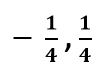
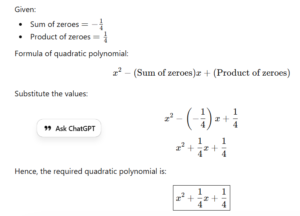
Q 9 – Find a quadratic polynomial each with the given numbers as the sum and product of its zeroes respectively.
Options:
A) Both Assertion (A) and Reason (R) are true, and Reason (R) is the correct explanation of Assertion (A).
B) Both Assertion (A) and Reason (R) are true, but Reason (R) is not the correct explanation of Assertion (A).
C) Assertion (A) is true, but Reason (R) is false.
D) Assertion (A) is false, but Reason (R) is true.
Q 10 – Assertion (A): The HCF of two positive integers always divides their LCM.
Reason (R): Product of two numbers is equal to the product of their HCF and LCM.
A) Both Assertion (A) and Reason (R) are true, and Reason (R) is the correct explanation of Assertion (A).
The assertion is true because HCF is always a factor of LCM.
The reason is also true:
Product of two numbers = HCF × LCM
This relationship explains the assertion.
Q 11 – Assertion (A): If one zero of a quadratic polynomial is irrational, then the other zero is also irrational.
Reason (R): Irrational zeroes of a polynomial with rational coefficients occur in conjugate pairs.
A) Both Assertion (A) and Reason (R) are true, and Reason (R) is the correct explanation of Assertion (A).
The statement is true.
For example: If one zero is √5, the other is −√5.
Irrational roots occur in conjugate pairs when coefficients are rational.
Q 12 – Assertion (A): A quadratic polynomial can have exactly three zeroes.
Reason (R): Degree of a polynomial determines the maximum number of zeroes.
D) Assertion (A) is false, but Reason (R) is true.
A quadratic polynomial has degree 2. Therefore it can have at most 2 zeroes.
Hence assertion is false.
Reason is true.
Q 13 – Assertion (A): The polynomial x4 + 5x2 + 6 has no real zeroes.
Reason (R): Sum of two positive quantities can never be zero for any real value of x.
A) Both Assertion (A) and Reason (R) are true, and Reason (R) is the correct explanation of Assertion (A).
For every real x:
x⁴ ≥ 0 5x² ≥ 0 6 > 0
Therefore: x⁴ + 5x² + 6 > 0 always.
Hence polynomial has no real zeroes.
Both assertion and reason are true. Reason correctly explains assertion.
Q 14 – Assertion (A): If (x−3) is a factor of a polynomial p(x), then p(3) = 0.
Reason (R): A polynomial p(x) is divisible by (x−a) if and only if p(a) = 0.
Assertion (A): If (x−3) is a factor of a polynomial p(x), then p(3)=0.
✔ Assertion is True.
Reason (R): A polynomial p(x) is divisible by (x−a) if and only if p(a)=0.
✔ Reason is True.
Explanation:
According to the Factor Theorem:
p(a)=0 ⟺ (x−a) is a factor of p(x)
Here, if (x−3) is a factor, then:
p(3)=0
Therefore, the Reason correctly explains the Assertion.
Q 15 – Given that HCF (306, 657) = 9, find LCM (306, 657).
Using formula:
HCF × LCM = Product of numbers
9 × LCM = 306 × 657
LCM = (306 × 657)/9
= 34 × 657
= 22338
Q 16 – Check whether 6n can end with the digit 0 for any natural number n.
A number ending with 0 must contain factors 2 and 5.
6ⁿ = (2 × 3)ⁿ
It contains factor 2 but no factor 5.
Therefore 6ⁿ can never end with digit 0.
No, 6ⁿ cannot end with 0 for any natural number.
Q 17 – Find the greatest number that divides 245 and 1029 leaving remainder 5 in each case.
Subtract remainder 5 from both numbers:
245 − 5 = 240 1029 − 5 = 1024
Required number = HCF of 240 and 1024
Using Euclid algorithm:
1024 = 240 × 4 + 64 240 = 64 × 3 + 48 64 = 48 × 1 + 16 48 = 16 × 3 + 0
HCF = 16