Q 1 – Check whether the following are quadratic equations:
i) x3 – 4x2 – x + 1 = (x – 2) 2
Step 1: Expand RHS
(x−2)2=x2−4x+4
Step 2: Bring all terms to one side
x3−4x2−x+1−x2+4x−4=0
x3−5x2+3x−3=0
Step 3: Check degree
Highest power of x = 3
Therefore, it is not a quadratic equation.
Answer: Not quadratic.
ii) (2x – 1)(x – 3) = (x + 5)(x – 1)
Step 1: Expand both sides
LHS: 2x2−6x−x+3
2x2−7x+3
RHS:
x2−x+5x−5
x2+4x−5
Step 2: Bring all terms to one side
2x2−7x+3−(x2+4x−5)=0
x2−11x+8=0
Step 3: Check degree
Highest power = 2
Answer: Yes, it is a quadratic equation.
Q 2 – A train travels a distance of 480 km at a uniform speed. If the speed had been 8 km/h less, then it would have taken 3 hours more to cover the same distance. We need to find the speed of the train.
Distance = 480 km
Let speed of train = x km/h
Reduced speed = (x−8) km/h
Step 1: Form equation
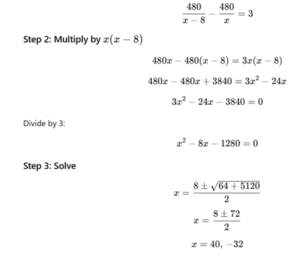
Speed cannot be negative.
Answer 40 km/h
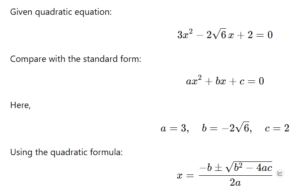
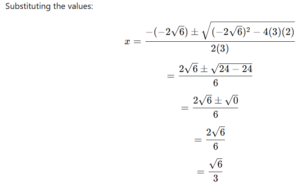
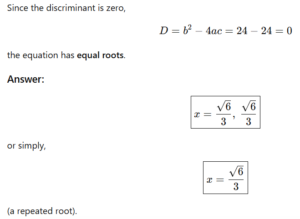
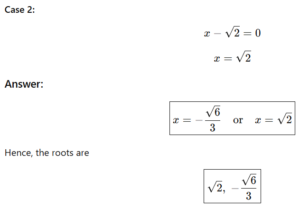
Q 3 – Find the roots of the quadratic equation 3x2 – 2 √6 x + 2 = 0.
Q 4 – If the quadratic equation px2 – 2px + 15 = 0 has two equal roots, then find the value of p.
For equal roots,
D=0
(−2p)2−4(p) (15) = 0
4p2 − 60p = 0
4p (p − 15) = 0
Since p ≠ 0,
P = 15
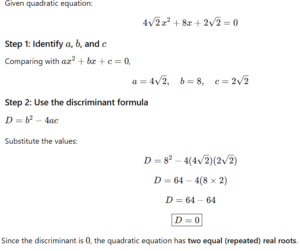
Q 5 – Find the discriminant of the quadratic equation 4 √2x2 +8x + 2√2 = 0).
Q 6 – Show that x = – 2 is a solution of 3x2 + 13x + 14 = 0.
Substitute x=−2
3 (−2)2+ 13 (−2) + 14
= 3(4) − 26 + 14
= 12−26 + 14
= 0
Hence,
x = -2 is a solution.
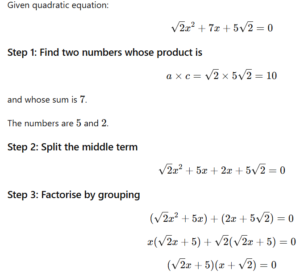
Q 7 – Find the roots of the following quadratic equations by factorisation:
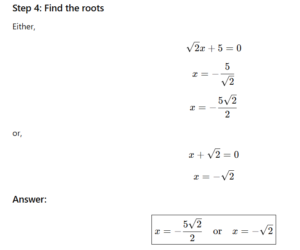
i) √2 x² + 7x + 5√2 = 0
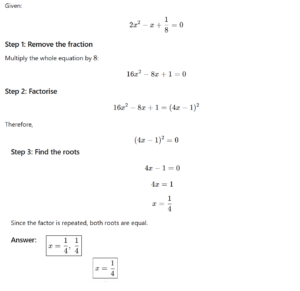
(ii) 2x2 – x + 1/8 = 0
Q 8 – The altitude of a right triangle is 7 cm less than its base. If the hypotenuse is 13 cm, find the other two sides.
Hypotenuse = 13 cm
Let base = x cm
Altitude = x−7cm
Using Pythagoras:
x2+(x−7)2=132
2x2−14x−120=0
x2−7x−60=0
(x−12)(x+5)=0
x=12
Answer:
Base = 12 cm
Altitude = 5 cm
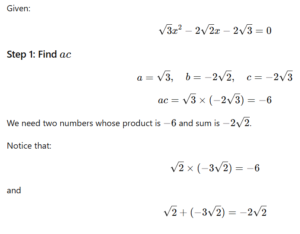
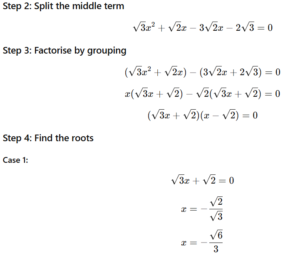
Q 9 – Solve for x: √3 x2 – 2 √2 x- 2 √3 = 0
Q 10 – Is it possible to design a rectangular mango grove whose length is twice its breadth, and the area is 800 m2 ? If so, find its length and breadth.
Let the breadth of the rectangular mango grove be x m.
Then, according to the question,
Length = 2x m
Area of rectangle = Length × Breadth
2x × x = 800
2x2 = 800
x2 = 400
x = ±20
Since the breadth cannot be negative,
x = 20
Therefore,
Breadth = 20 m
Length = 2 × 20 = 40 m
Verification
40×20=800 m2
Hence, the given area is obtained.
Answer
Yes, it is possible to design such a rectangular mango grove.
- Length = 40 m
- Breadth = 20 m
Q 11 – Is the following situation possible? If so, determine their present ages. The sum of the ages of two friends is 20 years. Four years ago, the product of their ages in years was 48.
Given:
- Sum of present ages of two friends = 20 years
- Four years ago, the product of their ages = 48
Step 1: Let present age of one friend be x years.
Then present age of the other friend = (20−x) years.
Step 2: Form the equation using ages four years ago.
Four years ago:
First friend’s age = (x−4) years
Second friend’s age = (20−x−4) = (16-x) years
According to the question,
(x−4)(16−x)=48
Step 3: Expand the equation.
16x−x2−64+4x=48
−x2+20x−64=48
Step 4: Bring all terms to one side.
−x2+20x−112=0
Multiply by −1:
x2−20x+112=0
Step 5: Factorise.
x2−20x+112=(x−8)(x−14)
(x−8)(x−14)=0
So, x=8 or x=14
Step 6: Find the other age.
If x=8, the other age = 20−8=12.
If x=14 , the other age = 20−14=6.
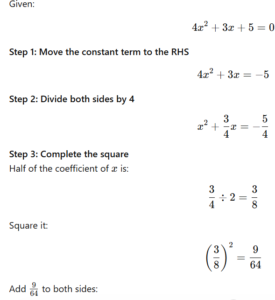
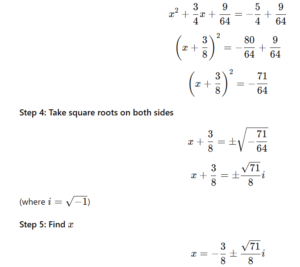
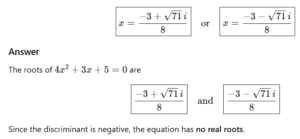
Q 12 – Find the roots of 4x2 + 3x + 5 = 0 by the method of completing the square.
Q 13 – A two digit number is four times the sum of the digits. It is also equal to 3 times the product of digits. Find the number.
Let the tens digit be x and the units digit be y.
Then the two-digit number is:
10x + y
Condition 1:
The number is four times the sum of its digits.
10x+y=4(x+y)
10x+y=4x+4y
6x−3y=0
2x−y=0
y=2x
Condition 2:
The number is 3 times the product of its digits.
10x+y=3xy
Substituting y=2x:
10x+2x=3x(2x)
12x=6x²
6x²−12x=0
6x(x−2)=0
x=0 or x=2
Since x=0 cannot be the tens digit of a two-digit number,
x=2
Then,y=2x=4
Therefore, the number is:
10(2)+4=24
Verified:
- Sum of digits =2 + 4 = 6
- 4 × 6 = 24
- Product of digits = 2×4=8
- 3 × 8 = 24
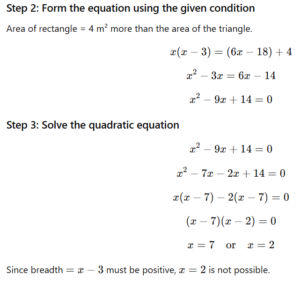
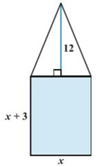
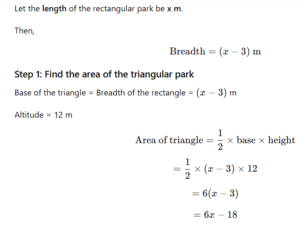
Q 14 – A rectangular park is to be designed whose breadth is 3 m less than its length. Its area is to be 4 square metres more than the area of a park that has already been made in the shape of an isosceles triangle with its base as the breadth of the rectangular park and of altitude 12 m (see Fig.). Find its length and breadth.
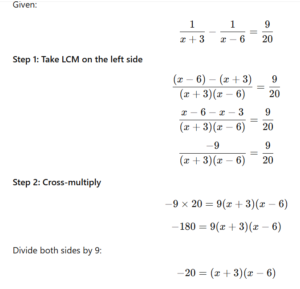
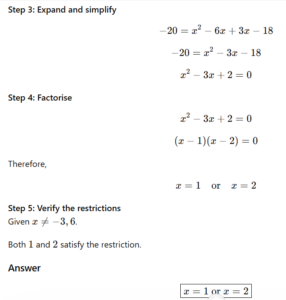
Q 15 – Find the roots of the following equation:

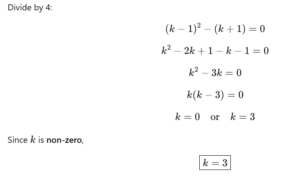
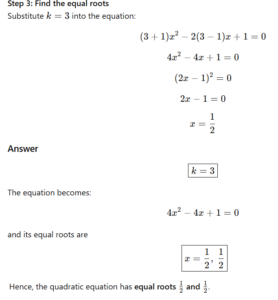
Q 16 – Find that non-zero value of k, for which the quadratic equation kx2 + 1 – 2(k – 1)x + x2 = 0 has equal roots. Hence find the roots of the equation.
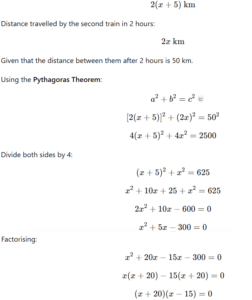
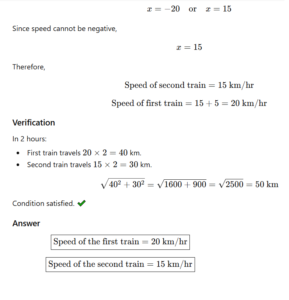
Q 17 – Two trains leave a railway station at the same time. The first train travels due west and the second train due north. The first train travels 5km/hr faster than the second train. If after two hours, they are 50km apart, find the average speed of each train.
Let the speed of the second train (northbound) be x km/hr.
Then the speed of the first train (westbound) is (x + 5) km/hr.
Since the trains travel at right angles to each other, their distances after 2 hours form a right-angled triangle.
Distance travelled by the first train in 2 hours:
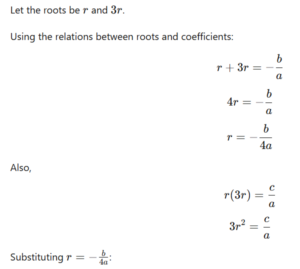
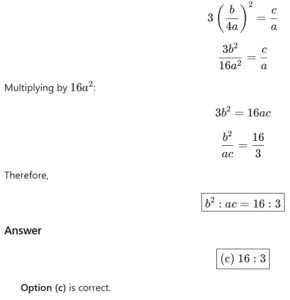
Q 18 – If one root of the equation ax2 + bx + c = 0 is three times the other, then b2 : ac =
(a) 3 : 1
(b) 3 : 16
(c) 16 : 3
(d) 16 : 1