Motion Numerical Class 9 Physics Important Questions (2026-27)

Q 1. Area under a v – t graph represents a physical quantity, which has the unit:

(a) m2

(b) m

(c) m3

(d) ms-1

Q 2. The speedometer readings of a car at different times are given below:

Time

Speedometer reading

9:25 am

36 km/h

9:45 am

72 km/h


The acceleration of the car is:

(a) 1.8 m/s2

(b) 1/420 m/ s2

(c) 1/120 m/ s2

(d) 4.8 m/ s2

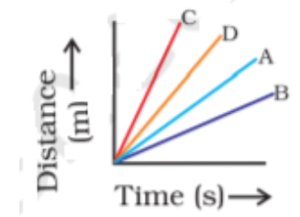
Q 3. Four cars A, B, C and D are moving on a levelled road. Their distance versus time graphs are shown in the given figure. Choose the correct statement:
(a) Car A is faster than car D.
(b) Car B is the slowest.
(c) Car D is faster than car C.
(d) Car C is the slowest.
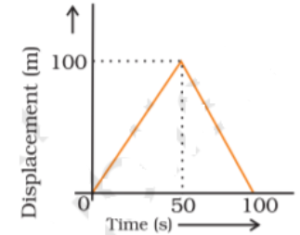
Q 4. A girl walks along a straight path to drop a letter in the letterbox and comes back to her initial position. Her displacement–time graph is shown in the given figure.
Plot a velocity–time graph for the same.
Q 5. A car starts from rest and moves along the x-axis with constant acceleration 5 ms-2 for 8 seconds. If it then continues with constant velocity, what distance will the car cover in 12 seconds since it started from the rest?

Q 6. A body is dropped from a height of 320m. The acceleration due to the gravity is 10 m/s2?
(a) How long does it take to reach the ground?
(b) What is the velocity with which it will strike the ground?

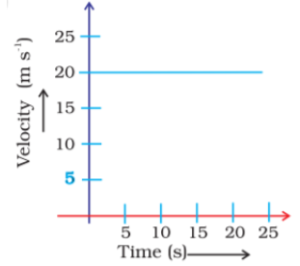
Q 7. The given velocity-time graph shows the motion of a cyclist. Find:
(a) its acceleration
(b) its velocity and
(c) the distance covered by the cyclist in 15 seconds.
Q 8. An object moves along a straight line with an acceleration of 2 m/s2. If its initial speed is 10 m/s, what will be its speed 2 seconds later?

Q 9. An athlete completes one round of a circular track of diameter 200 m in 40 s. What will be the distance covered and the displacement at the end of 2 minutes 20 s?

Q 10. A car accelerates uniformly at the rate of 2 ms-2 after starting from rest. Find the distance travelled and velocity attained by it in 4 seconds.

Q 11. A driver takes 0.20 seconds to apply the brakes. If he is driving car at a speed of 54 kmh-1 and the brakes cause a deceleration of 6.0 ms-2. Find the distance travelled by the car.

Q 12. A car moving along a straight line, at a speed of 54km/h stops in 5s after the brakes are applied.
(a) Find the acceleration, assuming it to be constant.
(b) Plot the graph of speed versus time.
(c) Using the graph, find the distance covered by the car after the brakes are applied?

Q 13. Joseph jogs from one end A to the other end B of a straight 300 m road in 2 minutes 30 seconds and then turns around and jogs 100 m back to point C in another 1 minute. What are Joseph’s average speeds and velocities in jogging (a) from A to B and (b) from A to C?

Q 14. A ball is thrown vertically upwards with a velocity of 20 m/s. How high did the ball go? (Consider the value of ‘g’ as 9.8 m/s2)

Q 15. An athlete completes one round of a circular track of diameter 100 m in 15 seconds.
(a) What will be the distance covered and the displacement at the end of 3 minutes and 30 seconds?
(b) Calculate the speed of the person, considering it to be uniform circular motion?

Q 16. Read the following paragraph and answer the questions that follow:
Aditya started driving his car from rest. He increases the speed till 4 seconds and then he kept his car at constant speed for 6 seconds. Then after that, he decreased the speed of the car up to another 6 seconds.
After 16 seconds of his driving, he applies the brakes to bring the car to rest.
(a) Plot the speed vs time graph for the 16 seconds journey of Aditya.
(b) Analyze the plotted graph and state what type of motion is performed by him for first 4 seconds of the journey?
(c) What type of motion is represented by his motion from 10 seconds to 16 seconds?
(d) Find the acceleration of Aditya’s motion.
(e) Calculate the retardation of the journey.
(f) Find the distance travelled by Aditya for completing his journey.

Q 17. A body starts from rest and moves with a uniform acceleration of 5m/s2 for 5s and then it moves with a constant velocity for 4s. Later it slows down and comes to rest in 5s. Draw the velocity-time graph for the motion of the body and answer the following questions:

(a) What is the maximum velocity attained by the body?
(b) Find the distance travelled during this period of acceleration?
(c) How much distance was covered, when the body was moving with constant velocity?
(d) Calculate the retardation of the body while slowing down?
(e) Find the distance travelled by retarding.
(f) What is the total distance travelled?

Q 18. A motorcyclist riding motorcycle A who is travelling at 36 km/h applies the brakes and stops the motorcycle in 10 s. another motorcyclist of motorcycle B who is travelling at 18 km/h applies the brakes and stops the motorcycle in 20s.
(a) Plot speed-time graph for the motion of motorcyclist A and motorcyclist B on the same graph paper.
(b) Which of the two motorcyclists A or B, travelled farther before coming to rest?

Q 19. A car is moving on a straight road with uniform acceleration. The following table gives the speed of the car at various instants of time

Time(s)

0

10

20

30

40

50

Speed (m/s)

5

10

15

20

25

30

(a) Draw a speed-time graph representing the above observations.
(b) Find the acceleration of the car throughout the journey.

Q 20. Using the given data, draw displacement-time graph for the moving object:

Time(s)

0

2

4

6

8

10

12

14

16

Displacement (m)

0

2

4

4

4

6

4

2

0

 Use the plotted graph to find:
(a) average velocity for first 4 s.
(b) average velocity for 4 to 8 s.
(c) average velocity in last 6 s.

 Q 21. Using the given data, plot the velocity-time graph for a moving body:

Time(s)

0

10

20

30

40

Velocity (m/s)

0

20

20

20

0

(a) State the kind of motion from 0 s to 10 s and from 30s to 40s.

(b) What is the velocity of the body after 10 s and after 40 s?

(c) Calculate the distance covered by the body between 10 to 30 seconds.

Q 22. A train travels in a straight line at a constant speed of 60 km/h for a particular distance ‘d’ and then travels another distance equal to ‘2d’ in the same direction at a constant speed of 80 km/h in the same direction as it was previously going. What is the average speed of the train during the whole journey?

Q 23. A farmer goes moves along the boundary of a rectangular field 10 m and 20 m in 60 s. what will be the magnitude of displacement of the farmer at the end of 2minutes and 30 seconds from the initial position.

(a) Define the term average speed. Write its formula also.
(b) A bus travels a distance of 120 km with a speed of 40 km/h and returns with a speed of 30 km/h.
Calculate the average speed for the entire journey.
(c) can average speed of a moving object be zero? Justify your answer.

Q 24. A circular track has a circumference of 3140 m with AB as one of the diameters. If you move along the circulat path. Find your distance and displacement. What will be your displacement if you cover three quarters of the circular park?

Q 25. A student jogs from one end A to the other end B of a straight 300 m road in 2 minutes 50 s and then returns around and jogs 100 m back to point C in another 1 minute, Find Joseph’s average speed and velocity in jogging from :
(a) A to B
(b) A to C