CORE OBJECTIVES & BIG QUESTIONS
This chapter explores the deepest roots of humanity and the shift from nomadic survival to complex, settled societies. The core areas of focus include:
- Pre-Civilisation Life: How our earliest ancestors survived, evolved, and adapted to changing climates before the dawn of civilisation.
- Pre-Literate Communication: Methods of expression (like cave art and symbolic engravings) before formal writing systems were invented.
- Archaeological Significance: How extractions, tool analysis, and fossil records help us reconstruct over 99% of human history.
- Inter-Civilisation Dynamics: The trade, cultural exchange, and geographical proximity that connected early Bronze Age empires.
1. The Invention of Writing: The Ultimate Historical Divide
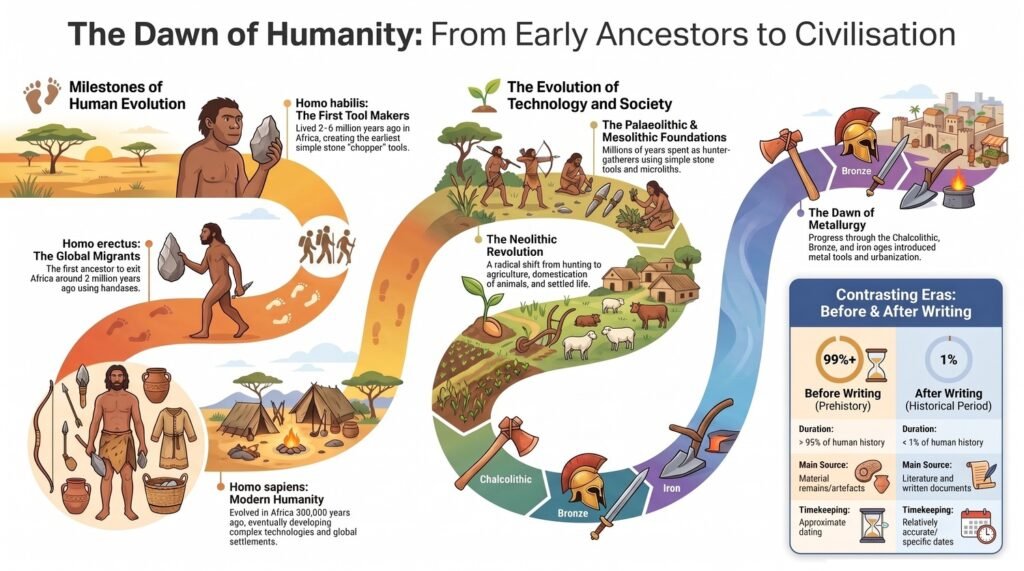
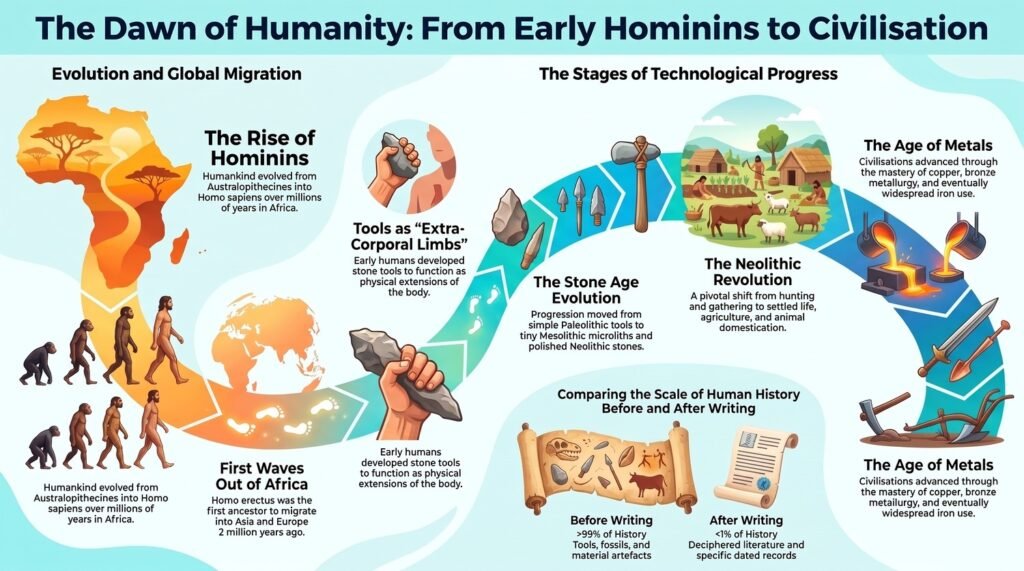
The invention of writing acts as the crucial dividing line between prehistory and history. Written languages did not emerge simultaneously across the globe but developed independently in different regions at different times.
|
Parameter |
Before the Invention of Writing (Prehistory) |
After the Invention of Writing (History) |
|
Timespan |
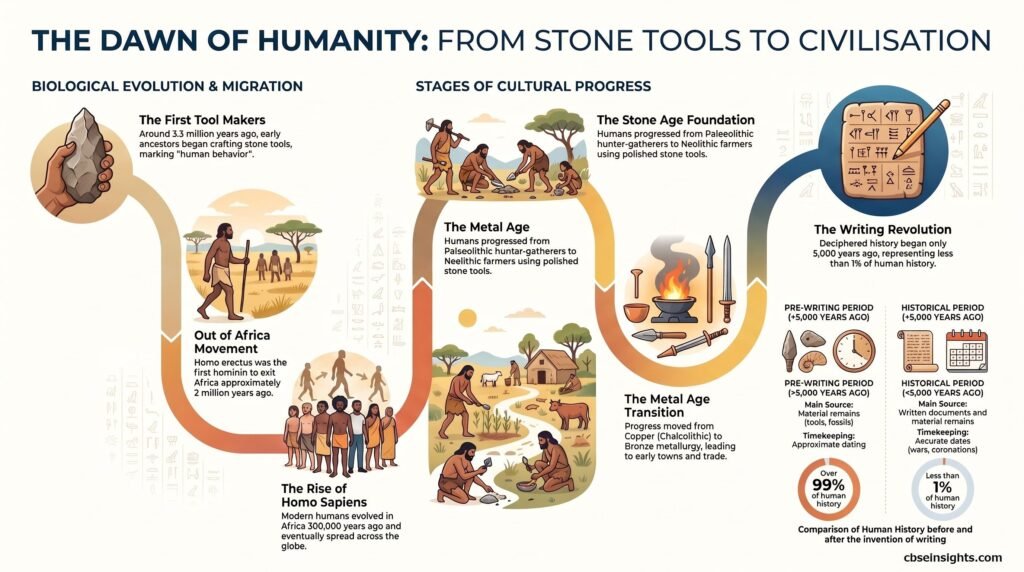
Encompasses more than 99% of human history (from ~3 million years ago to ~5000 years ago). |
Covers less than 1% of human history (the last 5000 years to the present day). |
|
Main Sources of Reconstruction |
Relies purely on material objects/artefacts (stone tools, implements, fossils, bones, cave paintings). |
Uses both material remains and written documents/literature. |
|
Understanding of Society |
It is inherently difficult to understand the exact thoughts, beliefs, and specific ideas of the people. |
Literature provides concrete names, events, laws, and details about social, political, and cultural life. |
|
Measurement of Time |
Dating of events and cultures is strictly approximate (using methods like carbon dating). |
Dating becomes relatively accurate (specific dates for coronations, wars, etc., are recorded). |
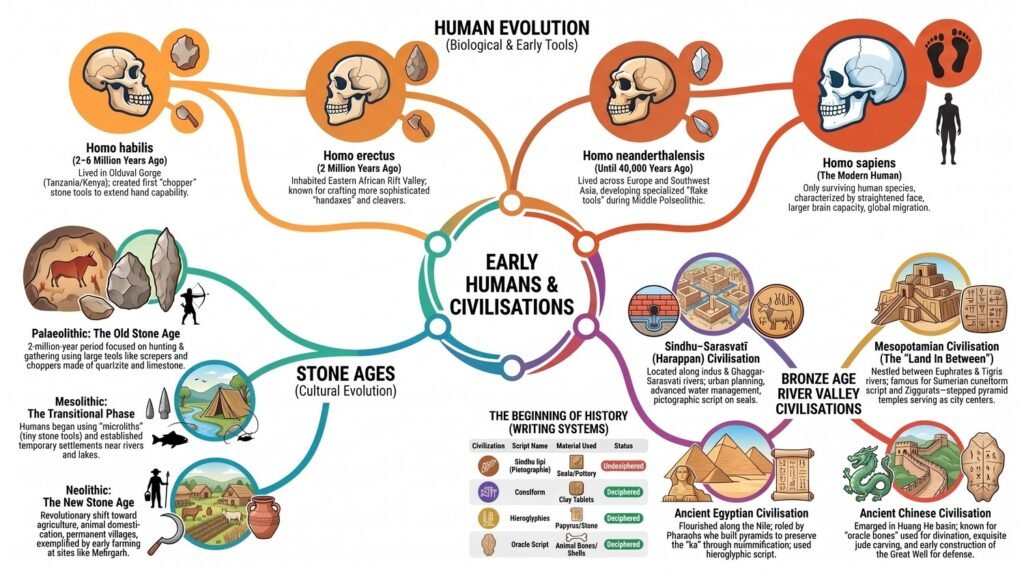
Evolution of Early Scripts
- Sindhu Lipi: The script of the Harappan/Indus Valley Civilisation. It is a pictographic script found on seals and pottery. Crucially, it remains undeciphered. (Harappan seal)
- Cuneiform: Developed by the Sumerians in Mesopotamia. This script has been successfully deciphered, marking the start of their historical period.
- Hieroglyphics: Flourished in Ancient Egypt around the same time as Harappan. It has also been deciphered.
- Brahmi: Used in southern India and the Ganga Valley from around 400 BCE. It was later formalised by Emperor Ashoka in the 3rd century BCE. (Brahmi inscription at Sanchi Stupa)
2. Human Evolution: Biological & Cultural
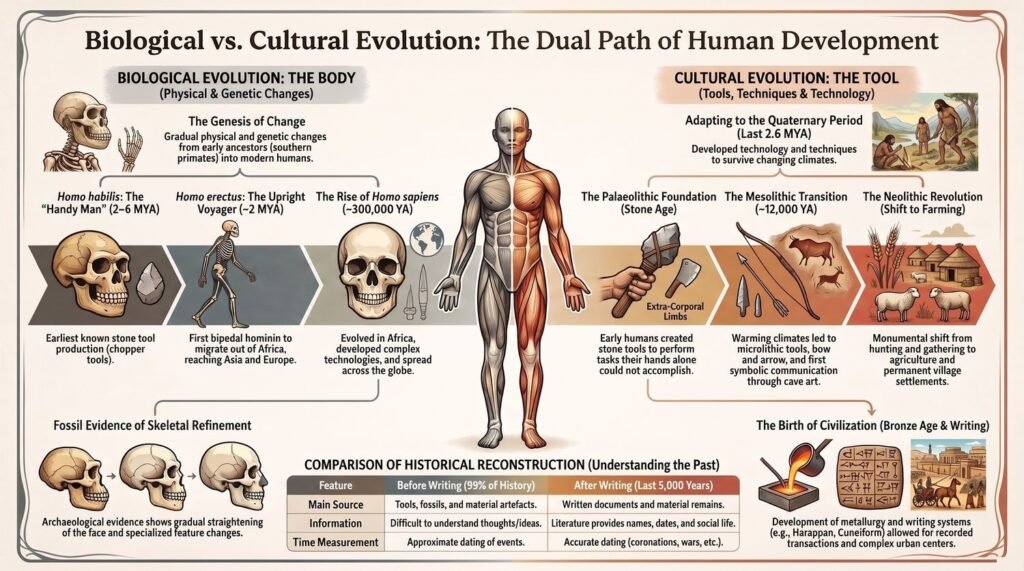
To understand early history, we must look at how humans changed both physically (biology) and behaviorally (culture) in response to the environment during the Quaternary Period (the last 26 lakh years).
Biological vs. Cultural Evolution
- Biological Evolution: The gradual physical and genetic changes spanning millions of years. It marks the transition from our early ancestors, the australopithecines (australis = southern, pithecus = primates), to modern humans, known as Homo sapiens.
- Cultural Evolution: The process by which humans adapted to environmental and climatic changes by developing tools, techniques, and technology. This culminated in the shift from hunting-gathering to agriculture, enabling surplus food production and civilisation.
Who Were Our Human Ancestors?
The earliest human settlements form what is known as the ‘Old World’ (Africa, Asia, and Europe). Around 3.3 million years ago, a critical shift occurred: human ancestors began crafting stone tools, marking the dawn of “human behaviour” (unlike animals, who lack the cognitive ability to craft such tools). Humans thus became known as hominins (tool makers).
Important NCERT Keyword: Stone tools are often referred to as Extra-corporal limbs. They functioned as extensions of the human body, allowing early humans to perform tasks (like cutting thick hide or crushing bones) that they could not do with bare hands.
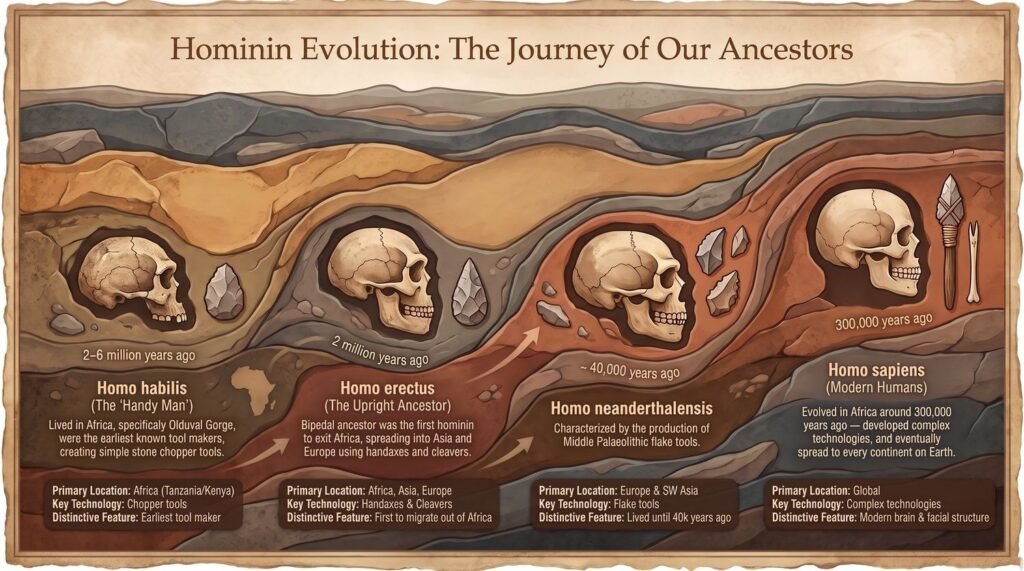
Timeline of Hominin Evolution
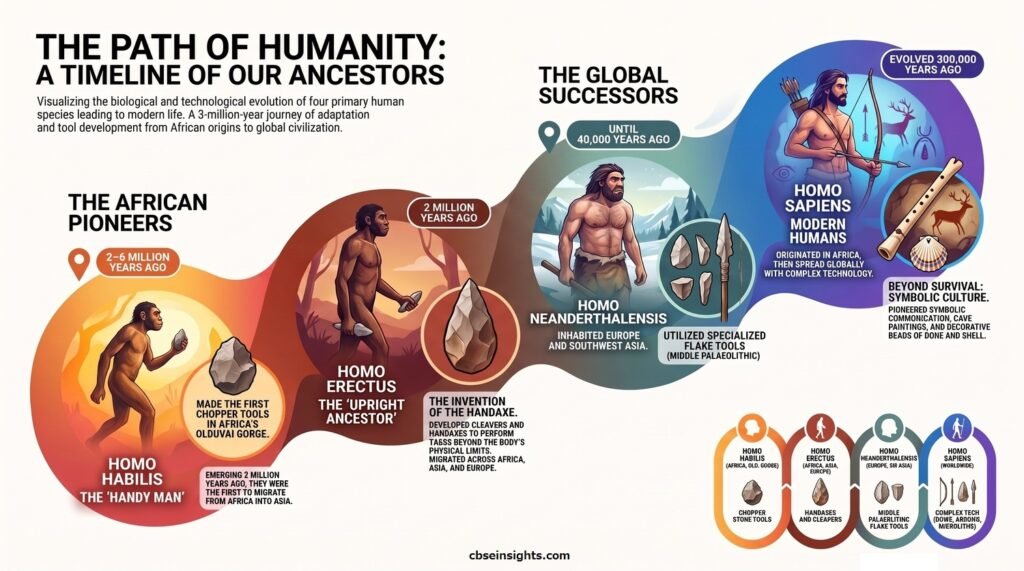
Homo habilis (“Handy Man”) | 2 to 6 million years ago
Lived primarily in Africa (Olduvai Gorge in Tanzania and Kenya). They are credited with making the earliest, simplest chopper stone tools.
Homo erectus (“Upright Man”) | ~2 million years ago
Evolved in the Eastern African Rift Valley. They invented more advanced tools like handaxes and cleavers. They were the very first hominin to migrate out of Africa (between 2 and 0.5 million years ago), spreading into Asia and Europe.
Homo neanderthalensis | Up to 40,000 years ago
Lived in Europe and Southwest Asia. They are associated with Middle Palaeolithic flake tools.
Homo sapiens (Modern Humans) | 300,000 years ago to Present
Evolved in Africa around 300,000 years ago. Initiated a major wave of migration out of Africa around 125,000 years ago, eventually spreading worldwide (including Australia and the Americas between 50,000 and 12,000 years ago). They developed highly complex technologies.
3. The Stone Age in the Indian Subcontinent
Early human history is divided based on technological progress in tool-making and lifestyle changes.
A. Palaeolithic Period (Old Stone Age)
The term derives from palaeo (old) and lithic (stone). Characterized by a hunting-gathering lifestyle and the use of unpolished, chipped stone tools.
- Oldest Indian Sites: Attirampakkam in Tamil Nadu (1.5-1.7 million years ago) and Isampur in Karnataka (1.2 million years ago).
- Tool Technology:
- Early Phase: Large cutting tools made of quartzite and limestone, such as handaxes, cleavers, stone scrapers, and choppers. Used for chopping meat, digging tubers, and cleaving bones for marrow.
- Middle Phase: Smaller tools like scrapers, borers, and points. These improved hunting efficiency by serving as tips for projectiles.
- Late Phase (Homo sapiens): Invention of the bow and arrow, parallel-sided blades, and microblades made from glassy rocks. Introduction of the burin (engraver) used to carve symbolic features on bones and ostrich shells.
- Cultural Advancements: Developed symbolic communication, decorated cave walls with paintings, used body pigments, and created the first beads from stone, bone, and shell. (Fig 4.11: Microlithic tools and bone points – Kurnool District)
B. Mesolithic Period (Transitional / Middle Stone Age)
Around 12,000 years ago, the Earth’s climate warmed significantly. Ice sheets melted, allowing forests and grasslands to expand.
- Population Explosion: New landscapes offered wider resource variety (small game, wild grains, fish), triggering the first population explosion in human history.
- Tools & Diet: Shifted to Microliths (tiny stone tools). Fishing became a massive part of the subsistence economy, utilizing both marine and freshwater sources.
- Habitats & Art: Increased occupation of rock shelters. Flourishing of cave art, most notably at the World Heritage Site of Bhimbetka in Madhya Pradesh.
C. Neolithic Period (New Stone Age) & The “Revolution”
The Neolithic Revolution refers to the monumental shift from hunting and gathering to a food-producing, settled agricultural lifestyle.
- Hallmarks of the Revolution: Domestication of select animals and plants, systematic cultivation, and animal husbandry.
- Tools & Crafts: Shifted from hunting tools to tools designed for food production and processing (polished stone tools). Developed a wide variety of earthenware pottery to store surplus grains.
- The First Villages: Established permanent village settlements, which laid the crucial foundation for the subsequent urban revolution.
KEY NEOLITHIC SITE: MEHRGARH (PAKISTAN)
Located on the Bolan River, Mehrgarh is the oldest Neolithic site in the Indian subcontinent (dating to ~7000 BCE).
- Architecture: Built handmade, sun-dried brick houses and granaries.
- Agriculture: Cultivated wheat and barley. Raised sheep, goats, and the Indian zebu humped bull.
- Culture: Buried their dead in graves and crafted ornaments from semi-precious stones (lapis lazuli, carnelian, shells).
- Technological Leap: They were the first in the region to make copper objects around 4000 BCE, transitioning into the Chalcolithic (Copper-Stone) Age.
4. Sindhu-Sarasvati Civilisation (Harappan Civilisation)
Building on the foundation of the Chalcolithic age (4000 BCE), the Bronze Age emerged around 3500 BCE in the fertile alluvial plains of the Indus and Ghaggar-Sarasvati basins.
Early Harappan Stage (7000 BCE – 2600 BCE)
- Key Sites: Bhirrana, Kunal (Haryana), Datrana (Gujarat), Harappa, Rehman Dheri.
- Advancements: Introduction of copper tools enhanced agricultural productivity. Regional styles in pottery and crafts flourished.
- Defining Features of this Stage: Building perimeter walls around settlements, use of seals, early bead production (semi-precious stones), shell bangles, and terracotta objects.
- Writing Forerunners: Extensive use of graffiti on pottery and early seals with geometric/animal motifs laid the groundwork for the mature Harappan script.
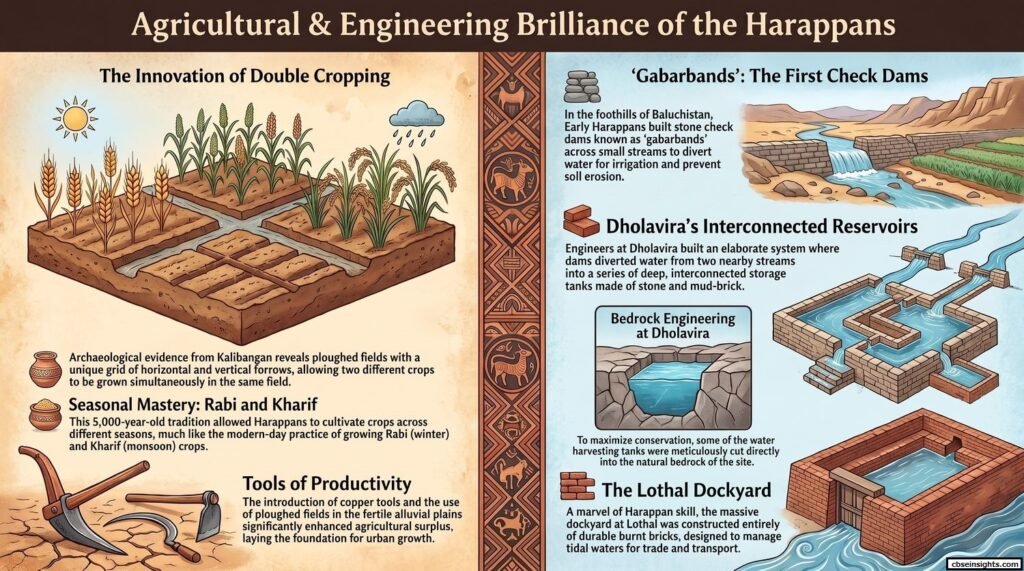
Agricultural & Engineering Brilliance
- Double Cropping: Ploughed fields at Kalibangan show horizontal and vertical furrows, proving they practiced double crop cultivation (similar to modern Rabi and Kharif seasons).
- Water Management: Early Harappans built check dams called gabarbands across streams. The mature phase saw marvels like the interconnected stone and mud-brick deep tanks at Dholavira and the massive burnt-brick dockyard at Lothal.
STANDARDIZATION: WEIGHTS AND MEASURES
A hallmark of the Harappan economic integration was their meticulously standardized system of cubical stone weights.
Small Denominations: Used a binary multiple system (1, 2, 4, 8, 16, etc.).
Large Denominations: Used multiples of ten (decimal system).
Significance: This standardization was absolutely critical for conducting fair and efficient long-distance trade.
5. Bronze Age Civilisations Outside India
Four major early civilisations emerged in river plains globally: Harappan (Sindhu/Sarasvati), Mesopotamian (Euphrates/Tigris), Egyptian (Nile), and Chinese (Huang He). Mesopotamia and Harappa had strong trade contacts due to geographical proximity.
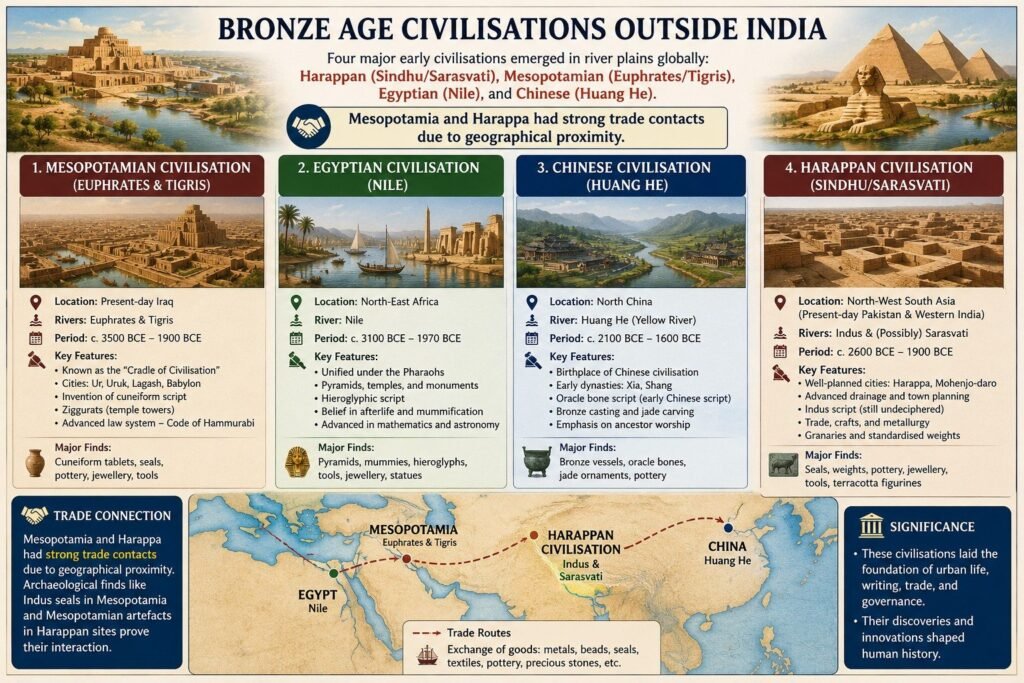
A. Mesopotamian Civilisation (“Land in Between”)
Located in West Asia (modern Iraq, Kuwait, parts of Turkey/Iran). The crescent-shaped foothills of the Zagros and Taurus mountains to the Mediterranean is known as the Fertile Crescent.
Civilisation Phase | Key Features & Innovations |
Sumerians | • Earliest city-based civilisation (e.g., city of Ur). |
Akkadians | • Led by King Sargon, they formed the world’s first dynastic empire. |
Assyrians & | • Assyrians (2154 BCE): Dominant in northern Mesopotamia (city of Assur). |
B. Egyptian Civilisation
Flourished along the Nile River. The annual summer floods brought rich mud called Kemet (“the black”), which was excellent for farming.
- Timekeeping & Calendar: Digging ditches and building reservoirs required tracking the Nile’s floods. By tracking the rising of Sirius (Dog Star), they created a highly accurate calendar: 3 seasons (Inundation, Peret, Shemu), comprising 365 days (12 months of 30 days + 5 extra days).
- Writing & Records:
- Used Hieroglyphics.
- Wrote on Papyrus (sheets made from pressed inner trunk strips of the papyrus plant). Contained stories, medical cures (Papyrus Ebers), and fables (like the oldest ‘Cinderella’).
- Decipherment: The Rosetta Stone (discovered in 1799 by Pierre Bouchard) contained Greek and hieroglyphs. It was deciphered in 1822 by French linguist Jean-François Champollion.
- Religion & Architecture:
- Believed every person had a Ka (spiritual double) living after death, necessitating Mummification (drying bodies with natron, wrapping in linen).
- Rulers (Pharaohs) were buried under rectangular structures called mastabas. Stacking these led to the creation of Pyramids (e.g., Step Pyramid at Saqqara).
- Society: Highly hierarchical (Pharaoh > Officials/Priests > Artisans/Merchants > Serfs/Slaves). Unlike contemporary societies, Egyptian women enjoyed extensive rights (owning property and businesses). Queen Cleopatra (69-30 BCE) is a famous example.
C. The Chinese Civilisation
Developed in the basins of the Huang He (Yellow River) and the Yangtze River. Transitioned to the Bronze age around 2000 BCE.
- Major Dynasties:
- Shang (1600-1046 BCE) & Zhou (1046-256 BCE): Bronze Age peaks. Zhou rulers were priest-kings believed to hold the “Mandate of Heaven.”
- Qin (221-206 BCE): First imperial dynasty, unified the country, and gave “China” its name (Iron Age).
- Han (206 BCE-220 CE): Established the famous Silk Route as silk became a major export in the 2nd century BCE.
- Historical Records & Script:
- Script is logographic (characters represent words/morphemes, not just sounds).
- Earliest info comes from Oracles: symbols carved on animal bones and tortoise shells. When heated, the cracks were interpreted to foretell the future.
- Crafts & Architecture:
- Jade: Highly prized prestige objects; carved into shapes (like fish) that produced musical sounds when struck.
- The Great Wall of China: Construction started around 680 BCE by the Zhou to protect against nomadic raids, expanded until the 17th century CE.
- Governance Innovations: First civilisation to introduce paper currency and implement civil service public examinations (testing archery, math, writing, music).