Q 1 – Based on the size of objects visible under a microscope, which of the following is the correct ascending order of size?
(a) Atoms < Viruses < Proteins < Ribosomes
(b) Atoms < Lipids < Viruses < Mitochondrion
(c) Small molecules < Ribosomes < Viruses < Lipids
(d) Proteins < Smallest bacteria < Viruses < Ribosomes
(a) Atoms < Viruses < Proteins < Ribosomes
Q 2 – Two similar animal cells are placed in two different solutions. Cell X is placed in pure water, and Cell Y is placed in a concentrated salt solution. After some time, Cell X swells and Cell Y shrinks. Which of the following explains this?
(a) Salt molecules moved into Cell Y, causing it to shrink.
(b) Water moved into Cell X and moved out of Cell Y through the cell membrane.
(c) More water moved out of Cell Y than the salt solution entered it.
(d) Solute movement caused osmosis in both cells
(b) Water moved into Cell X and moved out of Cell Y through the cell membrane.
Q 3 – A ball is thrown vertically upwards from point O. It travels 40 cm to point A And falls back down to point O. What is the displacement and total distance travelled by the ball?
(a) Displacement: 80 cm, Distance: 80 cm
(b) Displacement: 0 cm, Distance: 40 cm
(c) Displacement: 0 cm, Distance: 80 cm
(d) Displacement: 40 cm, Distance: 0 cm
(c) Displacement: 0 cm, Distance: 80 cm
Q 4 – A 0.1 kg bullet is fired from a 5 kg gun with a force of 2 N. What is the magnitude of the recoil force acting on the gun?
(a) 0.4 N
(b) 2 N
(c) 10 N
(d) 20 N
(b) 2 N
Q 5 – Which of the following methods is used to separate two miscible liquids that have a minimum difference of 25 °C in their boiling points?
(a) Paper Chromatography
(b) Centrifugation
(c) Crystallization
(d) Distillation
Q 6 – What does the slope of a straight line on a velocity-time graph represent?
(a) Total distance travelled
(b) Displacement
(c) Acceleration
(d) Uniform speed
(c) Acceleration
Q 7 – If you dissolve 10 g of salt in 90 g of water, what is the mass by mass percentage of the solution formed?
(a) 9%
(b) 10%
(c) 11.1%
(d) 90%
(b) 10%
Q 8 – Which scientist expanded the Cell Theory by stating that new cells are formed only from pre-existing cells?
(a) Matthias Schleiden
(b) Theodor Schwann
(c) Rudolf Virchow
(d) J. Craig Venter
(c) Rudolf Virchow
Q 9 – In uniform circular motion, which of the following is true?
(a) Both speed and velocity are constant.
(b) Speed is constant, but velocity continuously changes because the direction changes.
(c) Both speed and velocity continuously change.
(d) The object moves without any acceleration.
(b) Speed is constant, but velocity continuously changes because the direction changes.
Q 10 – When two equal and opposite forces act on the same object, what happens to the object?
(a) The forces do not balance each other, and it accelerates.
(b) The forces balance each other, and the net force is zero.
(c) The object moves in the direction of the first force.
(d) The object undergoes uniform circular motion
(b) The forces balance each other, and the net force is zero.
Directions: For questions 11 to 20, two statements are given—one labelled Assertion (A) and the other labelled Reason (R). Select the correct answer from the codes (a), (b), (c), and (d) below:
(a) Both A and R are true, and R is the correct explanation of A.
(b) Both A and R are true, but R is not the correct explanation of A.
(c) A is true, but R is false.
(d) A is false, but R is true.
Q 11 – Assertion (A): The cell membrane is referred to as the ‘mosaic’ model.
Reason (R): Proteins and lipid molecules in the membrane are arranged like tiles in a mosaic.
(a) Both A and R are true, and R is the correct explanation of A.
Q 12 – Assertion (A): Errors in the process of mitosis can lead to the formation of tumours in the body.
Reason (R): Normal cells grow in a controlled manner, while cancer cells lose control and divide uncontrollably.
(a) Both A and R are true, and R is the correct explanation of A.
Q 13 – Assertion (A): The magnitude of displacement can be greater than the total distance travelled by an object.
Reason (R): For motion in a straight line without turning back, the total distance travelled and the magnitude of displacement are equal.
(d) A is false, but R is true.
Q 14 – Assertion (A): Blood is classified as a true suspension because its components can be separated by centrifugation.
Reason (R): Blood is a colloid, not a solution or a true suspension, as its cells cannot be seen with the naked eye.
(d) A is false, but R is true.
Q 15 – Assertion (A): The solubility of gases dissolved in liquids generally decreases with an increase in temperature.
Reason (R): The solubility of a solid solute in a liquid solvent generally decreases with an increase in temperature.
(c) A is true, but R is false.
Q 16 – Assertion (A): When calculating the displacement of an object moving with constant acceleration, we find the area enclosed by the velocity- time graph and the time axis.
Reason (R): The kinematic equations are valid for any motion, regardless of whether the acceleration is constant or changing.
(c) A is true, but R is false.
Q 17 – Assertion (A): For a given magnitude of force, a larger mass experiences a smaller acceleration.
Reason (R): According to Newton’s second law of motion, acceleration is inversely proportional to the mass of the object.
(a) Both A and R are true, and R is the correct explanation of A.
Q 18 – Assertion (A): Sublimation is an effective separation technique for a mixture of naphthalene and sand.
Reason (R): Sublimation is the transition of a solid directly into a vapour below its melting point, without passing through the liquid state.
(a) Both A and R are true, and R is the correct explanation of A.
Q 19 – Assertion (A): When a fruit falls, the Earth and the fruit apply equal and opposite gravitational forces on each other.
Reason (R): Since the forces are equal in magnitude, the acceleration of the Earth towards the fruit is equal to the acceleration of the fruit falling towards the Earth.
(c) A is true, but R is false.
Q 20 – Assertion (A): The force of friction always acts in the direction of an object’s motion to keep it moving continuously.
Reason (R): To keep an object moving on a surface, we must continuously apply a force to counter the force of friction.
(d) A is false, but R is true.
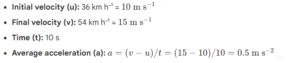
Q 21 – A bus driver moving at a velocity of 36 km h⁻¹ presses the accelerator for 10 s, increasing the velocity to 54 km h⁻¹. Calculate the average acceleration of the bus during this interval.
Q 22 – Briefly explain the Tyndall effect. Give two examples of a mixture that will exhibit this effect.
The Tyndall effect is the phenomenon where dispersed particles in a mixture scatter a beam of light passing through it. Two examples of mixtures that exhibit this effect are colloids and suspensions, such as a mixture of milk and water, or smoke in the air
Q 23 – What happens if gametes are formed by mitotic divisions instead of meiosis? Mention the role of meiosis in daughter cells.
Meiosis is a division process that produces gametes with half the number of chromosomes of the parent cell. If gametes were formed by mitotic division instead, they would retain the full set of chromosomes, causing the chromosome number to double with each successive generation after fertilization (Standard biological deduction based on text inquiry.)
Q 24 – Suppose a person is pushing a stationary box of 25 kg on a floor where the maximum force of friction opposing the motion is 50 N. If the person pushes with a force of exactly 50 N, what will be the net force and the resulting state of the box?
The force of friction opposing the motion is equal to the pushing force (50 N). Because these two equal forces act in opposite directions, they balance each other out. Therefore, the net force is zero, and the box remains stationary
Q 25 – What is the principle used in a separating funnel? Give an example of a mixture that can be separated using this apparatus.
A separating funnel is used to separate two immiscible liquids based on their differing densities. An example of a mixture separated this way is mustard oil and water, where they naturally form two distinct layers.
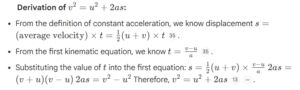
Q 26 – Using the definition of average velocity, derive the kinematic equation relating velocity, acceleration, and distance: v2 = u2 + 2as.
Q 27 – A sports car of mass 1500 kg accelerates uniformly from rest to a velocity of 10 m s⁻¹ in 5 seconds. Calculate the acceleration of the car and the magnitude of the net force acting on it.
Acceleration: a = (v − u) / t = (10 m s−1 − 0 m s−1) / 5 s = 2 m s−2.
Net Force: According to Newton’s second law (F = ma), the force is F = 1500 kg × 2 m s−2
= 3000 N
Q 28 – Mitochondria and chloroplasts are two essential organelles in a plant cell. Discuss how these two organelles are structurally similar to each other. Which of these is responsible for manufacturing food?
Mitochondria and chloroplasts are structurally similar because they both contain their own DNA and ribosomes, and they are both generally rod-shaped organelles. Between the two, the chloroplasts are the organelles responsible for manufacturing food for the plant cell (photosynthesis)
Q 29 – A 0.1 kg bullet is fired from a 5 kg gun with a force of 2 N. Using Newton’s second and third laws of motion, calculate the magnitude of the initial acceleration of both the bullet and the gun. Why do they experience different accelerations despite equal forces?
Bullet Acceleration: a = F / m = 2 N / 0.1 kg = 20 m s–2.
Gun Acceleration: a = F / m = 2 N / 5 kg = 0.4 m s–2
They experience different accelerations despite equal and opposite forces (Newton’s third law) because their masses are drastically different. Newton’s second law states that acceleration is inversely proportional to mass, so the heavier gun accelerates much less than the lighter bullet.
Q 30 – Three students prepared sugar solutions in a laboratory:
- Student A dissolved 20 g of sugar in 80 g of water.
- Student B dissolved 20 g of sugar in 100 g of water.
- Student C dissolved 30 g of sugar in 80 g of water. Calculate the mass by mass percentage (% m/m) concentration of sugar for Student A’s solution, and identify which of the three solutions is the most concentrated.
The formula for mass by mass percentage is (Mass of solute/Total mass of solution)×100.
Note that the total mass of the solution is the mass of the sugar + the mass of the water.
- Student A: 20 g / (20 g + 80 g) × 100 = 20 %.
- Student B: 20 g / (20 g + 100 g) × 100 = 16.67 %.
- Student C: 30 g / (30 g + 80 g) × 100 = 27.27 %. Student C’s solution is the most concentrated because it contains the highest proportion of solute relative to the total mass of the solution.
Q 31 – (a) State Newton’s Second Law of Motion.
(b) Two spring balances are connected together and pulled in opposite directions. Both scales show the exact same reading. Explain how this verifies Newton’s Third Law of Motion.
(c) The Earth exerts a gravitational force on a falling fruit. Does the fruit exert a force on the Earth? Why don’t we see the Earth accelerating towards the fruit?
(a) Newton’s second law of motion states that when a net force acts on an object, the object accelerates in the direction of the net force. The magnitude of this acceleration is proportional to the net force and inversely proportional to the mass of the object.
(b) When two connected spring balances are pulled in opposite directions, the readings on their scales are identical. This verifies Newton’s Third Law because it demonstrates that the force the first spring balance exerts on the second is exactly equal in magnitude and opposite in direction to the force the second exerts on the first.
(c) Yes, the falling fruit does exert a force on the Earth that is equal in magnitude and opposite in direction to the Earth’s gravitational pull. However, we do not see the Earth accelerating towards the fruit because the mass of the Earth is astronomically large compared to the fruit, rendering the Earth’s acceleration entirely negligible
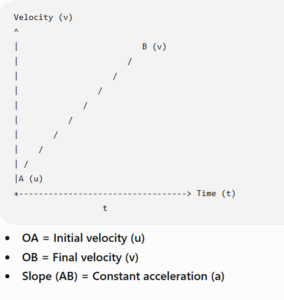
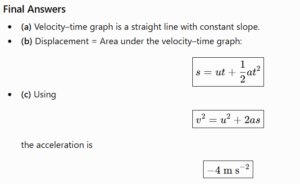
Q 32 – (a) Draw a velocity-time graph for an object moving with constant acceleration.
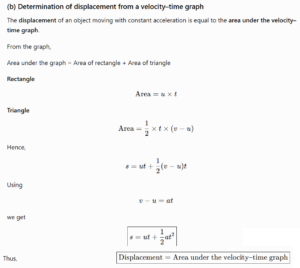
(b) How can you determine the displacement of an object moving with constant acceleration from a velocity-time graph? Show mathematically how the area under the graph relates to displacement.
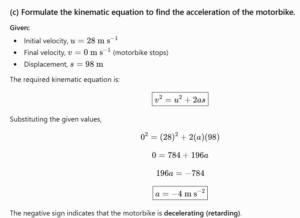
(c) A motorbike moving with an initial velocity of 28 m s⁻¹ and constant acceleration stops after travelling 98 m. Formulate the kinematic equation to find the acceleration of the motorbike.
Q 33 – (a) Differentiate between a solution, a suspension, and a colloid on the basis of particle visibility and whether they settle when left undisturbed.
(b) Describe the process of crystallization. Why is it used to separate substances like salt from seawater?
(c) A student makes a saturated solution of potassium chloride in water at 80 °C and leaves it to cool to room temperature (25 °C). Predict what the student will observe as the solsution cools, and explain the reason for this observation.
- A homogeneous mixture with extremely small particles (< 1 nm) that are not visible to the naked eye. The particles do not settle down when left undisturbed.
- Colloid: A heterogeneous mixture with moderate-sized particles (1–1000 nm). Particles are not clearly visible but scatter light (Tyndall effect). They do not settle out when left undisturbed.
- Suspension: A heterogeneous mixture with large-sized particles (> 1000 nm) that are visible. The particles will settle down at the bottom if left undisturbed.
- (b) Crystallization is a separation technique used to obtain a pure solid in the form of crystals from a saturated solution by cooling it. It is used to separate substances like salt from seawater because it selectively precipitates the pure solid in a regular geometric pattern while leaving impurities behind in the liquid.
- (c) As the saturated KCl solution cools from 80 °C down to room temperature (25 °C), the student will observe solid KCl precipitating and depositing as crystals at the bottom of the container. This happens because the solubility of a solid solute in a liquid solvent generally decreases with a decrease in temperature, forcing the excess solute to separate out of the liquid.