1. Choose the correct options and explain the reason for the correct and incorrect options in the context of Ernest Rutherford’s gold foil experiment:
(i) The experiment clearly showed the existence of neutrons in the nucleus.
INCORRECT: The gold foil scattering experiment (1911) only demonstrated that a positive charge and almost all mass are concentrated in a central dense nucleus. Neutrons are uncharged subatomic particles that were discovered much later in 1932 by James Chadwick.
(ii) The results disproved the plum pudding model and led to the idea of a nucleus at the centre of the atom.
CORRECT: Thomson’s plum pudding model stated that positive charge was spread uniformly throughout a sphere. The scattering of positive alpha particles—where most passed undeflected, but a few rebounded sharply—proved that the positive charge is highly concentrated in an extremely tiny region at the center, disproving uniform distribution.
(iii) The large deflection of a few alpha particles indicated that most of the mass of the atom and positive charge are packed into a tiny centre.
CORRECT: Since alpha particles are heavy, positively charged helium nuclei, their large-angle scattering and direct bouncing back could only happen if they experienced massive electrostatic repulsion from a highly dense, concentrated positive core containing almost all of the atom’s mass.
(iv) The way alpha particles were deflected showed that electrons move around the nucleus.
INCORRECT: The deflection of positively charged alpha particles gave information solely about the location and positive charge of the central nucleus. The planetary motion of electrons around the nucleus was Rutherford’s model postulate to explain the balance of charge, but it was not directly demonstrated or observed by particle deflection.
2. Which of the following statements are correct or incorrect according to the Bohr’s atomic model? Give a reason for each statement.
(i) Electrons lose energy while moving in fixed orbits and slowly fall into the nucleus.
INCORRECT: According to Bohr’s model, as long as an electron revolves within its specific permitted circular shell (stationary state), its energy remains constant and it does not lose energy. Thus, it does not spiral into the nucleus.
(ii) Electrons can exist anywhere around the nucleus with no fixed energy.
INCORRECT: Bohr postulated that electrons can revolve around the nucleus only in certain discrete, allowed circular shells (K, L, M, N… or n=1, 2, 3, 4…). In each specific shell, the electron has a definite, quantized amount of energy.
(iii) Electrons revolve around the nucleus in orbits of fixed energy without losing energy.
CORRECT: This is one of the core postulates of Bohr’s model. These allowed paths are called stationary orbits or energy levels where the energy of a revolving electron remains constant, preventing energy decay and collapsing.
(iv) Electrons can be found between energy levels as they move around the nucleus.
INCORRECT: Electrons are strictly confined to the defined energy levels and can never exist in intermediate regions between them. They can only transition from one energy level to another by absorbing or emitting a exact quantum of energy.
3. The composition of the nuclei of three atomic species X, Y, and Z are given as follows.
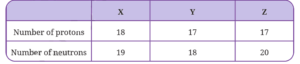
Explain the relation between the following:

(i) Relation between Y and Z:
Y and Z are Isotopes. Both species have the same number of protons (17), meaning they represent the same chemical element (Chlorine, Cl) and share identical atomic numbers (Z=17). However, they have different numbers of neutrons (18 vs. 20) and consequently different mass numbers (35 vs. 37).
(ii) Relation between Z and X:
Z and X are Isobars. Both species share the exact same mass number (37), meaning they have the same total number of nucleons in their nuclei. However, they represent entirely different elements because they have different atomic numbers (Z has 17 protons [Chlorine], while X has 18 protons [Argon]).
4. What conclusion did Rutherford draw about the position and characteristics of the atom’s positively charged part based on the few alpha particles that bounced back or were deflected at large angles in the gold foil experiment?
Rutherford analyzed the sharp scattering of alpha particles and deduced the following characteristics of the atom’s positive core:
• Concentrated Location: The positive charge of an atom is not spread throughout a sphere (as Thomson hypothesized) but is concentrated in a centrally located, extremely small region called the nucleus.
• Dense & Massive: The nucleus is incredibly dense, hard, and contains almost all of the mass of the atom, which prevents incoming energetic alpha particles from passing straight through when they make direct head-on approaches.
• Extremely Small Volume: The size of the nucleus is extremely small compared to the total size of the atom.
Rutherford calculated the diameter of an atom is about 10-10 m, while the diameter of the nucleus is about 10-15 m. This means the nucleus is approximately 100,000 (one lakh) times smaller than the atom itself.
5. Explain and arrange the following statements in the correct chronological order to show how atomic models have evolved over time.
(i) Bohr’s model proposed that electrons move in fixed orbits around the nucleus, each with a definite energy.
(ii) Thomson’s model depicted the atom as a ʻplum puddingʼ with electrons embedded in a sphere of positive charge.
(iii) Rutherford’s model proposed that atoms have a dense central nucleus.
(iv) Dalton’s model described atoms as indivisible particles.
The correct historical timeline of atomic models is as follows:
1. Dalton’s Model (1808) [Statement iv]: Described atoms as indivisible, indestructible fundamental particles that serve as the building blocks of all matter. Atoms of the same element are identical in mass and properties.
2. Thomson’s Model (1897) [Statement ii]: Proposed after his discovery of electrons. Depicted the atom as a neutral sphere of positive charge (‘pudding’ or watermelon pulp) with tiny negatively charged electrons embedded inside (‘plums’ or seeds).
3. Rutherford’s Model (1911) [Statement iii]: Formulated after the gold foil experiment. Proposed that atoms consist of mostly empty space with a dense, positively charged central core (nucleus) which electrons orbit like planets orbiting the Sun.
4. Bohr’s Model (1913) [Statement i]: Refined Rutherford’s planetary model to resolve energy loss and atomic instability. Postulated that electrons revolve in non-radiating, fixed circular shells (energy levels) with quantized energies.
Chronological Sequence: (iv) → (ii) → (iii) → (i)
6. Electrons move around the nucleus in orbits. Why do they not fly away from the atom? Explain what keeps them attracted to the nucleus.
Two crucial scientific concepts explain why orbiting electrons remain securely bound inside the atom:
• Electrostatic Attraction: Opposites attract. Electrons carry a negative unit charge (–1) while the protons concentrated in the nucleus carry a positive unit charge (+1). The strong electrostatic force of attraction between these opposite charges pulls revolving electrons toward the nucleus. This electrostatic force acts as the centripetal force required to keep the electrons in circular motion.
• Bohr’s Stationary Shells: To prevent electrons from losing energy and spiraling into the nucleus under classical electromagnetic attraction, Niels Bohr proposed that electrons can only move in allowed ‘stationary states’ or energy shells. Inside these shells, the energy of an electron remains constant and stable, keeping them orbiting at a fixed average distance from the nucleus without collapsing or flying away.
7. Assertion (A): The discovery of subatomic particles helped in understanding the atomic structure.
Reason (R): The number of electrons is equal to the number of protons in an atom.
Choose the correct option:
(i) Both A and R are true, and R is the correct explanation of A.
(ii) Both A and R are true, but R is not the correct explanation of A.
(iii) A is true, but R is false.
(iv) A is false, but R is true.
Correct Option: (ii) Both A and R are true, but R is not the correct explanation of A.
Reasoning:
• Assertion (A) is true because the discovery of the three fundamental subatomic particles—electrons
(Thomson, 1897), protons (Rutherford), and neutrons (Chadwick, 1932)—directly enabled scientists to build
and refine structural atomic models over time.
• Reason (R) is true because for any neutral atom, the negative charge of orbiting electrons must equal the
positive charge of protons in the nucleus, making the atom electrically neutral.
• However, the fact that an atom is electrically neutral (R) is not the causal reason *why* discovering these
particles helped us understand atomic structure (A). These are two independent scientific facts; hence, R is not the correct explanation of A.
8. Magnesium is essential for many biological processes, including muscle contraction. For an atom of magnesium with a mass number of 24 and atomic number 12, determine the number of (i) protons, (ii) neutrons, (iii) electrons, and also illustrate the arrangement of electrons in a magnesium atom.
Based on the given data for Magnesium (Atomic Number Z = 12, Mass Number A = 24):
• (i) Number of Protons: Equal to the Atomic Number (Z) = 12 protons.
• (ii) Number of Neutrons: Calculated as Mass Number (A) – Atomic Number (Z) = 24 – 12 = 12 neutrons.
• (iii) Number of Electrons: Since the atom is neutral, the number of electrons equals the number of protons = 12 electrons.
Electronic Arrangement (Electronic Configuration):
Following the Bohr-Bury rule for electron filling (maximum capacity = 2n²):
1. K-shell (n = 1): accommodates a maximum of 2 electrons (filled)
2. L-shell (n = 2): accommodates a maximum of 8 electrons (filled)
3. M-shell (n = 3): holds the remaining electrons = 12 – (2 + 8) = 2 electrons
Electronic Configuration of Mg: 2, 8, 2
(Visualizing the atom: A central nucleus containing 12 protons and 12 neutrons, surrounded by three concentric rings representing K, L, and M shells holding 2, 8, and 2 electrons respectively.)
9. Find the following information for the elements shown in Fig. 8.17:
(i) Name of the element
(ii) Symbol
(iii) Total number of electrons
(iv) Number of valence electrons
(v) Valency of the element
(vi) Number of protons
(vii) Atomic number
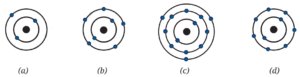
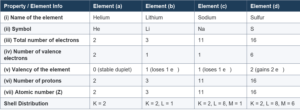
Valency Rule Explanations:
• Helium (a): Outermost shell (K) has 2 electrons, which is its maximum capacity. Since the shell is fully closed (stable duplet), its combining capacity is zero.
• Lithium (b) and Sodium (c): Outermost shells have only 1 valence electron. It is energetically easier to lose this single electron to achieve a closed-shell configuration than to gain 7. Thus, valency is 1.
• Sulfur (d): Outermost shell has 6 valence electrons. It needs 2 more to complete its octet (8). Hence, it gains 2 electrons, making its valency 8 – 6 = 2.
10. Both Rutherford’s and Bohr’s models have electrons orbiting the nucleus. Why did Rutherford’s model fail to explain atomic stability, while Bohr’s model succeeded?
Rutherford’s Model Failure:
According to classical laws of electromagnetism, any charged particle (like a negatively charged electron)
moving in a circular path undergoes continuous acceleration. An accelerating charge must continuously emit electromagnetic radiation (energy). Since a revolving electron would lose energy, its orbital radius would shrink, causing it to spiral inward and crash into the positively charged nucleus within fractions of a microsecond. If this happened, all atoms would collapse and matter would not exist. This is the main limitation of Rutherford’s planetary model.
Bohr’s Model Success:
Bohr overcame this failure by postulating that electrons do not revolve in arbitrary circular paths. Instead, they are restricted to certain discrete circular orbits called stationary states or energy shells (K, L, M, N…). He established as a postulate that while revolving within an allowed energy level, an electron does not emit or lose any energy. Because energy is conserved and constant in these stationary shells, electrons orbit stably without spiraling into the nucleus, successfully explaining atomic stability.
11. An atom 70 X has 31 electrons. How many neutrons are there in its nucleus?
Let the atomic species be represented as A_Z X where A is the mass number and Z is the atomic number.
• Total number of electrons = 31
• In a neutral atom, Number of protons (Z) = Number of electrons = 31
• Mass number (A) of species = 70
• Formula: Mass Number (A) = Protons (Z) + Neutrons (n)
• Neutrons = A – Z = 70 – 31 = 39 neutrons.
Answer: There are 39 neutrons present in the nucleus of element X (which is Gallium, 70 31Ga).
12. An atom has 79 protons and a mass number of 197. Calculate (i) the number of neutrons, and (ii) the number of electrons.
For the given atomic species with Protons (Z) = 79 and Mass Number (A) = 197:
• (i) Number of Neutrons: Calculated using the formula:
Neutrons (n) = Mass Number (A) – Protons (Z) = 197 – 79 = 118 neutrons.
• (ii) Number of Electrons: In any neutral atom, the negative charge of electrons perfectly balances the
positive charge of protons.
Electrons = Protons = 79 electrons.
Answer: The atom contains 118 neutrons and 79 electrons. (This element is Gold, 197 79 Au).
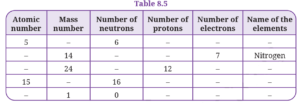
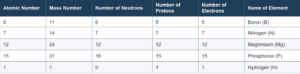
13. Complete the Table 8.5:


Formulas applied for calculations:
• Atomic Number (Z) = Number of Protons = Number of Electrons (for neutral atoms)
• Mass Number (A) = Number of Protons + Number of Neutrons
• Neutrons (n) = Mass Number (A) – Atomic Number (Z)
14. Aman was discussing the structure of atom with his classmates.
During the discussion, he learnt that an element X has a mass number of 35 and contains 18 neutrons. Based on this information, answer the following questions:
(i) How many electrons and protons does element X have?
(i) Number of electrons and protons:
Protons = Mass Number (A) – Neutrons = 35 – 18 = 17 protons.
Electrons = Protons (for neutral atom) = 17 electrons.
(ii) What is its atomic number?
(ii) Atomic number of X: Atomic Number (Z) = Number of Protons = 17.
(iii) Identify the element X.
(iii) Identity of Element X: The element with atomic number 17 is Chlorine (Cl)
(iv) Write its electronic confguration.
(iv) Electronic configuration: Shell capacities are K=2, L=8, M=7 (total 17). Configuration is 2, 8, 7.
(v) How many valence electrons does it have?
(v) Valence electrons: Electrons in outermost M-shell = 7 valence electrons.
(vi) What will be the mass number if two neutrons are added to its nucleus?
(vi) New mass number with two added neutrons: New mass number = Original protons (17) + (Original neutrons 18 + 2) = 17 + 20 = 37.
(vii) What will be the relation of X with the new atom?
(vii) Relation between original X and the new atom: They are Isotopes of Chlorine (3517 Cl and 3717Cl).
They have the exact same atomic number (17, same chemical element) but different mass numbers (35 and
37)
15. In an atom, there are 12 protons and 12 neutrons in the nucleus.
Now, imagine that all the electrons are replaced with some hypothetical particles that have the same charge as electrons but are 500 times heavier. What effect will this replacement have on the atom’s:
(i) Atomic number
Replacing the 12 electrons of Magnesium (Z=12, A=24) with hypothetical particles that have the same charge
(–1) but are 500 times heavier will have the following effects:
• (i) Atomic Number: NO EFFECT (remains 12). Atomic number is determined solely by the number of protons inside the nucleus, which are unchanged.
(ii) Atomic Mass
(ii) Atomic Mass: INCREASES significantly. The mass of standard electrons is almost negligible (approx. 1/1836th of a proton) and is ignored in atomic mass calculations. However, particles 500 times heavier have a substantial mass (500 * (1/1836) ≈ 0.27th of a proton mass each). For 12 such particles, their total mass adds about 3.27 u to the atom. This increases the total atomic mass from ≈ 24 u to ≈ 27.27 u (an increase of about 13.6%).
(iii) Mass Number
(iii) Mass Number: NO EFFECT (remains 24). Mass number is strictly defined as an integer representing the sum of protons and neutrons in the nucleus (nucleon count) and by definition completely excludes electronic masses
(iv) Overall Charge
(iv) Overall Charge: NO EFFECT (remains neutral, 0). Since the hypothetical particles carry the exact same charge (–1) as standard electrons, the positive charge of the 12 protons (+12) in the nucleus is still perfectly balanced by the negative charge of the 12 heavy particles (–12).