How Forces Affect Motion Class 9 Physics Important Questions (2026-27)

Q 1 – Two forces of 12 N and 5 N act on a body in opposite directions. If the body has a mass of 7 kg, its acceleration will be:
A. 0.71 m/s² in the direction of 12 N force
B. 1 m/s² in the direction of 5 N force
C. 1.71 m/s² in the direction of 12 N force
D. 17 m/s² in the direction of 12 N force

A. 0.71 m/s² in the direction of 12 N force

Q 2 – A ball moving towards the east is acted upon by a force directed towards the north. What happens to the ball’s motion?
A. Its speed must decrease
B. Its velocity changes because its direction changes
C. Its velocity remains unchanged
D. Its acceleration becomes zero

B. Its velocity changes because its direction changes

Q 3 – A 2 kg object is initially moving with a velocity of 5 m/s. A constant force of 6 N acts on it in the direction opposite to its motion for 1 s. What will be its velocity after 1 s?
A. 2 m/s in the original direction
B. 2 m/s opposite to the original direction
C. 8 m/s in the original direction
D. 3 m/s in the original direction

A. 2 m/s in the original direction

Q 4 – When a net force acts on an object, we observe that the object accelerates:
(i) opposite to the direction of force, with acceleration proportional to the
force acting on the object.
(ii) opposite to the direction of force, with acceleration proportional to the
mass of the object.
(iii) in the direction of force, with acceleration inversely proportional to the
force acting on the object.
(iv) in the direction of force, with acceleration proportional to the force acting
on the object.

(iv) in the direction of force, with acceleration proportional to the force acting on the object.

Q 5 – Fill in the Blanks:

1. For a given force, the acceleration of an object is __________ proportional to its mass.

2. A body of greater mass has greater __________ and therefore requires a greater force to produce the same acceleration.

3. When balanced forces act on a moving object, its __________ remains unchanged.

4. The acceleration produced in an object depends on both the __________ acting on it and its __________.

5. If the net force acting on an object is zero, the object can either remain at rest or continue moving with __________ velocity.

1. inversely
2. inertia
3. velocity
4. force, mass
5. uniform

(a) Both assertion and reason are true and reason is the correct explanation of assertion.
(b) Both assertion and reason are true but reason is not the correct explanation of assertion.
(c) Assertion is true but reason is false.
(d) Both Assertion and Reason are false.

Q 6 – Assertion : A boy facing forward in a moving bus throws a ball straight up. At the same instant the bus begins to accelerate. The ball goes up and falls in front of the boy.

Reason : As the ball rises, velocity remains constant.

(c) Assertion is true but Reason is false.

Q 7 – Assertion: While sharpening a knife along the moving grinding wheel, the sparks fly off tangentially due to the inertia of direction.

Reason: It is the inherent property of a body by virtue of which it can’t change its direction of motion is called inertia of direction.

(a) Both assertion and reason are true and reason is the correct explanation of assertion.

Q 8 – Assertion: When a gun is fired, it gives a backward jerk. 
Reason: By law of conservation of momentum for an isolated system.
The linear momentum is always conserved.

(a) Both assertion and reason are true and reason is the correct explanation of assertion.

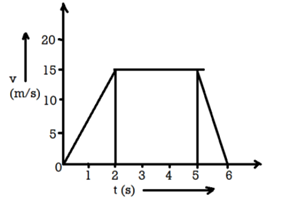
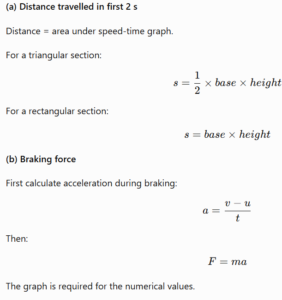
Q 9 – The speed-time graph of a car is given:

(a) What is the distance travelled by the car in first 2s?
(b) What is the braking force applied at the end of 5s to bring the car to stop within 1 second?
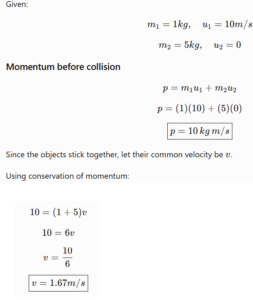
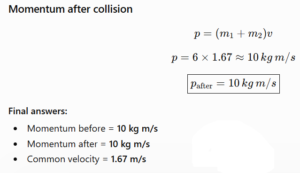
Q 10 – An object of mass 1 kg travelling in a straight line with a velocity of 10 ms–1 collides with, and sticks to a stationary wooden block of mass 5 kg.

Then they both move off together in the same straight line. Calculate the total momentum just before the impact and just after the impact. Also, calculate the velocity of the combined object.

Q 11 – A sailor jumps out from a small boat to the shore (Fig. 6.38). As the sailor jumps forward, will the boat move? If yes, in which direction and why.
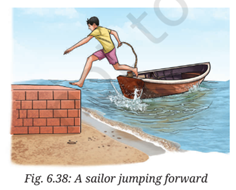
Yes, the boat will move.

When the sailor jumps forward, he exerts a force on the boat in the opposite direction.

By the law of conservation of momentum, the forward momentum of the sailor is balanced by backward momentum of the boat.

Therefore:

The boat moves backward, opposite to the sailor’s motion.

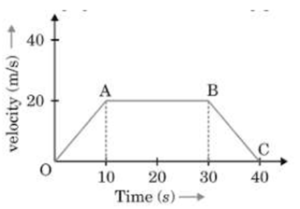
Q 12 – In the given velocity-time graph of a ball of mass 100 g rolling on a concrete floor, calculate following :
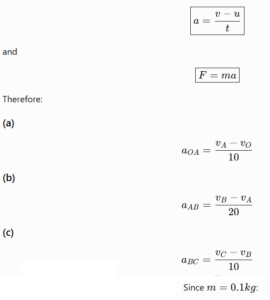
(a) acceleration in first 10 sec.
(b) acceleration in next 20 sec.
(c) acceleration in last 10 sec.
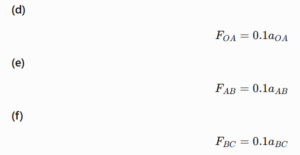
(d) force acting on the ball from O to A
(e) force acting on the ball from A to B
(f) force acting on the ball from B to C
The ball has mass:

100g = 0.1 kg100g=0.1kg

The question requires accelerations for three different portions of the velocity-time graph and corresponding forces.

However, the actual graph containing the velocities at O, A, B and C is not included in the extracted file text, so exact numerical values cannot be determined safely.

Use:
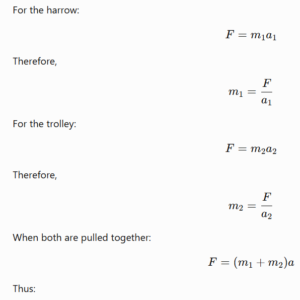
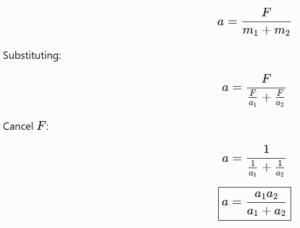
Q 13 – A tractor pulls a harrow (a ploughing tool) of mass m1 with a net force F resulting in an acceleration of a1. The same tractor pulls a trolley of mass m2 with a force F producing an acceleration of a2. If the tractor now pulls the trolley with the harrow placed on it (with the same force F), then obtain an expression for the resulting acceleration in terms of a1 and a2. Ignore friction.


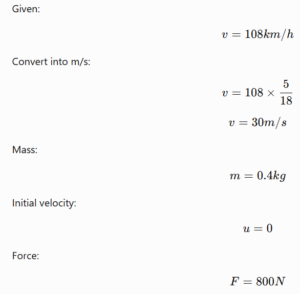
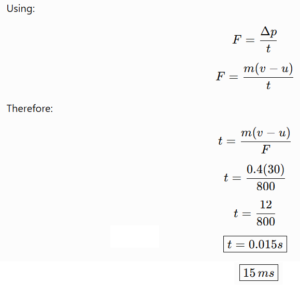
Q 14 – An ace footballer converted a penalty shot by kicking the football with a speed of 108 km h– 1 . The estimated force they imparted was 800 N. The mass of the football was 0.4 kg. Calculate the time of contact between their foot and the ball.

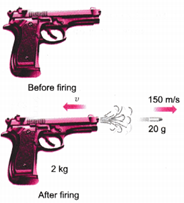
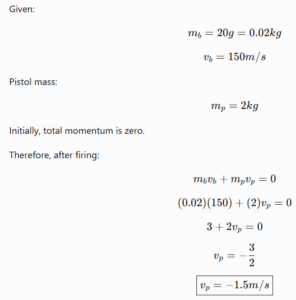
Q 15 – A bullet of mass 20 g is horizontally fired with a horizontal velocity 150 ms-1 from a pistol of mass 2 kg. What is the recoil velocity of the pistol?
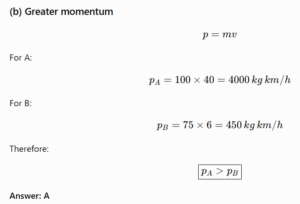
Q 16 – Two objects A and B, having mass 100 kg and 75 kg, moving with velocity 40 km/hr and 6 km/hr respectively. Answer the following:

(a) Which will have greater inertia?
(b) Which will have greater momentum?
(c) Which will stop first if equal negative acceleration is applied on both?
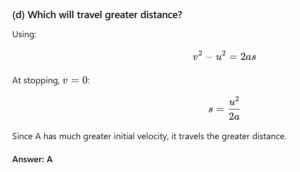
(d) Which will travel greater distance?
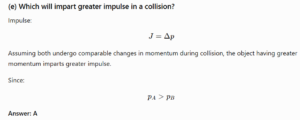
(e) Which will impart greater impulse if collides with a wall?

Given:

QuantityAB
Mass100 kg75 kg
Velocity40 km/h6 km/h

(a) Greater inertia

Inertia depends on mass.

Since:

100 kg > 75 kg100kg>75kg

Answer: A