Q 1 – A chemical reaction is carried out in a closed container. The total mass before the reaction is 36 g. Which observation would contradict the Law of
Conservation of Mass, assuming accurate measurements?
A. The products have a combined mass of 36 g.
B. A gas forms but remains inside the container.
C. The products have a combined mass of 34 g.
D. The appearance of the substances changes.
C. The products have a combined mass of 34 g.
Q 2 – Two samples of a pure compound are obtained from different sources. Sample P contains 8 g of oxygen combined with 1 g of hydrogen. If sample Q contains 24 g of oxygen, what mass of hydrogen should it contain?
A. 1 g
B. 2 g
C. 3 g
D. 8 g
C. 3 g
Q 3 – In an experiment, the mass appears to decrease after vinegar reacts with baking soda in an open flask. Which explanation is most scientifically appropriate?
A. Matter has been destroyed during the reaction.
B. The atoms of the reactants have lost mass.
C. A gaseous product escapes from the system.
D. The Law of Conservation of Mass applies only to physical changes.
C. A gaseous product escapes from the system.
Q 4 – Which pair of observations best supports the Law of Constant Proportions?
A. Two samples of a compound have different colours.
B. Two samples of a pure compound contain the same elements in the same mass ratio.
C. Two compounds contain the same elements in equal masses.
D. A compound and a mixture have identical physical properties.
B. Two samples of a pure compound contain the same elements in the same mass ratio.
Q 5 – Carbon and oxygen combine to form carbon dioxide. If 12 g of carbon combines completely with 32 g of oxygen, what mass of carbon dioxide is formed?
A. 20 g
B. 32 g
C. 40 g
D. 44 g
D. 44 g
Q 6 – Which statement correctly distinguishes a chemical compound from a mixture?
A. The components of a compound are always present in any proportion.
B. The elements in a pure compound combine in a definite proportion by mass.
C. The components of a mixture always form a new substance.
D. A compound can always be separated by physical methods.
B. The elements in a pure compound combine in a definite proportion by mass.
Q 7 – An element forms an ion by losing two electrons. Which statement correctly describes the resulting ion?
A. It has two more electrons than protons.
B. It has two fewer protons than the neutral atom.
C. It has two fewer electrons than the neutral atom and a 2+ charge.
D. It has gained two neutrons and a 2 – charge.
C. It has two fewer electrons than the neutral atom and a 2+ charge.
Q 8 – An atom of an element has valency 3, while another element has valency 2. Using the crossover method and the simplest whole-number ratio, which formula is correct?
A. AB
B. A2B3
C. A3B2
D. A2B2
C. A3B2
Q 9 – Which statement about the Law of Conservation of Mass is correct?
A. It holds only when no gas is produced.
B. It holds for chemical reactions when all reactants and products are accounted for.
C. It applies only to reactions involving solids.
D. It states that the mass of each individual product must equal the mass of each reactant.
B. It holds for chemical reactions when all reactants and products are accounted for.
Q 10 – A substance has the formula X2Y3. If the atomic masses of X and Y are 14 u and 16 u respectively, its formula mass is:
A. 44 u
B. 60 u
C. 76 u
D. 96 u
C. 76 u
Q 11 – Fill in the blanks:
1. The law stating that matter can neither be created nor destroyed in a chemical reaction was proposed by __________.
2. According to the Law of Constant Proportions, the elements in a pure compound are present in a fixed ratio by __________.
3. When a gas escapes from an open reaction vessel, the measured mass of the remaining contents may appear to __________.
4. The scientist associated with the Law of Constant Proportions is __________.
5. The smallest particle of an element that retains its chemical identity is called an __________.
6. A group of atoms chemically bonded together and behaving as a single unit is called a __________.
7. The combining capacity of an atom, used when writing chemical formulae, is called its __________.
8. The chemical formula of the sulfate ion is __________.
9. The total of the atomic masses of all atoms represented in a molecular formula is called the __________ mass.
10. In a chemical formula, the small number written at the lower right of an element symbol indicates the number of __________ of that element.
1. Antoine Lavoisier
2. Mass
3. Decrease
4. Joseph Proust
5. Atom
6. Molecule
7. Valency
8. SO₄²⁻
9. Molecular
10.
Atoms
Q 12 – A student mixes 15 g of substance A with 10 g of substance B in a closed vessel. After a chemical reaction, the total mass of the products is 25 g. Explain how this observation supports the Law of Conservation of Mass.
According to the Law of Conservation of Mass, matter can neither be created nor destroyed during a chemical reaction.
Given:
Mass of substance A = 15 g
Mass of substance B = 10 g
Total mass of reactants: 15+10=25 g
Total mass of products = 25 g.
Therefore,
Q 13 – A pure compound contains 2 g of hydrogen and 16 g of oxygen. Another sample of the same compound contains 5 g of hydrogen. Calculate the mass of oxygen expected in the second sample, using the Law of Constant Proportions.
According to the Law of Constant Proportions, the elements in a pure compound are always present in a fixed ratio by mass.
Given:
Hydrogen = 2 g
Oxygen = 16 g
Mass ratio:
For 5 g of hydrogen:
Q 14 – Explain why the measured mass may decrease when baking soda reacts with vinegar in an open container, even though the Law of Conservation of Mass remains valid.
When baking soda (sodium hydrogencarbonate) reacts with vinegar (acetic acid), carbon dioxide gas is produced along with water and sodium acetate.
The chemical reaction is:
CH3COOH + NaHCO3 →CH3COONa + H2O + CO2
In an open container, carbon dioxide gas escapes into the atmosphere. As a result, the mass measured in the container decreases.
However, matter is not destroyed. If all the reactants and products, including the escaped carbon dioxide, are considered, the total mass remains conserved.
Q 15 – Write the chemical formulae of the following compounds using their valencies. Show the crossover step.
A. Aluminium oxide: Al (valency 3), O (valency 2)
B. Magnesium chloride: Mg (valency 2), Cl (valency 1)
(a) Aluminium oxide
Given:
Aluminium (Al) = 3
Oxygen (O) = 2
Crossover method: Al3O2 → Al2O3
(b) Magnesium chloride
Given:
Magnesium (Mg) = 2
Chlorine (Cl) = 1
Crossover method:
Mg²Cl¹→ Mg1Cl2
Removing the subscript 1:
MgCl²
Q 16 – Calculate the formula mass of calcium hydroxide, Ca(OH)2, using Ca = 40, u, O = 16,u and H = 1,u. Show the contribution of each type of atom.
Given:
Ca = 40 u
O = 16 u
H = 1 u
Formula:Ca(OH)2
Number of atoms:
Calcium = 1
Oxygen = 2
Hydrogen = 2
Calculation:
Formula Mass = 40 + 2 (16) + 2 (1)
= 40 + 32 + 2
= 74 u
Q 17 – Describe an experiment to verify the Law of Conservation of Mass using vinegar and baking soda. Your answer must include:
1. The apparatus and arrangement.
2. The observation during the reaction.
3. Why a closed arrangement is important.
4. The conclusion drawn from the experiment.
Aim: To verify the Law of Conservation of Mass during a chemical reaction.
a. Apparatus and arrangement:
A conical flask
Vinegar
Baking soda
A small container for baking soda
A balloon
A weighing balance
Take vinegar in a conical flask. Put baking soda in a small container and place it inside the flask without allowing it to mix with vinegar. Fit a balloon tightly over the mouth of the flask.
b. Observation during the reaction:
Record the total mass of the complete arrangement. Allow baking soda to mix with vinegar. Bubbles of carbon dioxide gas are produced, and the balloon inflates.
The mass of the complete closed arrangement remains unchanged.
c. Why is a closed arrangement important?
The closed arrangement prevents carbon dioxide from escaping into the atmosphere. Therefore, all the products remain within the system and can be accounted for.
d. Conclusion:
The total mass before and after the chemical reaction remains the same.
Hence, the experiment verifies the Law of Conservation of Mass.
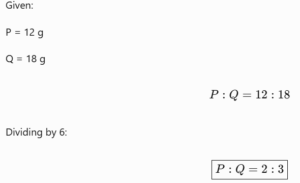
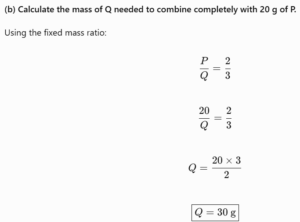
Q 18 – A compound is prepared from elements P and Q. In one experiment, 12 g of P combines completely with 18 g of Q.
a. State the mass ratio P:Q.
b. Calculate the mass of Q needed to combine completely with 20 g of P.
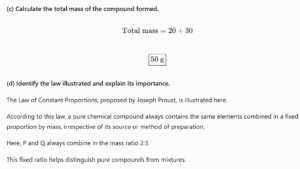
c. Calculate the total mass of the compound formed in part (b).
d. Identify the law illustrated by these results and explain why the ratio is important.