Chemical Reaction and Equation Paper 3 For Class 10 Chemistry Important Questions

Q 1 – Complete the following equation:

Answer

Q 2 – We store silver chloride in a dark coloured bottle because it is

(a) a white solid

(b) undergoes redox reaction

(c) to avoid action by sunlight

(d) none of the above

(c) to avoid action by sunlight

Q 3 – Dilute hydrochloric acid is added to granulated zinc taken in a test tube.

 The following observations are recorded. Point out the correct observation.
 (a) The surface of metal becomes shining
 (b) The reaction mixture turns milky
 (c) Odour of a pungent smelling gas is recorded
 (d) A colourless and odourless gas is evolved

 (d) A colourless and odourless gas is evolved

Q 4 – Which among the following is (are) double displacement reaction(s)?

(i) Pb + CuCl → PbCl2 + Cu

(ii) Na2SO4 + BaCl2 → BaSO4 + 2NaCl

(iii) C + O2 → CO

(iv) CH + 2O → CO2 + 2H2O

 (a) (i) and (iv)                                                         (b) (ii) only
 (c) (i) and (ii)                                                          (d) (iii) and (iv)

(b) (ii) only

Q 5 – On immersing an iron nail in CuSO4 solution for few minutes, you will observe
(a) no reaction takes place
(b) the colour of solution fades away
(c) the surface of iron nails acquire a black coating
(d) the colour of solution changes to green

(d) the colour of solution changes to green

Q 6 – An element X on exposure to moist air turns reddish-brown and a new compound Y is formed. The substance X and Y are

(a) X = Fe, Y = Fe2O3

(b) X = Ag, Y = Ag2S

(c) X = Cu, Y = CuO

(d) X = Al, Y = Al2O3

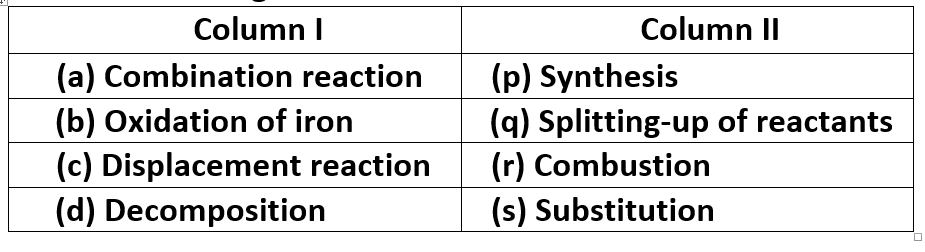
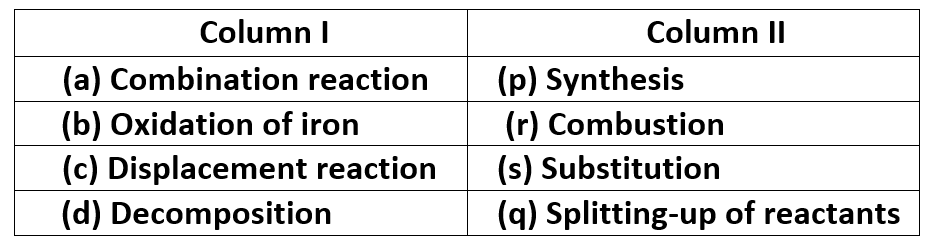
Q 7 – Match the following:

Answer

Q 8 – A teacher gave two test tubes to the students, one containing water and the other containing sodium hydroxide. She asked them to identify the test tube containing sodium hydroxide solution. Which one of the following can be used for the identification?

(a) Blue litmus

(b) Red litmus

(c) Sodium carbonate solution

(d) Dilute hydrochloric acid

(b) Red litmus

Q 9 – The following reaction is an example of a

4NH3(g) + 5O2(g)  4NO(g) + 6H2O(g)

 (i) displacement reaction

(ii) combination reaction

(iii) redox reaction

(iv) neutralisation reaction


(a)  (i) and (iv)

(b)  (ii) and (iii)

(c)  (i) and (iii)

(d)  (iii) and (iv)

(b) (ii) and (iii)

Q 10 – The following reaction is used for the preparation of oxygen gas in the laboratory:  

 Which of the following statement about the reaction is correct?
(a) It is a decomposition reaction and endothermic in nature.
(b) It is a combination reaction.
(c) It is a decomposition reaction and accompanied by release of heat.
(d) It is a photochemical decomposition reaction and exothermic in nature.

(a) It is a decomposition reaction and endothermic in nature.

Q 11 – Electrolysis of water is a decomposition reaction. The mole ratio of hydrogen and oxygen gases liberated during electrolysis of water is

(a) 1 : 1

(b) 2 : 1

(c) 4 : 1

(d) 1 : 2

(b) 2 : 1

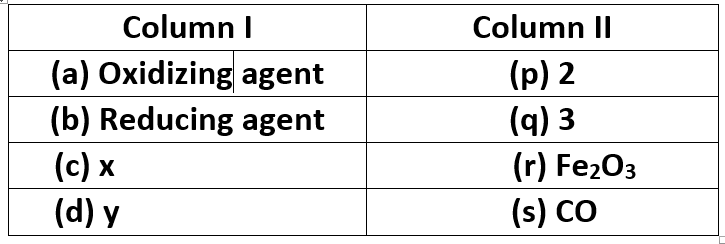
Q 12 – For the given reaction, match column I with column II and mark the correct option from the codes given below.  

  Fe2O3 + x CO → y Fe +  CO2

(A)  (a)-(s), (b)-(r), (c)-(q), (d)-(p) 

(B)  (a)-(s), (b)-(r), (c)-(p), (d)-(q) 

(c)   (a)-(r), (b)-(s), (c)-(q), (d)-(p) 

(D)  (a)-(r), (b)-(s), (c)-(p), (d)-(q)

(A)  (a)-(s), (b)-(r), (c)-(q), (d)-(p) 

Q 13 – Silver article turns black when kept in the open for a few days due to formation of

(a) H2S

(b) AgS

(c) AgSO4

(d) Ag2S

(d) Ag2S

Q 14 – Which of the following is not true with respect to the neutralisation reaction?

(a) Salt is formed.                               

(b) Reaction occurs between an acid and a base.

(c) Reactive element displaces less reactive element.

(d) Reactants are in gaseous state.

(c) Reactive element displaces less reactive element.

Q 15 – Barium chloride on reacting with ammonium sulphate forms barium sulphate and ammonium chloride. Which of the following correctly represents the type of the reaction involved?
(i) Displacement reaction

(ii) Precipitation reaction

(iii) Combination reaction

(iv) Double displacement reaction

(a) (i) only

(b) (ii) only

(c) (iv) only

(d) (ii) and (iv)

(d) (ii) and (iv)

Q 17 – What happens when magnesium ribbon burns in air?

Magnesium burns with a dazzling white flame forming magnesium oxide (MgO).

Q 18 – Why are decomposition reactions called the opposite of combination reactions? Write equations for these reactions.

Decomposition reactions are opposite to combination reactions because:

  • Combination: Two or more substances combine → one product
  • Decomposition: One substance breaks → two or more products

Equations:
Combination:

CaO + H2O → Ca(OH)2

Decomposition:
CaCO3 → CaO + CO2

Q 19 – What changes in the colour of iron nails and copper sulphate solution do you observe after  keeping the iron nails dipped in copper sulphate solution for about 30 minutes ?

  • Iron nail: gets a brown coating (copper deposition)
  • Solution: blue colour fades to green (FeSO4)

Q 20 – Give reasons :
(a) Aluminium is a reactive metal but is still used for packing food articles.
(b) Red litmus paper turns blue when touched with aqueous solution of  magnesium oxide.

(a) Aluminium forms a protective oxide layer (Al2O3), preventing further reaction.

(b) MgO is basic → turns red litmus blue.

Q 21 – Write the balanced chemical equation for the following and identify the type of reaction in each case.
(a) Potassium bromide(aq) + Barium iodide(aq) → Potassium iodide(aq) + Barium
 bromide(s)
(b) Zinc carbonate(s) → Zinc oxide(s) + Carbon dioxide(g)
(c) Hydrogen(g) + Chlorine(g) → Hydrogen chloride(g)
(d) Magnesium(s) + Hydrochloric acid(aq) → Magnesium chloride(aq) + Hydrogen(g)

(a)
2KBr + BaI2 → 2KI + BaBr2
Type: Double displacement

(b)
ZnCO3 → ZnO + CO2
Type: Decomposition

(c)
H2 + Cl2 → 2HCl
Type: Combination

(d)
Mg + 2HCl → MgCl2 + H2
Type: Displacement