Class-8 How When and Where – Very Short Questions
Q 1 – History is about finding out how things were in the past and how things have ________
(a) Changed
(b) Started
(c) Ended/completed
(d) Evolved
Ans – (a) Changed
Q 2 – Historians believed that Time does not have _________ dates in terms of a particular year or month
(a) Abstruse
(b) Precise
(c) Ambiguous
(d) Imprecise
Ans – (b) Precise
Q 3 – Historians often compared Past with the Present and always referred to _________. i.e. Before and After.
(a) Event
(b) Time
(c) Period
(d) Phase
Ans – (b) Time
Q 4 – A list of historical events is given below. Choose the one where a precise date can be fixed.
(a) Start of Mughal Rule in India
(b) Start of British rule in India
(c) Assassination of Mahatma Gandhi
(d) Start of Non- cooperation Movement
Ans – (c) Assassination of Mahatma Gandhi
Q 5 – James Mill was of the opinion that before British came to India, __________ruled the country.
(a) Hindus and Muslims
(b) Only Hindus
(c) Hindus, Muslims and Christians
(d) Only Muslims
Ans – (a) Hindus and Muslims
Q 6 – What is Imperialism?
(a) Imperialism is a political system
(b) Imperialism is a technical term
(c) Imperialism is a traditional system
(d) None of these
Ans – (a) Imperialism is a political system
Q 7 – The chosen set of dates by the Historians become more vital when the focus is on a
(a) Particular set of events
(b) Particular Location
(c) Particular Battle
(d) Particular King
Ans – (a) Particular set of events
Q 8 – From a layman’s point of view, which one of the following option is synonymous with the study of History and very difficult to memorise?
(a) Dates
(b) Census
(c) Surveys
(d) Artefacts
Ans – (a) Dates
Q 9 – When Historians write History, they divide it into different chapters. Why?
(a) To give a neat look and presentation
(b) To give each chapter some coherence
(c) For easier selection of dates.
(d) To associate the events separately
Ans – (a) To give a neat look and presentation
Q 10 – Pick out the statement that does not justify the significance of a timeline in History.
(a) A time line helps to identify the chronological occurrence of an event in a planned and arranged manner
(b) A timeline helps to keep information according to the sequence of events
(c) A timeline is not a graphical interpretation
(d) A timeline is organized according to the dates
Ans – (c) A timeline is not a graphical interpretation
Class-10 How When and Where
Q 11 – What was the important suggestion made by James Mill to the British?
(a) British should conquer all the territories in India to ensure the
enlightenment and happiness of Indian People
(b) Introduction of European manners and Western education will lower the level of Indian civilization
(c) With Religious tolerance, caste taboos and other superstitious practices only India can progress.
(d) India will progress without British help.
Ans – (a) British should conquer all the territories in India to ensure the enlightenment and happiness of Indian People
Q 12 – Name the three volume work of James Mill, the Scottish economist and philosopher.
(a) Glimpses of India
(b) History of British India
(c) An ancient History of India
(d) Glimpses of British History
Ans – (b) History of British India
Q 13 – Given below are some reasons to study History in the present world. Select the one that is not applicable to the study of history
(a) Since future is moulded on the basis of past events, it is important to study History.
(b) History is a record of people, places, events of the present arranged in chronological order.
(c) History is all about finding out how things have changed over a period of time.
(d) History is a catalogue of events, to understand about people, their
customs, traditions etc.
Ans – (b) History is a record of people, places, events of the present arranged in chronological order.
Q 14 – What are the sources of information of the periods?
(a) Primary sources
(b) Secondary sources
(c) Both a and b
(d) None of these
Ans – (c) Both a and b
Q 15 – History is considered to be a study of _____________.
(a) Comparisons
(b) The Present
(c) The Past
(d) The Future
Ans – (c) The Past
Q 16 – When did Tipu Sultan become the ruler of Mysore?
(a) 1781
(b) 1780
(c) 1779
(d) 1782
Ans – (d) 1782
Class-8 How When and Where
Q 17 – Answer the following questions :-
(i) A History of British India was written by
(a) Charles Darwin
(b) James Mill
(c) Albert Einstein
(d) ThomasHardy
(ii) The first Governor-General of India was
(a) Lord Dathousie
(b) Lord Mountbatten
(c) Lord William Bentinck
(d) Warren Hastings
(iii) The National Archives of India came up in the
(a) 1920s
(b) 1930s
(c) 1940s
(d) 1950s
(iv) The word ‘Calligrapher’ means
(a) One who is specialized in the art of painting.
(b) One who is specialized in the art of music.
(c) One who is specialized in the art of beautiful writing.
(d) One who is specialized in the art of public speaking.
(v) Census operations are held
(a) every five years
(b) every seven years
(c) every ten years
(d) every twelve years
Ans – (i) – (b), (ii) – (d), (iii) – (a), (iv) – (c), (v) – (c).
Class-8 How When and Where
Q 18 – Fill in the blanks with appropriate words to complete each sentence.
(i) The colonial government gave much importance to the practice of
(ii) Historians have usually divided Indian history into ancient, and
(iii) A History of British India is a massive work.
(iv) Mill thought that all Asian societies were at a level of civilisation than Europe.
(v) The British established specialized institutions and to preserve important documents.
Ans – (i) Surveying
(ii) medieval- modem
(iii) three-volume
(iv) lower
(v) archives- museums.
Q 19 – State whether each of the following statements is True or False.
(i) The British were very particular about preserving official documents.
(ii) Printing began to spread by the middle of the 20th century.
(iii) The periodisation of Indian history offered by James Mill was not at all accepted.
(iv) The British carried out detailed surveys by the early 19th century in order to map the entire country.
(v) James Mill glorified India and its culture in his book A History of British India.
Ans – (i) True,
(ii) False,
(iii) False,
(iv) True,
(v) False.
Q 20 – Match the items given in Column A correctly with those given in Column B.
| Column A | Column B |
| (i) A place where historical documents or records of a government, etc. are kept. | (a) Museum |
| (ii) A building in which objects of historical or scientific interest are kept to show them to the public. | (b) Colonization |
| (iii) An important taste of the British administration | (c) Archives |
| (iv) Subjugation of one country by another | (d) Carrying out surveys |
Ans – (i) – (c), (ii) – (a), (iii) – (d), (iv) – (b)
Class-8 How When and Where
Q 21 – Name the events for which specific dates can be determined.
Ans – The year a king was crowned, the year he married, the year he had a child, the year he fought a particular battle, the year he died, etc.
Q 22 – What was an important aspect of the histories written by the British historians in India?
Ans – The rule of each Governor-General was an important aspect.
Q 23 – Who was James Mill?
Ans – He was a Scottish economist and political philosopher and is known for his book A History of British India.
Q 24 – What was Mill’s opinion about the Asian societies?
Ans – In Mill’s opinion all Asian societies were at a lower level of civilisation than Europe.
Q 25 – What evil practices, according to James Mill, dominated the Indian social life before the British came to India?
Ans – According to James Mill, the evil practices that dominated to the Indian social life were religious intolerance, caste taboos and superstitious practices.
Q 26 – How did paintings project Governor-General?
Ans – Paintings projected Governors-General as powerful figures.
Q 27 – Why do many historians refer to the modem period as colonial?
Ans – It is because, under British rule, people did not have equality, freedom, or liberty—the symbols of modernity.
Class-10 How When and Where
Q 28 – Mention one important source used by historians in writing about the last 230 years of Indian history.
Ans – The official records of the British administration.
Class-8 How When and Where
Q 29 – What is done under census?
Ans – It records the number of people living in all the provinces of India and gathers information on castes, religions, and occupations.
Q 30 – What do official records not tell?
Ans – Official records do not tell what other people in the country felt, and what lay behind their actions.
Q 31 – Why do we try and divide history into different periods?
Ans – We do so in order to capture the characteristics of a time, its central features as they appear to us.
Class-8 How When and Where
Q 32 – How did James Mill view India?
Ans – James Mill did not cherish any positive ideas about India. He was of the opinion that all Asian societies were at a lower level of civilization than Europe. According to his telling of history, before the British came to India, the Hindu and the Muslim despots ruled the country. Religious intolerance, caste taboos, and superstitious practices dominated social life. He felt that only British rule could civilize India.
He suggested that the British should conquer all the territories of India to ensure the enlightenment and happiness of the Indian people. For India was not capable of progress without the help of the British.
Q 33 – Historians divide Indian history into ancient, medieval, and modem. But this division to has its problems. What are these problems?
Ans – This periodization has been borrowed from the West where the modem period was associated with the growth of all the forces of modernity such as science, reason, democracy, liberty, and equality. Medieval was a term used to describe a society where these features of modem society did not exist.
It is difficult for us to accept this characterization of the modem period. Here, it is worth mentioning that Indians did not have equality, freedom, or liberty under British rule. The country also lacked economic growth and progress in that period. It is therefore many historians refer to the modem period as the colonial period.
Q 34 – What did the British do to preserve important official documents and letters?
Ans – The British felt the need to preserve all the important official documents and letters. For this, they set up record rooms attached to all administrative institutions. The village tahsildar’s office, the collectorate, the commissioner’s office, the provincial secretariats, the lawcourts— all had their record rooms. The British also established specialized institutions such as archives and museums to preserve important records.
Q 35 – What do official records not tell? How do we come to know about them?
Ans – Official records do not always help us understand what other people in the country felt, and what lay behind their actions. For that, we have diaries of people, accounts of pilgrims and travellers, autobiographies of important personalities, and popular books, etc. that were sold in the local bazaars. With the spread of the printing press, newspapers came to be published and issues began to be debated in public. Leaders and reformers wrote to spread their ideas, poets and novelists wrote to express their feelings.
Class-8 How When and Where
Q 36 – How did the British conquer India and establish their rule?
Ans – The British conquered India in the following ways:
(a) They subjugated local nawabs and rajas.
(b) They established control over the economy and society collected revenue to meet all their expenses, bought goods they wanted at lower
prices and produced crops they needed for export.
(c) They brought changes in rulers and tastes, customs, and practices.
(d) Thus, they molded everything in their favor and subjugated the country very soon.
Class-8 How When and Where
Q 37 – How do the official records of the British administration help historians to write about the last 250 years of Indian history?
Ans – The British believed that the act of writing was important. Hence, they got written up every instruction, plan, policy decision, agreement, investigation, etc. They thought that once this was done, things could be properly studied and debated. This conviction produced an administrative culture of memos, notings, and reports.
The British were very interested in preserving all important documents and letters. For this, they established record rooms attached to all administrative institutions such as the village tahsildar’s office, the collectorate, law courts, etc. They also set up archives and museums to preserve important records.
Letters and memos that moved from one branch of the administration to smother in the early years of the 19th century can still be read in the archives. Historians can also take help from the notes and reports that district officials prepared or the instructions and directives that were sent by officials at the top to the provincial administrators.
Q 38 – How did surveys become important under the colonial administration?
Ans – The British gave much importance to the practice of surveying because they believed that a country had to be properly known before it could be effectively administered. Therefore, they carried out detailed surveys by the early 19 th century in order to map the entire country:
•They conducted revenue surveys in villages.
• They made efforts to know the topography, the soil quality, the flora, the fauna, the local histories, and the cropping pattern.
• They also introduced census operations, held at the interval of every ten years from the end of the 19th century. They prepared detailed
records of the number of people in all the provinces of India, noting information on castes, religions, and occupation separately.
• The British also carried on several other surveys such as botanical surveys, zoological surveys, archeolo¬gical surveys, forest surveys, etc. In this way, they gathered all the facts that were essential for administering a country
Class-8 How When and Where
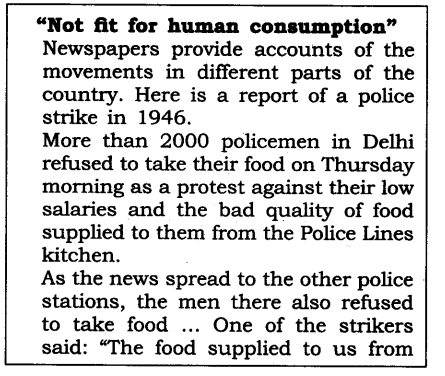
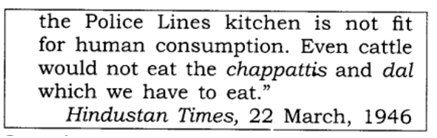
Q 39 – Read the following extract (source 2) taken from the NCERT textbook page 7 and answer the questions that follow:
Class-8 How When and Where
Q 40 – (i) Why did the policemen in Delhi refuse to take their food on Thursday morning?
(ii) How did the men in other police stations react when they came to know about the protest?
(iii) What was the comment of one of the strikers on the food supplied to them?
Answers:
(i) They did so as a protest against their low salaries and the inferior quality of food supplied to them from the Police Lines kitchen.
(ii) They also refused to take food.
(iii) One of the strikers said that the food supplied to them was not fit for human consumption. Even cattle would not eat the chapatis and dal
which they had to eat.
Class-10 How When and Where – Picture Based Questions
Q 41 – Observe the picture below taken from NCERT textbook (page 1) and answer the questions that follow:
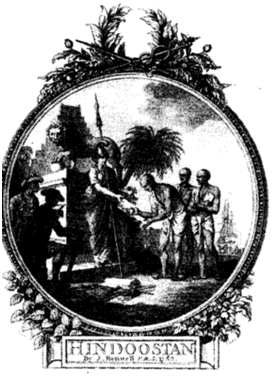
Q 42 – (i) What does the above picture try to suggest?
(ii) Explain how this image projects an imperial perception.
Ans –
(i) The picture tries to suggest that Indians willingly gave over their ancient texts scriptures (shashtra) to Britannia, the symbol of British power,
as if asking her to become the protector of Indian culture.
(ii) This image clearly depicts the imperial superiority. The image of lion symbolises superior power. The empire is the giver and its subjects are
always loyal to the throne.
Class-8 How When and Where
Q 43 – Observe the picture below taken from NCERT textbook (page 5) and answer the questions that follow:
Questions:
(i) What is it?
(ii) When did it come up?
(iii) Where was it located when Delhi was built?
(iv) What does this location reflect?
Ans –
(i) It is the National Archives of India.
(ii) It came up in the 1920s.
(iii) When Delhi was built, it was located close to the Viceregal Palace.
(iv) It reflects the importance of this institution in the British eyes.
Download PDF File How, When, and Where Class 8 History Extra Question and Answers