Class 9 Science Combined Paper  Is Matter Around us Pure (up to Solutions), Cells, Motion (up to Nucleous)

Q 1. Which of the following statement is correct regarding velocity and speed of a moving body? 
(a) Velocity of a moving body is always higher than its speed
(b) Speed of a moving body is always higher than its velocity
(c) Speed of a moving body is its velocity in a given direction
(d) Velocity of a moving body is its speed in a given direction

(d) Velocity of a moving body is its speed in a given direction

Explanation: Speed is a scalar quantity indicating only magnitude. Velocity is a vector quantity combining speed and direction.

Q 2. For a body performing motion with uniform speed, the distance-time graph is:
(a) Straight line parallel to y-axis

(b) Straight line inclined to the time axis

(c) Straight line parallel to x-axis

(d) Curved line

(b) Straight line inclined to the time axis

Explanation: In uniform speed, distance increases equally in equal time intervals. This yields a constant slope, forming a straight line tilted relative to the axes.

Q 3. A liquid boils at a fixed temperature and leaves no residue after evaporation. It is most likely a:

(a) Mixture

(b) Suspension

(c) Pure substance

(d) Colloid

(c) Pure substance

Explanation: Pure liquids possess fixed, sharp boiling points. They evaporate entirely without leaving any chemical residue behind. 

Q 4. An object travels 20 m in 5 sec and then another 40 m in 5 sec. What is the average speed of the object?
(a) 6 m/s

(b) 2 m/s

(c) 12 m/s

(d) 0 m/s

Given:

  • First distance = 20 m in 5 s
  • Second distance = 40 m in 5 s

Total distance = 20 + 40 = 60 m

Total time = 5 + 5 = 10 s

Average speed = Total distance / Total time

= 60 / 10

= 6 m/s

Correct option: (a) 6 m/s

Q 5. A plant cell becomes turgid due to –

(a) Plasmolysis

(b) Exosmosis

(c) Endosmosis

(d) Electrolysis

(c) Endosmosis

Explanation Water enters the plant cell causing it to swell and become turgid.

Q 6. Which of the following pairs represents a homogeneous mixture?

(a) Smoke and fog

(b) Brass and air

(c) Soil and milk

(d) Oil and water

(b) Brass and air

Explanation:

  • Brass is a homogeneous mixture of copper and zinc.
  • Air is also a homogeneous mixture of gases

Q 7. Which of the following situations represents uniform motion?

(a) A freely falling stone
(b) A pendulum in motion
(c) A car moving on a straight road at constant speed
(d) A cyclist moving through crowded traffic

(c) A car moving on a straight road at constant speed

Q 8. Two objects move with the same speed. They must have the same:

(a) Velocity

(b) Displacement

(c) Distance travelled

(d) Magnitude of velocity

(d) Magnitude of velocity

Q 9. Which statement correctly differentiates diffusion from osmosis?

(a) Osmosis occurs only in gases

(b) Diffusion requires a semipermeable membrane

(c) Osmosis involves movement of solvent molecules through a semipermeable  membrane

(d) Diffusion occurs only in liquids

(c) Osmosis involves movement of solvent molecules through a semipermeable  membrane

Q 10. The cell wall of a plant cell is made up of:

(a) glucose

(b) fructose

(c) protein

(d) cellulose

(d) cellulose

Q 11. Fill in the blanks:

1. In prokaryotes, the nuclear membrane is ________.

2. The _________ consists of stacks of membranes bound vesicles that function in the storage and packaging.

3. Gametes of reproductive organs are formed by cell division called _______.

4. Instantaneous speed of an object is measured with ______________ and total distance travelled by an object is measured with ____________ .

5. Sodium and potassium are stored in __________ to prevent them from reacting with air and moisture.
6. The property of breaking into pieces when hammered is called __________.
7. Bromine is the only non-metal that exists in __________ state at room temperature.

8. Diamond and graphite are ____________ forms of carbon .
9. The dense spherical body present inside the nucleus is called the __________.
10. The statement “all cells arise from pre-existing cells” was added by __________.

1. absent

2. Golgi apparatus

3. meiosis

4. speedometer, odometer

5. kerosene oil

6. brittleness

7. liquid

8. allotropes

9. nucleolus

10. Rudolf Virchow

Directions:

For each question, choose the correct option:

A. Both Assertion (A) and Reason (R) are true, and R is the correct explanation of A.

B. Both A and R are true, but R is not the correct explanation of A.
C. A is true, but R is false.
D. A is false, but R is true.

Q 12. Assertion (A): A body moving with constant speed can still have acceleration.

Reason (R): Acceleration occurs whenever there is a change in velocity, even if only the direction changes.

A. Both Assertion (A) and Reason (R) are true, and R is the correct explanation of A.

Explanation: A body moving in a circular path with constant speed changes its direction continuously, therefore velocity changes and acceleration is produced.

Q 13. Assertion (A): The numerical value of displacement can never be greater than the distance travelled by an object.

Reason (R): Distance depends only on the initial and final positions of the object, whereas displacement depends on the actual path followed.

C. A is true, but R is false.

Explanation: Distance depends on actual path followed while displacement depends only on initial and final positions.

Q 14. Assertion (A): Red blood cells in humans can carry more oxygen because they lack a nucleus at maturity.

Reason (R): Absence of nucleus provides more internal space for haemoglobin molecules inside the cell.

A. Both Assertion (A) and Reason (R) are true, and R is the correct explanation of A.

Explanation: Mature RBCs lack nucleus which creates more space for haemoglobin, increasing oxygen carrying capacity.

Q 15. Assertion (A): The nucleus is called the control centre of the cell because all Cellular activities occur inside it.

Reason (R): The nucleus contains chromosomes carrying hereditary information which regulates cell functions.

D. A is false, but R is true.

Explanation: All cellular activities do not occur inside nucleus. However, nucleus regulates cell activities through hereditary material.

Q 16. Assertion (A): Components of a homogeneous mixture can always be separated by filtration.

Reason (R): The particles of a homogeneous mixture are uniformly distributed throughout the mixture.

D. A is false, but R is true.

Explanation: Homogeneous mixtures cannot generally be separated by filtration because particles are uniformly distributed and very small.

Q 17. Which cell organelle controls most of the activities of the cell? 

The nucleus controls most activities of the cell.

Functions:

1. Controls cellular activities.

2. Contains hereditary material (DNA/chromosomes).

3. Controls growth and reproduction.

Q 18. Describe the microscopic structure of the cell.

The cell is the basic structural and functional unit of life.

Microscopic structure of a cell includes:

1. Plasma membrane:

  • Thin outer covering.
  • Selectively permeable.
  • Controls movement of substances.

2. Cytoplasm:

  • Jelly-like substance.
  • Contains cell organelles.

3. Nucleus:

  • Control centre of the cell.
  • Contains chromosomes and nucleolus.

4. Cell organelles:

  • Mitochondria
  • Endoplasmic reticulum
  • Golgi apparatus
  • Vacuoles
  • Ribosomes etc.

Plant cells additionally possess cell wall and plastids.

Q 19. What is membrane biogenesis? How is plasma membrane formed during this process?

Membrane biogenesis is the process of formation of cell membranes.

Formation of plasma membrane:

1. Proteins are synthesized by ribosomes attached to rough endoplasmic reticulum.

2. Lipids are synthesized in smooth endoplasmic reticulum.

3. These materials move to Golgi apparatus for modification and packaging.

4. Vesicles carrying proteins and lipids fuse with plasma membrane.

Thus new plasma membrane is formed.

Q 20. Graphically derive the distance-time equation and distance- velocity equation.

For uniform motion:

Distance-time relation:

Distance travelled = Speed × Time

s = vt

Where:

  • s = distance
  • v = velocity/speed
  • t = time

Velocity – distance relation from graph:

Velocity = Distance / Time

v = s/t

In a distance-time graph:

Slope of graph = velocity

Q 21. Differentiate between the properties of Compounds and Mixtures with an example.

Compound

Mixture

Formed by chemical combination

Formed by physical mixing

Fixed composition

Variable composition

New properties formed

Constituents retain properties

Cannot be separated by physical methods

Can be separated physically

Definite melting/boiling point

No fixed melting/boiling point

Example: Water (H₂O)

Example: Air

Q 22. A bus decreases its speed from 80 kmh-1 in 5 seconds. Find its acceleration and retardation.

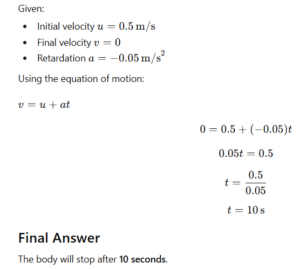
Q 23. A body starts to slide over a horizontal surface with an initial velocity of 0.5 m/s. Due to friction, its velocity decreases at the rate 0.05 m/s2. How much time will it take for the body to stop?

Q 24. Four cars A, B, C and D are moving on a levelled road. Their distance versus time graphs are shown in figure. Which car is the slowest?
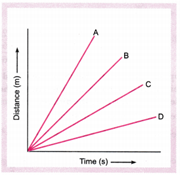
Based on the specific graph provided in this test paper, Car D is the slowest.

1. Slope Represents Speed: On a distance-time graph, the slope (steepness) of the line directly represents the speed of the object.

Speed = Distance / Time = Slope of the line

2. Comparing Slopes:

  • A steeper line means more distance is covered in less time (higher speed).
  • A flatter line means less distance is covered over the same period of time (lower speed).

3. Conclusion: Since Line D has the lowest incline (it is the flattest line closest to the time axis), Car D has the minimum speed and is therefore the slowest.

  1.  

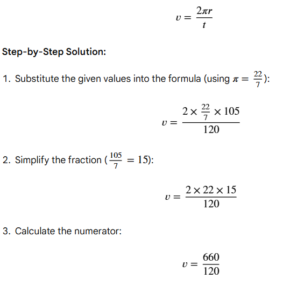
Q 25. Define uniform circular motion. Is it a case of accelerated motion or non-accelerated motion. A satellite covers a circular distance of a circle with radius 105 m in 2 minutes . Calculate the speed of satellite .

Uniform Circular Motion

When an object moves along a circular path with constant speed, its motion is called uniform circular motion.

Example: Motion of a satellite around the Earth.

It is a case of accelerated motion because although the speed remains constant, the direction of motion changes continuously. Since velocity changes, acceleration is produced.

Calculation of Satellite Speed

Given Data:

  • Radius of the circular path (r) = m
  • Time taken (t) = 2 minutes = 2 x 60s = 120 s
    The speed (v) of an object in a circular orbit is given by the total circumference divided by the time period:
Q 26. A man walks on a straight road from his home to a market 2.5 km away with a speed of 5 km h. Finding the market closed, he instantly turns and walks back home with a speed of 7.5 km h. Find the magnitude of average velocity, and average speed of the man over the interval of time
(i) 
0 to 30 min
(ii) 
0 to 50 min 
(iii) 
0 to 40 min 

Distance from home to market = 2.5 km

Speed while going = 5 km/h

Time taken to reach market:

Time = Distance/Speed

= 2.5/5

= 0.5 h = 30 min

Return speed = 7.5 km/h

Time for return:

= 2.5/7.5

= 1/3 h = 20 min

Total round trip time = 50 min

(i) 0 to 30 min

Displacement = 2.5 km

Average velocity = 2.5/0.5 = 5 km/h

Distance travelled = 2.5 km

Average speed = 2.5/0.5 = 5 km/h

(ii) 0 to 50 min

Net displacement = 0

Average velocity = 0

Total distance = 5 km

Total time = 50 min = 5/6 h

Average speed = 5 ÷ (5/6)

= 6 km/h

(iii) 0 to 40 min

In return journey after 10 min:

Distance covered back:

= 7.5 × (10/60)

= 1.25 km

Position from home:

= 2.5 − 1.25

= 1.25 km

Displacement = 1.25 km

Time = 40 min = 2/3 h

Average velocity:

= 1.25 ÷ (2/3)

= 1.875 km/h

Total distance travelled:

= 2.5 + 1.25

= 3.75 km

Average speed:

= 3.75 ÷ (2/3)

= 5.625 km/h

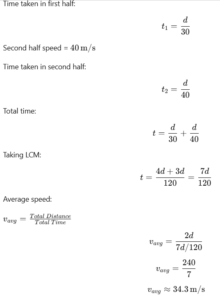
Q 27. A train covers half of its journey with a speed of 30ms-1 and the order half with a speed of 40 ms-1 . Calculate the average speed of the train during whole journey.

Let the total distance of the journey be 2d

Then:

  • First half distance = d
  • Second half distance = d

First half speed = 30 m/s
Q 28. A boy moves along the edge of a square park of side 40 m and stops at the diagonally opposite end of it. Find his velocity and speed if he takes 0.5 minutes to reach there.

Given:

  • Side of square park = 40 m
  • Time taken = 0.5 minute = 30 s

The boy moves along the edges of the square to the diagonally opposite corner.

Step 1: Distance travelled

He moves along two sides of the square.

Distance = 40 + 40 = 80 m

Speed:

Speed=Distance/Time

= 80/30

= 2.67 m/s

Step 2: Displacement

Displacement is the shortest distance between initial and final positions.

This is the diagonal of the square.

Using Pythagoras theorem:

d=a√2

= 40√2

≈ 56.6 m

Velocity:

Velocity=Displacement/Time

= 56.6/30

≈ 1.89 m/s

Ans. ·  Speed = 2.67 m/s

  • Velocity = 1.89 m/s