Q 1 – Resistance of a wire is y Ω. The wire is stretched to triple its length, then the resistance becomes
(a) y/3
(b) 3y
(c) 6y
(d) y/6
(d) y/6
Q 2 – A cylindrical conductor of length l and uniform area of cross-section A has resistance R. Another conductor of length 2l and resistance R of the same material has area of crosssection.
(a) A/
(b) 3A/2
(c) 2A
(d) 3A
(c) 2A
Q 3 – A voltmeter has a least count of 0.05 volt. While doing Ohm’s law experiment, a student observed that the pointer of the voltmeter coincides with 15th division, the observed reading is
(a) 0.75 V
(b) 0.075 V
(c) 7.5 V
(d) 0. 75 V
(a) 0.75 V

Q 5 – An ammeter has 20 divisions between mark 0 and mark 2 on its scale. The least count ofthe ammeter is :
(a) 0.02 A
(b) 0.01 A
(c) 0.2 A
(d) 0.1 A
(d) 0.1 A
Q 6 – In the following Questions, the Assertion and Reason have been put forward. Read the
statements carefully and choose the correct alternative from the following:
(a) Both the Assertion and the Reason are correct and the Reason is the correct explanation of the Assertion.
(b) The Assertion and the Reason are correct but the Reason is not the correct explanation
of the Assertion.
(c) Assertion is true but the Reason is false.
(d) The statement of the Assertion is false but the Reason is true.
1. Assertion: Drift velocity of electrons in a conductor increase on increasing the temperature of the conductor.
Reason: On increasing the temperature of a conductor, resistivity of the conductor increases.
(d) The statement of the Assertion is false but the Reason is true.
2. Assertion: Conductors allow the current to flow through themselves.
Reason: They have free charge carriers.
(a) Both the Assertion and the Reason are correct and the Reason is the correct explanation of the Assertion.
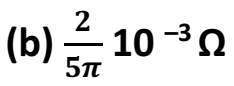
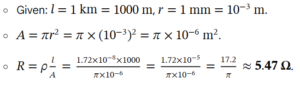
Q 7 – (a) Calculate the resistance of 1 km long copper wire of radius 1 mm. Resistivity of the copper is 1.72 x 10 Ω m.
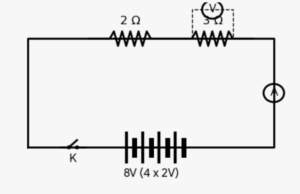
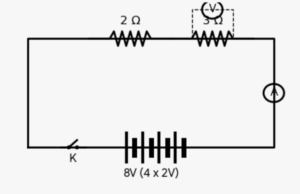
(b) Draw a schematic diagram of a circuit consisting of a battery of 4 cells of 2V each connected to a key, an ammeter and two resistors of 2 Ω and 3 Ω respectively in series and a voltmeter to measure potential difference across 3.
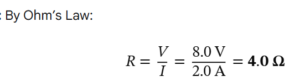
Q 8 – An EMF source of 8.0 V is connected to a purely resistive electrical appliance (a light bulb). An electric current of 2.0 A flows through it. Consider the conducting wires to be resistance-free. Calculate the resistance offered by the electrical appliance.
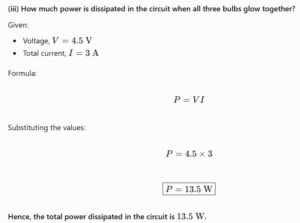
Q 9 – Three bulbs each having power P are connected in series in an electric circuit. In another circuit, another set of three bulbs of same power are connected in parallel to the same
source.
(i) Will the bulbs in both the circuits glow with the same brightness? Justify your answer.
- No. In parallel, each bulb gets the full source voltage V, dissipating full power. In series, the voltage splits equally (V/3) each), meaning each bulb drops to (1\9})th of its individual rated power. Thus, parallel bulbs glow much brighter.
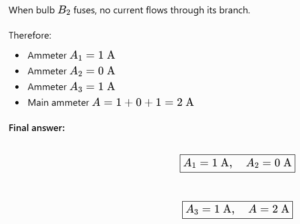
(ii) Now let one bulb in each circuit get fused. Will the rest of the bulbs continue to glow in each circuit? Give reason.
- Series: No. Fusing breaks the continuous single loop path, shutting down the whole circuit.
- Parallel: Yes. Every branch behaves independently; a broken filament in one branch doesn’t disrupt current flowing to the others.
(iii) Representing each bulb by a resistor, draw circuit diagram for each case.
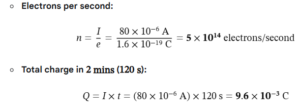
Q 10 – In a particular television tube, a beam of electrons is emitted. The beam current is 80 µA. how many electrons strike the screen of TV every second? Also find the total charge striking the screen in 2 min.
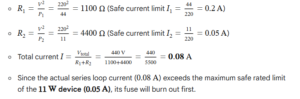
Q 11 – Two devices of rating 44 W, 220 V and 11 W, 220 V are connected in series. The combination is connected across a 440 V mains. The fuse of which of the two devices is likely to burn when the switch is ON? Justify your answer.
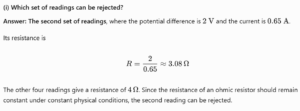
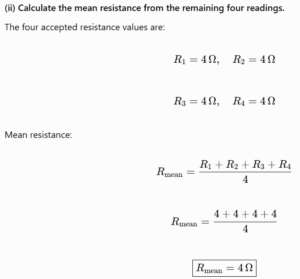
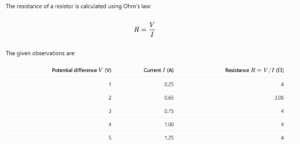
Q 12 – In an experiment to study the resistance between the potential difference across a resistor and the current through it, a student recorded the following observations:

Which one of the above sets of readings can be rejected? Calculate the mean value of resistance of the resistor based on the remaining four sets of readings.
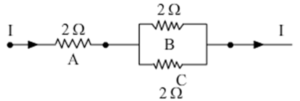
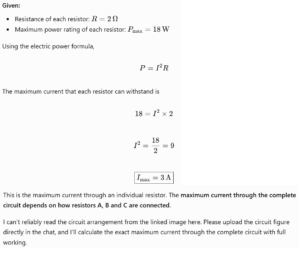
Q 13 – Three 2 Ω resistors, A, B and C, are connected as shown in Figure. Each of them dissipates energy and can withstand a maximum power of 18 W without melting.
Find the maximum current that can flow through the three resistors?
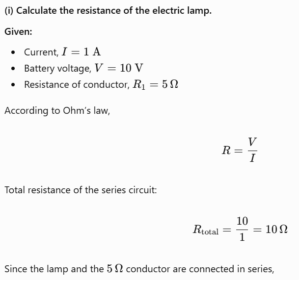
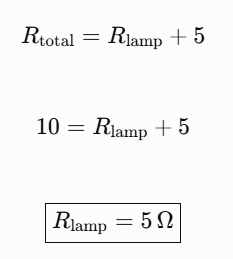
Q 14 – A current of 1 ampere flows in a series circuit containing an electric lamp and a conductor of 5 Ω when connected to a 10 V battery. Calculate the resistance of the electric lamp.
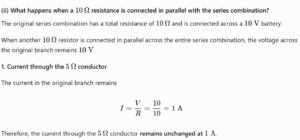
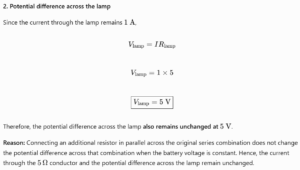
Now if a resistance of 10 Ω is connected in parallel with this series combination, what change (if any) in current flowing through 5 Ω conductor and potential difference across the lamp will take place? Give reason.

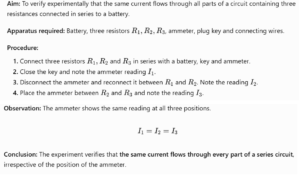
Q 16 – How will you infer with the help of an experiment that the same current flows through every part of the circuit containing three resistances in series connected to a battery?