Q 1 – The basic unit of life is:
(a) tissue
(b) cell
(c) both
(d) none of them
(b) cell
Q 2 – Who discovered the cell?
(a) Robert Hooke
(b) Leeuwenhoek
(c) Robert Brown
(d) T. Schwann
(a) Robert Hooke
Q 3 – The cell wall of a plant cell is made up of:
(a) glucose
(b) fructose
(c) protein
(d) cellulose
(d) cellulose
Q 4 – Which of the following controls all biological activities of a cell?
(a) Protoplasm
(b) Cell wall
(c) Nucleus
(d) All of these
(c) Nucleus
Q 5 – The undefined nuclear region of prokaryotes is also known as
(a) nucleus
(b) nucleolus
(c) Nucleic acid
(d) nucleoid
(d) nucleoid
Q 6 – Chromosomes are made up of
(a) DNA
(b) protein
(c) DNA and Protein
(d) RNA
(c) DNA and Protein
Q 7 – Which is the longest cell of the human body?
(a) Nerve cell
(b) Liver cell
(c) Kidney cell
(d) Cardiac cell
(a) Nerve cell
Q 8 – The proteins and lipids, essential for building the cell membrane, are manufactured by
(a) endoplasmic reticulum
(b) Golgi apparatus
(c) mitochondria
(d) peroxisomes
(a) endoplasmic reticulum
Q 9 – Amoeba acquires its food through a process termed as
(a) exocytosis
(b) endocytosis
(c) plasmolsis
(d) exocytosis and endocytosis both
(b) endocytosis
Q 10 – Fill in the blanks :
- Every cell is surrounded by a _______
- The cell wall of a plant cell is made up of _________
- The term protoplasm was coined by ___________
- Ribosomes are concerned with the synthesis of __________.
- Chromosomes are made up of nucleic acid and ________.
1. Plasma membrane (cell membrane)
2. Cellulose
3. Purkinje
4. Proteins
5. Protein (Histones)
Q 11 – True or False:
1. Prokaryotic cells have no membrane-bound organelles, their chromosome is composed of only nucleic acid and they have only small ribosomes.
2. The cell is a Latin word for ‘a little room’.
3. Amoeba is a multicellular organism.
4. Nucleolus has a limiting membrane.
5. Cell wall of plant cell is a living structure.
6. Robert Brown discovered protoplasm in 1831.
7. Movement of a substance from the area of low concentration to an area of high concentration is called diffusion.
8. A dilute solution is called hypertonic solution.
9. Smooth endoplasmic reticulum detoxifies many poisons and drugs.
10. Central vacuole occupies 10-20% of plant cell volume.
1. True
2. True
3. False
4. False
5. False
6. False
7. False
8. False
9. True
10.False
Q 12 – Who discovered electron microscope and when was it discovered and put into use?
The electron microscope was discovered by Ernst Ruska and Max Knoll in 1931, and later improvements made it widely usable in scientific research.
Q 13 – What is nucleoid?
The nucleoid is an irregular, non-membrane-bound region in prokaryotic cells that contains genetic material (DNA).
Q 14 – If the organization of a cell is destroyed due to some physical and chemical influence What will happen.
If the organization of a cell is destroyed due to physical or chemical factors, the cell loses its ability to function and eventually dies.
Q 15 – What is Plasma membrane and why it is called selectively permeably membrane.
The plasma membrane is a thin, flexible outer covering of the cell that separates the cell from its surrounding environment. It is made up of lipids and proteins and controls the movement of substances in and out of the cell.
It is called selectively permeable because it allows only certain substances (like water, oxygen, and small molecules) to pass through it, while restricting others. This helps the cell maintain a proper internal balance.
Q 16 – How are chromatin, Chromatid and chromosome related to each other?
Chromatin, chromatid and chromosome are different forms of the same genetic material (DNA + protein) inside the cell.
- Chromatin is a long, thin, thread-like structure present in the nucleus during the resting stage of the cell.
- When the cell prepares to divide, this chromatin condenses and coils tightly to form a chromosome.
- Each duplicated chromosome consists of two identical halves called chromatids, which are joined at a centromere.
Thus, chromatin → condenses to form chromosome → each chromosome has chromatids.
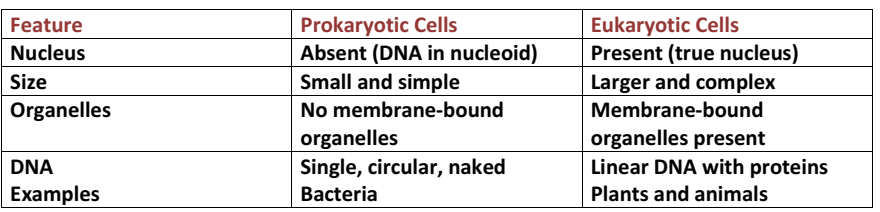
Q 17 – Differentiate between Prokaryotic and Eukaryotic.
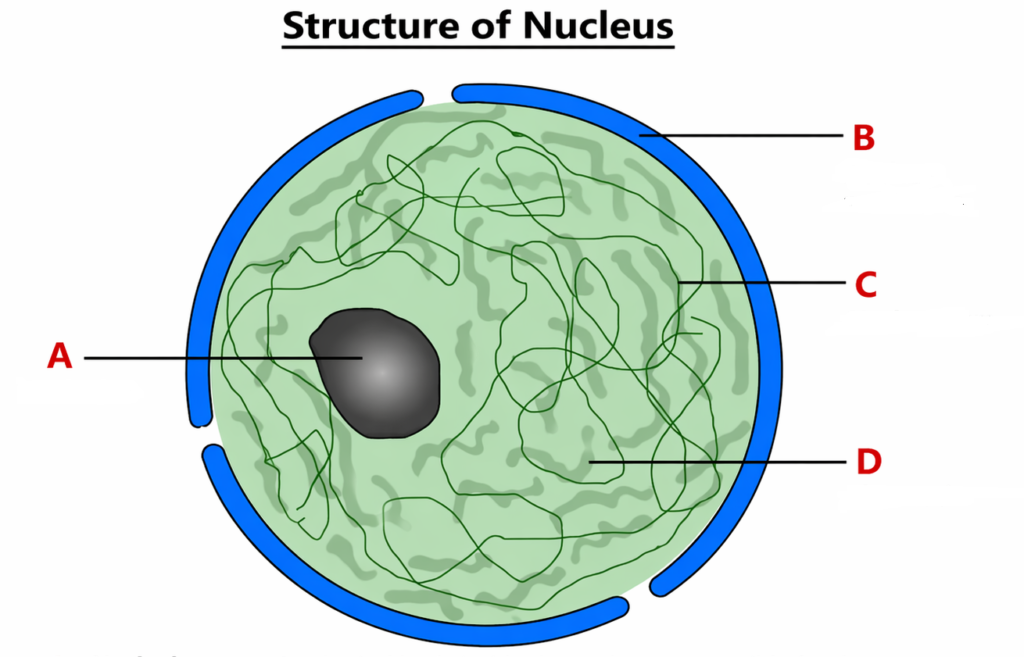
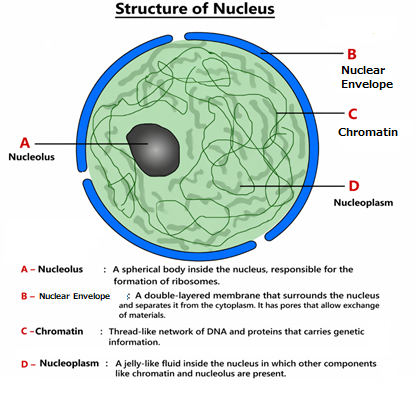
Q 18 – Label the various parts of Nucleus as per the given diagram.
Q 19 – What are the main parts of cell? Also draw the well labelled diagram of Plant Cell.
Main parts of a cell:
A cell has three main parts:
1. Plasma membrane (cell membrane):
It is the outer covering of the cell that protects the cell and controls the movement of substances in and out of the cell.
2. Cytoplasm:
It is a jelly-like substance present inside the cell where all the cell organelles are found and most metabolic activities take place.
3. lo-Nucleus:
It is the control centre of the cell which contains genetic material (DNA) and controls all activities of the cell.
Plant cell (description instead of diagram):
A plant cell has all the basic parts along with some special structures:
Cell wall: Outer rigid layer made of cellulose that provides support
Plasma membrane
Cytoplasm
Nucleus
Large central vacuole: Stores cell sap and maintains shape
Chloroplasts: Help in photosynthesis
Q 20 – Define Osmosis. Also define isotonic solution, hypotonic solution and hypertonic solution. What happens when mammalian RBC is put in the ringer solution?
Osmosis:
Osmosis is the process by which water moves from a region of higher water concentration to a region of lower water concentration through a semi-permeable membrane.
Types of solutions:
1. Isotonic solution:
A solution having equal concentration of solute as compared to the cell.
No net movement of water occurs.
2. Hypotonic solution:
A solution having lower solute concentration than the cell.
Water enters the cell, and the cell swells.
3. Hypertonic solution:
A solution having higher solute concentration than the cell.
Water leaves the cell, and the cell shrinks.
4. RBC in Ringer solution:
Ringer solution is an isotonic solution, so when a mammalian RBC is placed in it, there is no change in size or shape of the cell (it remains normal).