Exploring Mixtures and their Separation Class 9 New Chemistry NCERT Solutions (2026-27)

1. Which of the following mixtures are correctly classified as homogeneous (Hm) and heterogeneous (Ht)? Choose the correct option.

(i) Air – Hm, Milk – Ht, Sugar solution – Hm, Smoke – Hm

(ii) Brass – Ht, Fog – Ht, Vinegar – Ht, Muddy water – Hm

(iii) Copper sulphate solution – Hm, Salt solution – Hm, Milk – Hm, Bronze – Hm

(iv) Muddy water – Ht, Milk – Ht, Blood – Ht, Brass – Hm

Correct Option: (iv)

Explanation:

  • Muddy water → Heterogeneous mixture because particles are not uniformly distributed.

  • Milk → Heterogeneous (a colloid).

  • Blood → Heterogeneous mixture.

  • Brass → Homogeneous alloy of copper and zinc.

2. Choose the correct options and explain the reason.

Which among the following mixtures show the Tyndall Effect?

(a) air and dust particles
(b) copper sulphate and water
(c) starch and water
(d) acetone and water

Options:

(i) a and b

(ii) b and d

(iii) a and c

(iv) c and d

Correct Option: (iii) a and c

Explanation:

The Tyndall effect is shown by colloidal particles because they scatter light.

  • Air + dust particles → Colloid → Shows Tyndall effect.

  • Starch + water → Colloid → Shows Tyndall effect.

  • Copper sulphate + water → True solution → No Tyndall effect.

  • Acetone + water → True solution → No Tyndall effect.

3. A mixture can be categorised as a solution, suspension, or colloid, each possessing distinct properties. Utilise the words or phrases provided in the box to fill in the Table 5.2. Words and phrases may be use more than once.

PropertySolutionSuspensionColloid
NatureHomogeneousHeterogeneousHeterogeneous
Particle SizeVery small (<1 nm)Large (>1000 nm)Intermediate (1–1000 nm)
VisibilityParticles not visibleParticles visibleParticles not visible to naked eye
SettlingDo not settle downSettle down on standingDo not settle down
FiltrationCannot be separated by filtrationCan be separated by filtrationCannot be separated by ordinary filtration
Tyndall EffectDoes not showShowsShows

Examples:

  • Solution: Salt solution
  • Suspension: Muddy water
  • Colloid: Milk

4. Solve the following problems.

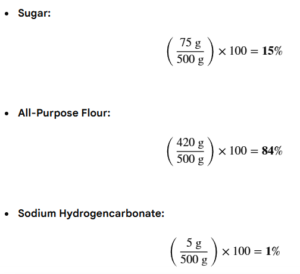
(i) A cake recipe uses dry ingredients, namely 75 g of sugar for 420 g of all-purpose flour and 5 g of sodium hydrogencarbonate. Express the concentration of each component in the mixture using an appropriate method.

Percentage of Sugar=  75 / 420 x 100

= 17.86 %


Answer:

Sugar = 17.86%

(ii) An brass alloy contains 70% copper by mass. Calculate the quantities of copper present in 120 g of the brass.

Copper = 70/ 100 x 120

= 84 g

Answer : 84 g

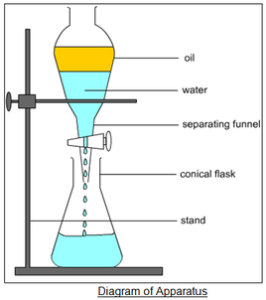
5. The label on a cooking oil pack says one litre (910 g). If this oil is mixed with water, will it form a separate layer? If so, which substance will be on top? How will you separate layers? also, draw the diagram of the apparatus used.

(i) How will it form separate layers?

Answers. 

Oil and water are immiscible liquids. Oil is lighter than water, so oil forms the upper layer and water forms the lower layer.

(ii) How can we separate the two layers?

Answer:

The two layers can be separated using a separating funnel.

(iii) Draw the diagram of the apparatus used.

Separating Funnel Diagram
6. Assertion and Reason

Assertion (A): Solutions do not exhibit the Tyndall effect.

Reason (R): The particles in solutions are larger than 100 nm, so they scatter light.

Options:

1. Both A and R are true and R is the correct explanation of A.

2. Both A and R are true but R is not the correct explanation of A.

3. A is true but R is false.

4. A is false but R is true.

Correct Option: 3

Explanation:

  • Assertion is true because true solutions do not scatter light.

  • Reason is false because solution particles are extremely small (less than 1 nm), not larger than 100 nm.

7. How would you separate the mixtures given in Table 5.3? Mention the reason for choosing your method. If mixture cannot be separated, explain. why

MixtureMethod of SeparationReason
Mud from muddy waterFiltrationMud is insoluble in water
Plasma from bloodCentrifugationComponents differ in density
Naphthalene and sandSublimationNaphthalene sublimes
Chalk powder and common saltDissolution + Filtration + EvaporationSalt dissolves, chalk does not
Common salt and waterEvaporationWater evaporates leaving salt
Oil from waterSeparating funnelLiquids are immiscible
Pigments of flowerChromatographyDifferent pigments move at different speeds

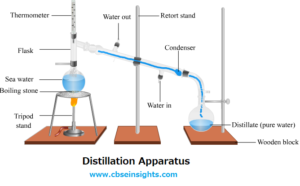
8. Two miscible liquids A and B are present in a mixture. The boiling point of A is 60°C and B is 90°C. Suggest a method to separate them. Also, draw a labelled diagram of the method suggested.

The liquids can be separated using distillation.

Reason:

  • The liquids are miscible.
  • They have different boiling points.
  • Liquid A (60°C) vaporises first and is condensed separately.

Distillation Apparatus
9. Compare evaporation, crystallisation and distillation.

MethodPurposePrinciple
EvaporationObtain solid from solutionLiquid evaporates
CrystallisationObtain pure crystalsDifference in solubility
DistillationSeparate liquidsDifference in boiling points

10. Blood is an example of a colloidal mixture.

(i) What would happen if blood behaved like a true suspension inside the body?

If blood behaved like a true suspension inside the body, its particles would settle down after some time because suspension particles are large and unstable.

(ii) In a blood sample, identify the dispersed phase and the dispersion medium.

Blood particles would settle down, making blood circulation impossible.

In blood:

  • Dispersed phase: Blood cells (RBCs, WBCs, and platelets)
  • Dispersion medium: Plasma

Explanation:

Blood is a colloid in which tiny blood cells are dispersed throughout the liquid plasma. Hence, plasma acts as the continuous medium, while blood cells form the dispersed particles.

11.You are given a mixture of sand, common salt and naphthalene (fig. 5.25a). The Fig. 5.25b depicts various steps used to separate the components of this mixture. Identify and write down the correct sequence of separation techniques.
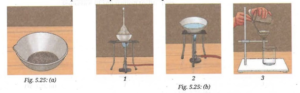
Correct sequence:

1. Sublimation Separate naphthalene.

2. Dissolution in water Salt dissolves.

3. Filtration Separate sand.

4. Evaporation Obtain salt.

12. Why is distillation an effective method for separating a mixture of water and acetone?

Distillation is effective because water and acetone have different boiling points.

  • Acetone boils at 56°C
  • Water boils at 100°C

Acetone vaporises first and is condensed separately.

13. Answer the following questions using Table 5.4.

Salts10°C20°C30°C40°C60°C80°C
Potassium nitrate21324562106167
Sodium chloride363636.336.53737
Potassium chloride353537.4404654
Ammonium chloride243741415566

(i) What mass of potassium nitrate would be needed to prepare its saturated solution in 50 g water at 40°C?

Given:

Solubility at 40°C = 62 g per 100 g water.

Solution:

62 / 100 x 50 = 31 g

31 g potassium nitrate

(ii) A student makes a saturated solution of potassium chloride in water at 80°C and leaves it to cool to room temperature (25ºC). What would she observe as the solution to cools? Explain.

The student would observe that crystals of potassium chloride separate out from the solution as it cools.

Explanation:

From Table 5.4:

TemperatureSolubility of Potassium Chloride (g per 100 g water)
80°C54 g
Around 25°CAbout 35–37 g

At 80°C, more potassium chloride dissolves in water because solubility is high.
When the solution cools to room temperature, the solubility decreases. The extra dissolved potassium chloride can no longer remain dissolved and hence separates out in the form of crystals.

(iii) What is the effect of the change in temperature on the solubility of salts? Also compare changes in the solubility of the four given salts with increasing temperature from 10 º C to 80 º C.

Effect of Temperature on Solubility:

Generally, the solubility of salts increases with increase in temperature. When water is heated, more solute can dissolve in it.


Comparison of Solubility Changes (10°C to 80°C)

SaltSolubility at 10°C (g/100 g water)Solubility at 80°C (g/100 g water)Change Observed
Potassium nitrate21167Very large increase
Sodium chloride3637Very small increase
Potassium chloride3554Moderate increase
Ammonium chloride2466Large increase

Explanation:

1. Potassium nitrate

  • Shows the maximum increase in solubility.

  • Solubility rises sharply from 21 g to 167 g.

2. Sodium chloride

  • Shows very little change in solubility.

  • Solubility increases only from 36 g to 37 g.

3. Potassium chloride

  • Shows a moderate increase in solubility.

  • Solubility rises from 35 g to 54 g.

4. Ammonium chloride

  • Shows a considerable increase in solubility.

  • Solubility increases from 24 g to 66 g.

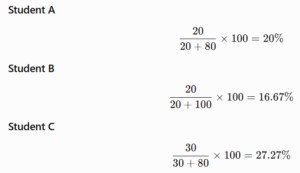
14. Three students A, B and C preparing sugar solutions for an experiment:

  • Student A dissolves 20 g sugar in 80 g of water.

  • Student B dissolves 20 g sugar in 100 g of water.

  • Student C dissolves 30 g sugar in 80 g of water.

(i) Calculate percentage concentration (% m/m) concentration of sugar in each student’s solution.

(ii) Whose solution is most concentrated? Explain Why.

Student C’s solution is most concentrated because it has the highest percentage concentration (27.27%).

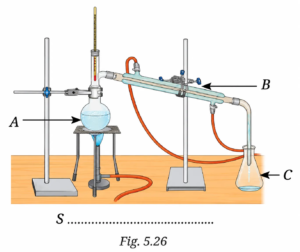
15. Examine Fig 5.26.

(i) Identify the separation technique marked as ‘S’.

(ii) Label the apparatus A, B and C.

(iii) Which of the following mixtures can be separated by the technique identified above? Use the data given in Table 5.5. Mixtures:

(a) water – acetone

(b) water – salt

(c) acetone – alcohol

(d) sand – salt

(e) alcohol – chloroform

(f) alcohol – benzene

(i) Identify the separation technique marked as ‘S’.

Answer: The separation technique marked as ‘S’ is Fractional Distillation.

Explanation:

Fractional distillation is used to separate miscible liquids having close boiling points.

(ii) Label the apparatus A, B and C.

Answer:

LabelApparatus
AThermometer
BFractionating column
CCondenser

(iii) Which of the following mixtures can be separated by the technique identified above?

Table 5.5 (Boiling Points)

SubstanceBoiling Point
Water100°C
Acetone56°C
Alcohol78°C
Chloroform61°C
Benzene80°C

Answer:

MixtureCan be separated by Fractional Distillation?Reason
(a) Water – acetoneNoBoiling points differ greatly
(b) Water – saltNoSalt is a solid dissolved in liquid
(c) Acetone – alcoholYesMiscible liquids with close boiling points
(d) Sand – saltNoSolid-solid mixture
(e) Alcohol – chloroformYesMiscible liquids with close boiling points
(f) Alcohol – benzeneYesMiscible liquids with close boiling points

Final Answer:

The mixtures that can be separated by fractional distillation are:

(c) Acetone – alcohol

(e) Alcohol – chloroform

(f) Alcohol – benzene