CLASSIFICATION OF MIXTURES
A mixture contains two or more substances physically combined. They can be broadly classified based on the uniformity of their composition.
MIXTURE CLASSIFICATION FLOWCHART
MIXTURES
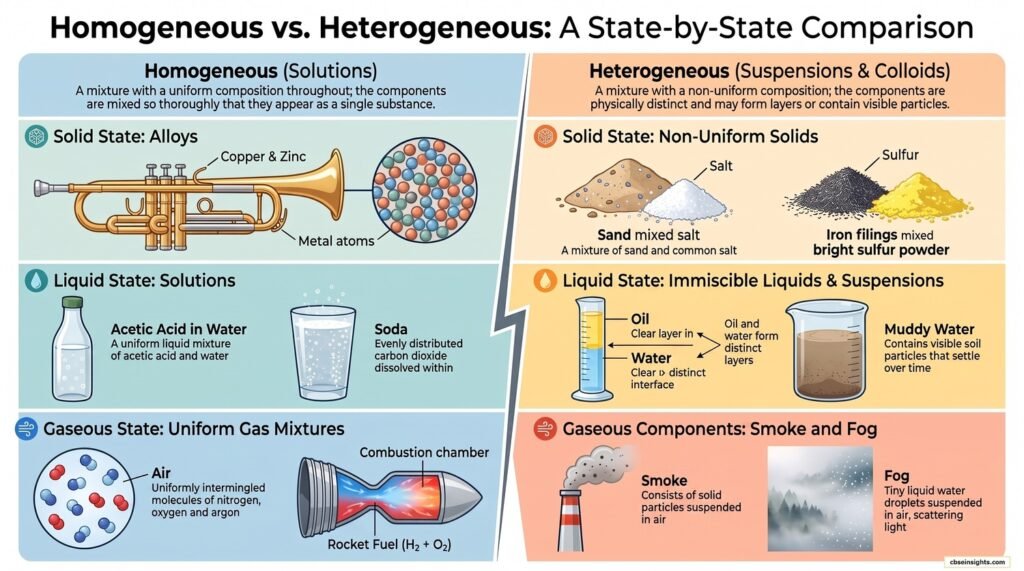
- Homogeneous Mixtures: Uniform composition throughout.
Examples: Sugar in water, vinegar (acetic acid in water), aerated drinks (soda). Also called Solutions.
- Heterogeneous Mixtures: Non-uniform composition; parts are visible and separate over time.
Examples: Sand in water, oil and water, iron filings and sulfur. Includes Suspensions and Colloids.
State of Mixtures: Most solid-solid mixtures (like sand and salt) are heterogeneous, whereas most gas-gas mixtures (like hydrogen and oxygen) mix uniformly and are homogeneous.
However, gases containing suspended solids or liquids (like smoke, fog, or dust in air) are heterogeneous.
SOLUTIONS & THEIR CONCENTRATION
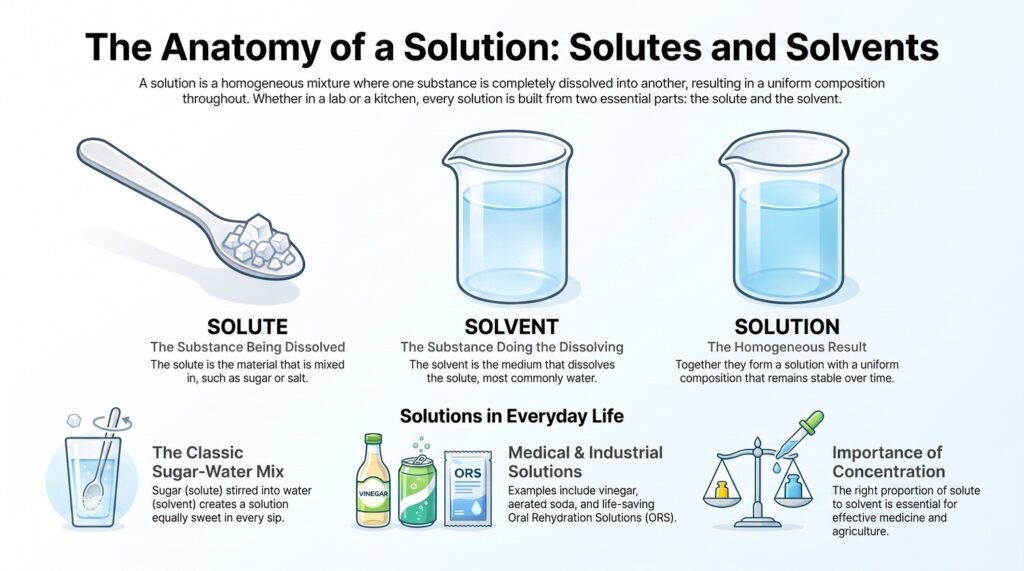
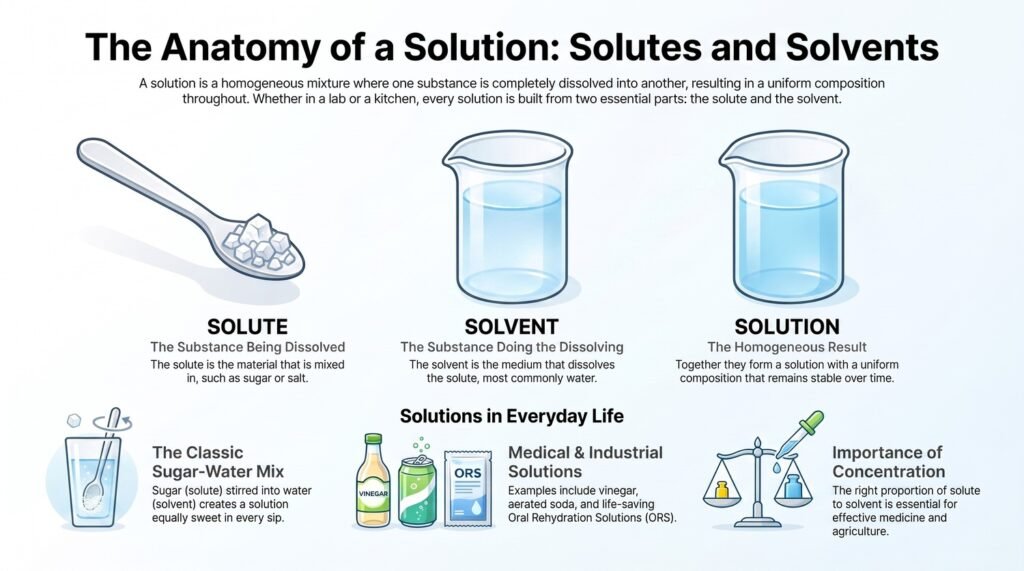
A solution is a homogeneous mixture of two or more substances.
Solvent: The substance that dissolves the solute (present in a larger amount).
Solute: The substance that gets dissolved (present in a smaller amount).
Important Fact: The ORS Solution
Oral Rehydration Solution (ORS) requires a specific, fixed proportion of salt and sugar in water; adding arbitrary amounts will not yield ORS. It was formulated by Indian paediatrician Dr. Dilip Mahalanabis, saving millions of lives from dehydration caused by diarrhoea and cholera.
Expressing Concentration
The concentration of a solution is the amount of solute dissolved in a given amount of solvent or solution. Getting the exact proportion is critical in fields like medicine and agriculture (e.g., pesticide sprays).
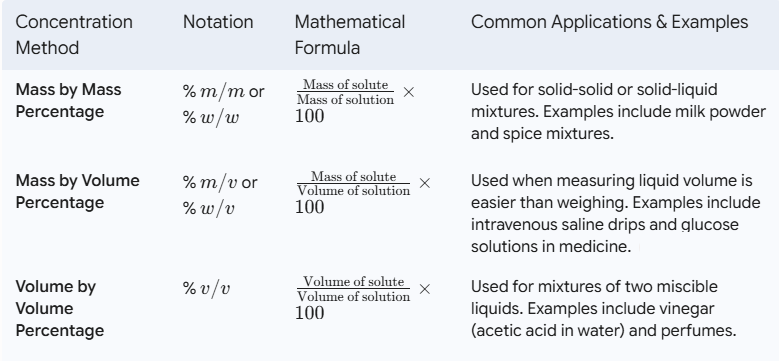
Formulas for Concentration (Percentage Methods):
Here is a concise table summarizing the formulas and their applications for expressing the concentration of a solution:
SOLUBILITY & ITS DYNAMICS
Solubility: The maximum amount of solute that can dissolve in a fixed quantity of solvent (usually 100 g or 100 mL) at a specific temperature.
Saturated Solution: A solution that cannot dissolve any more solute at a given temperature.
Effect of Temperature:
For Solid in Liquid: Solubility generally increases with an increase in temperature.
For Gas in Liquid: Solubility generally decreases with an increase in temperature.
Solubility Curve: A graph plotting solubility (y-axis, g/100g water) against temperature (x-axis, °C). (Refer Fig. 5.6 for visualizing solubility trends of different compounds).
SEPARATING HOMOGENEOUS MIXTURES
These techniques separate mixtures that have a uniform composition.
A. Crystallization
Principle: Based on the difference in solubility of a substance at different temperatures. When a hot, saturated solution cools, the excess solute separates out as pure solid crystals.
What is a Crystal? A solid made up of particles arranged in a regular, repeating geometric pattern.
Process: Heat solvent -> add solute until saturated -> filter insoluble impurities -> cool down slowly without disturbance -> pure crystals form -> filter and dry.
Why is it better than simple evaporation? Crystallization removes unwanted impurities from new compounds and leaves behind highly pure, well-shaped solids. Rapid cooling produces smaller, less-formed crystals; slow cooling yields larger crystals.
Examples: Rock salt, candy sugar (mishri), snowflakes, frost, copper sulfate (blue vitriol), quartz.
Historical Fact: Coastal communities in India historically made panga salt by boiling sea brines, and karkatch salt by evaporating seawater.
B. Distillation
Principle: Separates two miscible liquids that have a significant difference in their boiling points (at least ~25°C).
Process: The mixture is heated in a distillation flask -> the liquid with the lower boiling point vaporises first -> vapours pass through a water condenser -> cool down into pure liquid (distillate) -> collected in a separate flask.
Example: Separating acetone (boiling point 56°C) and water (boiling point 100°C).
Historical Fact: The traditional Deg-Bhapka method in Kannauj (UP) uses distillation to extract earthy fragrances (Mitti ka Ittar) from flowers and soil.
Fractional Distillation: Used when boiling point differences are less than 25°C. E.g., Refining crude petroleum into fractions like petroleum gas (LPG), aviation fuel, petrol, and diesel.
C. Paper Chromatography
Origin: Greek words chroma (colour) and graphein (to write).
Principle: Separates components based on differences in their interaction with the solvent and the chromatographic paper. As solvent moves up, it carries substances at different speeds.
Method: A spot of mixture (e.g., ink) is placed on paper -> dipped in a solvent (solvent level must be below the spot initially) -> solvent rises, separating colours.
Uses: Separating dyes in black ink, pigments from spinach leaves, or coloured pigments in flower petals.
SEPARATING HETEROGENEOUS MIXTURES
These techniques deal with non-uniform mixtures containing visible boundaries.
A. Separation of Immiscible Liquids
Principle: Liquids that do not mix (e.g., oil and water) separate into distinct layers based on their densities.
Apparatus: Separating Funnel.
Example: Mustard oil (lighter, forms upper layer) and water (heavier, forms lower layer). Opening the stopcock drains the heavier liquid out first.
B. Sublimation & Deposition
Sublimation: Solid changing directly to vapour on heating (below melting point) without becoming liquid.
Deposition: Vapour condensing directly back into solid upon cooling.
Process: Mixture placed in china dish -> inverted funnel plugged with cotton placed over it -> sublimable substance vaporises and deposits on cooler inner walls of the funnel.
Examples of Sublimable Solids: Camphor, naphthalene, dry ice (solid carbon dioxide). This method separates these from non-sublimable solids like sand
SUSPENSIONS & COLLOIDS: A DEEPER LOOK
Suspensions (e.g., Muddy Water)
Definition: Heterogeneous mixtures where solid particles do NOT dissolve but remain suspended throughout the bulk of the medium.
Particle Size: Very large (>1000 nm diameter); visible to the naked eye.
Settling: Particles settle down at the bottom if left undisturbed (sedimentation).
Separation: Can often be separated by filtration, but fine suspended particles require advanced techniques like Centrifugation or Coagulation.
Technique 1: Centrifugation
- Principle: Spinning a mixture in a tube at high speed. Centrifugal force (outward force in circular motion) forces heavier particles to settle at the bottom, while lighter liquid remains on top.
- Uses: Separating blood components (RBCs, WBCs, platelets, plasma) in labs and industries.
- Tech Innovation – The Paperfuge: A hand-powered, electricity-free device based on a spinning toy (like phugadi). Used in remote areas to separate blood samples and detect malaria or anaemia.
Technique 2: Coagulation
- Principle: Adding a chemical (coagulant) to a heterogeneous mixture to make fine suspended particles clump together into larger, heavier masses that settle via gravity.
- Uses: Adding alum (fitkari) to purify muddy water. Adding an acid (lemon/vinegar) to milk to coagulate milk proteins and make cheese (paneer).
Colloids (e.g., Milk, Blood)
1. Definition: Mixtures that appear homogeneous but are actually heterogeneous.
2. Particle Size: Moderate size (1 to 1000 nm). Too small to be seen with the naked eye, but larger than particles in a true solution.
3. Settling: Particles do NOT settle out over time; they remain uniformly dispersed.
4. Structure: Made of two parts:
1. Dispersed Phase: The solute-like suspended particles.
2. Dispersion Medium: The medium in which particles are suspended.
5. Emulsions: A specific type of colloid where BOTH the dispersed phase and dispersion medium are liquids.
Oil-in-Water: Milk, vanishing creams.
Water-in-Oil: Butter, body lotions, cold cream.
Stabilizers: Emulsifying agents (like proteins in milk) keep emulsions stable.
The Tyndall Effect
Definition: The scattering of a beam of light by dispersed particles in a colloid or a suspension, making the path of the light visible.
Condition: Occurs in colloids and suspensions, but NOT in transparent true solutions.
Discovery: Named after scientist John Tyndall.
Real-Life Examples: A fine light beam entering a dark room filled with dust; sunlight passing through the dense canopy of a forest; floodlights in a sports stadium cutting through hazy/smoky air.
QUICK REVISION & EVERYDAY APPLICATIONS
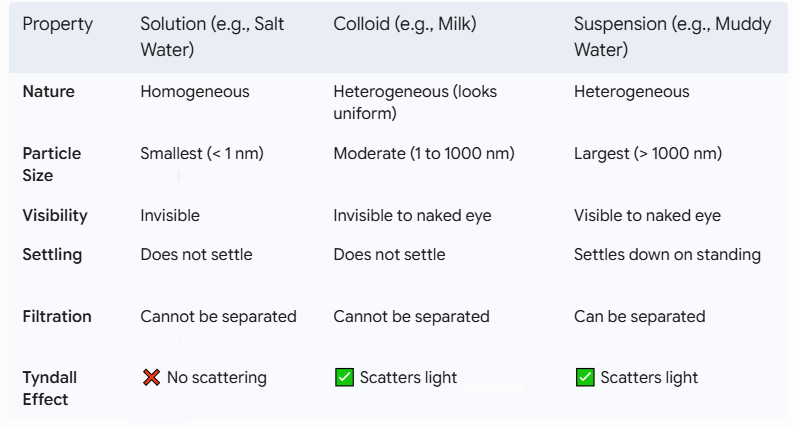
Comparison: Solution vs. Colloid vs. Suspension
Special Mixtures: Alloys
Definition: A homogeneous mixture of two or more metals (or a metal and a non-metal) created by melting them at high temperatures.
Characteristics: Cannot be separated by physical methods. Made to be stronger, rigid, or corrosion-resistant.
Key Examples:
Brass: 80% Copper + 20% Zinc.
Bronze: 80% Copper + 20% Tin.
Stainless Steel: Iron + Carbon, Chromium, Nickel, Molybdenum.