Q 1 – The site of photosynthesis in plant cells is:
a) Mitochondria
b) Ribosome
c) Chloroplast
d) Nucleus
c) Chloroplast
Q 2 – Which enzyme is present in saliva and what is its function?
a) Pepsin – breaks proteins
b) Amylase – converts starch into sugars
c) Lipase – digests fats
d) Trypsin – digests proteins
b) Amylase – converts starch into sugars
Q 3 – The end product of photosynthesis is:
a) Oxygen only
b) Glucose
c) Carbon dioxide
d) Nitrogen
b) Glucose
Q 4 – Bile juice helps in:
A. Protein digestion
B. Carbohydrate digestion
C. Fat emulsification
D. Vitamin synthesis
C. Fat emulsification
Q 5 – Why do herbivores have longer small intestines than carnivores?
a) To digest proteins efficiently
b) To absorb more water
c) To allow cellulose digestion
d) To store food
c) To allow cellulose digestion
Q 6 – Which of the following is NOT a function of the liver?
A. Detoxification
B. Bile production
C. Insulin production
D. Glycogen storage
C. Insulin production
Q 7 – Fill in the blanks:
a) The pigment responsible for trapping light energy in plants is __________.
b) The enzyme present in the stomach that digests proteins is __________.
c) The transport of food in plants occurs through __________ tissue.
d) The process of removal of nitrogenous wastes from the body is known as __________.
e) The process by which green plants prepare food using sunlight is called __________.
f) The enzyme that digests fats in the small intestine is __________.
g) The liquid part of blood without cells is called __________.
h) The movement of food in the alimentary canal is facilitated by rhythmic contractions called __________.
i) The dark reaction of photosynthesis takes place in the __________ of chloroplast.
j) The length of small intestine in a human adult is about _________.
a) Chlorophyll
b) Pepsin
c) Phloem
d) Excretion
e) Photosynthesis
f) Lipase
g) Plasma
h) Peristalsis
i) Stroma
j) 6–7 metres
Q 8 – True or False :
a) The stomach mainly digests carbohydrates.
b) Ingestion is the process of breaking down complex food into simpler substances.
c) Bile juice contains enzymes that digest fats.
d) Trypsin is secreted by the pancreas and helps in protein digestion.
e) Peristalsis helps in mixing food with digestive juices only in the stomach.
f) The oesophagus secretes digestive enzymes.
g) The liver produces bile which emulsifies fats.
h) All nutrients are absorbed in the stomach.
i) The inner lining of the small intestine has villi to increase surface area.
j) Egestion is the process of removing undigested food from the body.
a) False
b) False
c) False
d) True
e) False
f) False
g) True
h) False
i) True
j) True
Directions:
Choose the correct option:
A. Both Assertion (A) and Reason (R) are true, and R is the correct explanation of A
B. Both A and R are true, but R is NOT the correct explanation of A
C. A is true, but R is false
D. A is false, but R is true
Q 9 – Assertion (A): ATP is called the energy currency of the cell.
Reason (R): ATP releases energy when its terminal phosphate bond is broken.
A. Both Assertion (A) and Reason (R) are true, and R is the correct explanation of A
Q 10 – Assertion (A): Plants can survive without animals, but animals cannot survive without plants.
Reason (R): Plants are primary producers and provide oxygen and food.
A. Both Assertion (A) and Reason (R) are true, and R is the correct explanation of A
Q 11 – Assertion (A): Plants perform photosynthesis only during the day.
Reason (R): Light reaction requires sunlight.
A. Both Assertion (A) and Reason (R) are true, and R is the correct explanation of A
Q 12 – Assertion (A): The liver secretes bile which contains digestive enzymes.
Reason (R): Bile helps in digestion of fats.
D. A is false, but R is true
Q 13 – Assertion (A): Villi increase the efficiency of absorption in the intestine.
Reason (R): They increase the surface area for absorption.
A. Both Assertion (A) and Reason (R) are true, and R is the correct explanation of A
Q 14 – Assertion (A): The small intestine is longer in herbivores than in carnivores.
Reason (R): Cellulose digestion requires more time.
A. Both Assertion (A) and Reason (R) are true, and R is the correct explanation of A
Q 15 – Name the structure marked as ‘X’ in the given figure and also mention the functions of this structure.
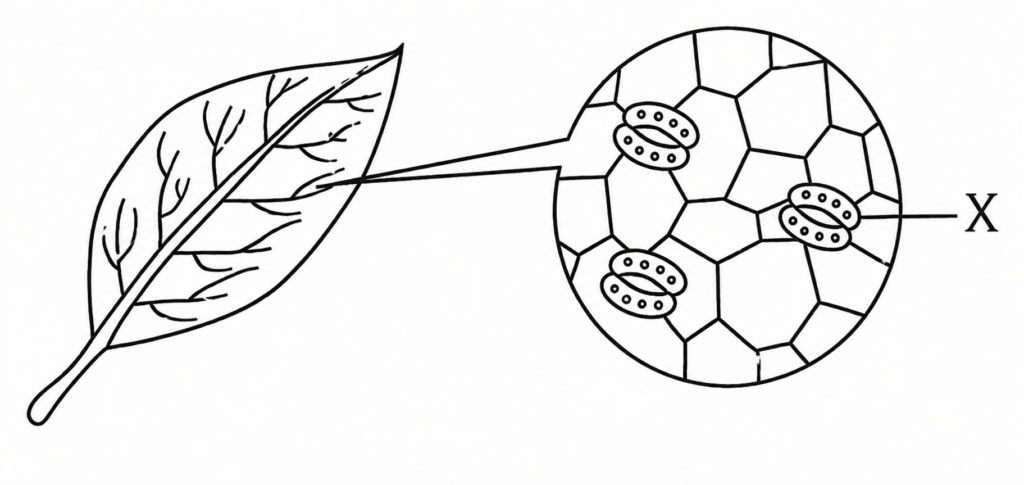
Structure ‘X’: Stomata
Functions:
- Exchange of gases (CO₂, O₂)
- Transpiration (loss of water vapour)
Q 16 – (a) How does carbon dioxide from the air enter the leaves of a plant to be used in photosynthesis ?
(a) CO₂ enters leaves:
Through stomata by diffusion
(b) How does water from the soil reach the leaves of a plant to be used in photosynthesis ?
(b) Water reaches leaves:
Absorbed by roots
Transported via xylem
Driven by transpiration pull
Q 17 – Name two autotrophic plants which also show heterotrophic mode of nutrition. Why do they need to switch to the latter mode?
Examples:
- Pitcher plant
- Venus flytrap
Reason:
- Grow in nitrogen-poor soil
Need insects for nitrogen
Q 18 – (a) What is common for Cuscuta, ticks and leeches ?
(b) Name the substances on which the following enzymes act in the human digestive system :
(i) Trypsin
(ii) Amylase
(iii) Pepsin
(iv) Lipase
(a) Common feature: Parasitic mode of nutrition
(i) Trypsin – Proteins
(ii) Amylase – Starch
(iii) Pepsin – Proteins
(iv) Lipase – Fats
Q 19 – (a) Describe the process of nutrition in Amoeba. Draw labelled diagrams to show the various steps in the nutrition in Amoeba.
(b) What is the mode of nutrition in Amoeba known as ?
(c) What is the process of obtaining food by Amoeba called ? What does it mean ?
(a) Process of Nutrition in Amoeba
Amoeba shows a stepwise process of nutrition:
1. Ingestion – Amoeba extends finger-like projections called pseudopodia to surround and engulf food particles, forming a food vacuole.
2. Digestion – Digestive enzymes are released into the food vacuole to break complex food into simpler substances.
3. Absorption – The digested food diffuses into the cytoplasm.
4. Assimilation – Absorbed nutrients are used for energy, growth, and repair.
5. Egestion – Undigested food is expelled outside through the cell membrane.
(b) Holozoic nutrition
(c) Phagocytosis
It is the process in which Amoeba engulfs food particles using pseudopodia to form a food vacuole.
Q 20 – (a) Name the main organs of the human digestive system. Also name the associated glands.
Main organs:
Mouth (buccal cavity)
Oesophagus
Stomach
Small intestine
Large intestine
Rectum and Anus
Associated glands:
Salivary glands
Liver
Pancreas
(b) How do carbohydrates, fats and proteins get digested in human beings ?
Carbohydrates
Digestion begins in mouth by salivary amylase (starch → sugar)
Continues in small intestine by pancreatic amylase
Finally converted into glucose
Proteins
Digestion starts in stomach by pepsin (proteins → peptides)
Completed in small intestine by trypsin (peptides → amino acids)
Fats
Digestion occurs mainly in small intestine
Bile juice (from liver) breaks fats into small droplets (emulsification)
Lipase enzyme converts fats → fatty acids + glycerol
Q 21 – (a) What is photosynthesis ?
Photosynthesis is the process by which green plants prepare their own food using sunlight, carbon dioxide, and water in the presence of chlorophyll, releasing oxygen as a by-product.
(b) Write a chemical equation to show the process of photosynthesis in plants.
Answer

(c) Explain the mechanism of photosynthesis.
1. Light Reaction (Light-dependent reaction)
Occurs in the grana (thylakoids)
Requires sunlight
Chlorophyll absorbs light energy
Water splits into hydrogen and oxygen (photolysis)
Oxygen is released
Energy is stored in the form of ATP and NADPH
2. Dark Reaction (Light-independent reaction / Calvin Cycle)
Occurs in the stroma
Does not require direct sunlight
Carbon dioxide is reduced using ATP and NADPH
Forms glucose (food)
Overall Process:
Light energy → converted into chemical energy
CO₂ + H₂O → Glucose + O₂