Life Processes Respiration Standard Test (2026-27) Class 10 Biology Important Questions

Q 1 – In which mode of nutrition an organism derives its food from the body of another living organism without killing it?

(a) Saprotrophic nutrition

(b) Parasitic nutrition

(c) Holozoic nutrition

(d) Autotrophic nutrition

(b) Parasitic nutrition

Q 2 – Roots of the plants absorb water from the soil through the process of:

(a) diffusion

(b) transpiration

(c) osmosis

(d) None of these

(c) osmosis

Q 3 – In amoeba, food is digested in the:

(a) food vacuole

(b) mitochondria

(c) pseudopodia

(d) chloroplast

(a) food vacuole

Q 4 – Which of the following events in the mouth cavity will be affected if  salivary amylase is lacking in the saliva?
(a) Starch breaking down into sugars.
(b) Proteins breaking down into amino acids.
(c) Absorption of vitamins.
(d) Fats breaking down into fatty acids and glycerol.

(a) Starch breaking down into sugars.

Q 5 – Glycolysis process occurs in which part of the cell?

(a) Cytoplasm

(b) Nucleus

(c) Mitochondria

(d) Chloroplast

(a) Cytoplasm

Q 6 – Which plant tissue transports water and minerals from the roots to the leaf?

(a) Xylem

(b) Phloem

(c) Parenchyma

(d) Collenchyma

(a) Xylem

Q 7 – Single circulation, i.e., blood flows through the heart only once during one cycle of passage through the body, is exhibited by which of the following:

(a) hyla, rana, draco

(b) whale, dolphin, turtle

(c) labeo, chameleon, salamander

(d) hippocampus, exocoetus, anabas

(d) hippocampus, exocoetus, anabas

Q 8 – Identify the correct path of urine in the human body.
(a) Kidney → urinary bladder → urethra → ureter
(b) Urinary bladder → ureter → kidney → urethra
(c) Kidney → ureter → urethra → urinary bladder
(d) Kidney → ureter → urinary bladder → urethra

(d) Kidney → ureter → urinary bladder → urethra

Q 9 – Label the various parts of the Alimentary Canal
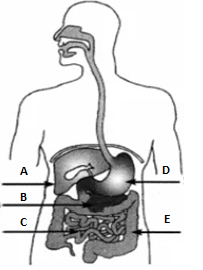
Alimentary Canal Labels
Mouth → Oesophagus → Stomach → Small Intestine → Large Intestine → Rectum → Anus

Q 10 – Fill in the Blanks:                                            
1. The exit of food from the stomach is regulated by a __________ muscle.
2. ________ is the longest part of the alimentary canal.
3. The process of breakdown of glucose, (a six-carbon molecule) into pyruvate, (a three-carbon molecule), takes place in the __________
4. __________ is the site of the complete digestion of carbohydrates, proteins and fats.
5. Breaking of pyruvate using oxygen takes place in the ____________
6. Rings of cartilage are present in the wind pipe to ensure that the ___________
7. The blood has _________ cells which plug the leakage in the vessels by helping to clot the blood at the  point of injury.
8. __________ transports products of photosynthesis from the leaves to other parts of the plant.

9. During dialysis , blood is taken from ____________ and is inserted back in _________ of the human body .

10.The correct pathway for water being absorbed from soil to vascular bundle tissues in the plants is Soil , Root-hairs , __________ , _________ , __________ & vascular bundle tissues.

1. Sphincter

2. Small intestine

3. Cytoplasm

4. Small intestine

5. Mitochondria

6. Air passage remains open

7. Platelets

8. Phloem

9. Artery, Vein

10. Epidermis, Cortex, Endodermis

Q 11 – Where does the blood finally enters from the Lymphatic system in Blood circulatory system ?

(a) Vena Cava

(b) Atrein Vein

(c) Pulmonary Artery

(d) Subclavian Vein

(d) Subclavian Vein

Q 12 – Name the tube which connects the kidneys to the urinary bladder.

(a) Urethra

(b) Nephron

(c) Tubule

(d) Ureter

(d) Ureter

Q 13 – The movement of food in phloem is called:

(a) transpiration

(b) translocation

(c) respiration

(d) evaporation

(b) translocation

Q 14 – The mode of nutrition found in fungi is:

(a) Parasitic nutrition

(b) Holozoic nutrition

(c) Autotrophic nutrition

(d) Saprotrophic nutrition

(d) Saprotrophic nutrition

Q 15 – The exit of unabsorbed food material is regulated by:

(a) liver

(b) anus

(c) small intestine

(d) anal sphincter

(d) anal sphincter

Q 16 – What are the products obtained by anaerobic respiration in plants?

(a) Lactic acid + Energy

(b) Carbon dioxide + Water + Energy

(c) Ethanol + Carbon dioxide + Energy

(d) Pyruvate

(c) Ethanol + Carbon dioxide + Energy

Q 17 – The breakdown of pyruvate to give carbon di-oxide, water and energy takes place in

(a) cytoplasm

(b) mitochondria

(c) chloroplast

(d) nucleus

(b) mitochondria

Q 18 – Name the substances whose build up in the muscles during vigorous physical exercise may cause cramps?

(a) Ethanol + Carbon dioxide + Energy

(b) Lactic acid + Energy

(c) Carbon dioxide + Water + Energy

(d) Pyruvate

(b) Lactic acid + Energy

Q 19 – Name the pores in a leaf through which respiratory exchange of gases takes place.

(a) Lenticels

(b) Vacuoles

(c) Xylem

(d) Stomata

(d) Stomata

Q 20 – The respiratory pigment in human beings is:

(a) carotene

(b) chlorophyll

(c) haemoglobin

(d) mitochondria

(c) haemoglobin

Q 21 – The Solution used to absorb exess COfrom the container :

(a) Potassium Permangnate

(b) Potassium Hydride

(c) Potassium Hydroxide

(d) Methyl Hydroxide.

(c) Potassium Hydroxide

Q 22 – A blood vessel which pumps the blood from the heart to the entire body:

(a) artery

(b) capillary

(c) Vein

(d) Haemoglobin

(a) artery

Q 23 – Name the tube which collects the urine from the millions of tubules of Nephron and passes the urine in the Ureter .

(a) Urea collecting duct .

(b) Tubule

(c) Urine collecting duct .

(d) Urethra

(c) Urine collecting duct

Q 24 – Where is the dirty blood in our body filtered?

(a) Heart

(b) Lungs

(c) Ureter

(d) Kidneys

(d) Kidneys

Q 25 – The procedure used for cleaning the blood of a person by separating urea  from it is called:

(a) osmosis

(b) Filtration

(c) dialysis

(d) double circulation

(c) dialysis

Q 26 – Which is the correct sequence of body parts in the human alimentary canal?
(a) Mouth → stomach → small intestine → large intestine → oesophagus
(b) Mouth → oesophagus → stomach → small intestine → large intestine
(c) Mouth → stomach → oesophagus → small intestine → large intestine
(d) Mouth → oesophagus → stomach → large intestine → small intestine

Q 27 – The basic life process common to all the living organisms are ___________,   _________, _________,_________,__________ and  __________.

Q 28 – What is the difference between parasitic nutrition and saprotrophic nutrition?

Q 29 – Complete the following reaction:

Q 30 – Name the two plants which eat insects.

Q 31 – The different steps in the process of nutrition in animals are _______, digestion,  _______, ________ and egestion.

Q 32 – The three substances present in the gastric juice are:

(a) Trypsin, Pepsin, Mucus

(b) Hydrochloric acid, Amylase, Mucus

(c) Mucus, Enzyme pepsin, hydrochloric acid

(d) Fatty acid, Lipase, Bile

Q 33 – Define Dental Plaque.

Q 34 – When the cell needs energy then the ATP can be broken down using water to release energy. Complete the following reaction

Q 35 – Define Glycolysis.

Q 36 – Write the chemical formula of Pyruvic acid and lactic acid.      

Q 37 – What are the living organisms that cannot make their own food called?

Q 38 – In insects like grasshopper, cockroach, housefly and a mosquito, the tiny holes  ________ present on the body and the air tubes called ________ are the respiratory organs.

Q 39 – The lungs are covered by two thin membranes called:

a) Gleura

b) Palate

c) Pleura

d) Ribs Gleura

Q 40 – The Voice box in the trachea is known as _________ & the part of throat between the Mouth and Windpipe is called __________ .

Q 41 – The Normal range of Haemoglobin in the blood of a person is from

a) 12.5 to 17.5 g/10 dL

b) 12.7 to 17.2 g/dL

c) 12 to 18 g/dL

d) 12 to 18 g/10ml

Q 42 – In Xylem the flow of water is _______ directional and in Phloem the flow of water is ________ directional .

Q 43 – The fighter cells present in the body are

a) WBC’s

b) RBC’s

c) Platelets

d) Blood Plasma

 Q 44 – The Lymphatic system consists of the following parts. Choose the correct option.
a) lymph, lymph glands , lymph Capillaries , Smaller lymph vessels .
b) lymph glands , lymphocytes , larger lymph vessels , lymph nodes .
c) lymphocytes , lymph nodes , larger Lymph vessels , lymph capillaries.
d) Lymphocytes, lymph nodes, smaller lymph vessels , lymph capillaries.

 Q 45 – The instrument use to measure the blood pressure is _________. Also explain about Systolic and Diastolic blood pressures.

 Q 46 – What is saliva? State its role in the digestion of food.

Q 47 – In single celled organisms diffusion is sufficient to meet all their requirements of food, exchange of gases or removal of wastes but it is not in case of multicellular organisms. Explain the reason for this difference.

 Q 48 – What would be the consequences of deficiency of hemoglobin in your body?

 Q 49 – What are cramps and the cause of cramps? How can we get relief from them?

 Q 50 – In mammals and birds why is it necessary to separate oxygenated and de-oxygenated blood ?

 Q 51 – Name three different glands associated with the digestive system in humans. Also name their secretions.
                                                    Or
Bile juice does not contain any enzyme but bile salts are important for digestion and absorption of fats. State reason.

 Q 52 – How are water and minerals transported in plants ?

 Q 53 – In human alimentary canal, name the site of complete digestion of various components of food. Explain the process of digestion.

 Q 54 – Explain the process of excretion in Human beings? 
                                                      Or
Explain in detail the blood pressure in human beings and how can we measure it.

 Q 55 – Explain the Lymphatic System in the human body.

 Q 56 – Explain in detail the Human Circulatory system. Why heart is called Double Pump or Double Circulation system.