The World of Numbers Class 9 New Maths NCERT Book Solutions

Exercise Set :  3.1

1. A merchant in the port city of Lothal is exchanging bags of spices for copper ingots. He receives 15 ingots for every 2 bags of spices. If he brings 12 bags of spices to the market, how many copper ingots will he leave with?

Given:

  • 2 bags of spices → 15 copper ingots
  • 12 bags of spices → ? copper ingots

First find how many groups of 2 bags are present in 12 bags:

12 ÷ 2 = 6

So, there are 6 groups of 2 bags.

Each group gives 15 copper ingots.

Therefore,

6 × 15 = 90

Answer: 90 copper ingots 

2. Look at the sequence of numbers on one column of the Ishango bone: 11, 13, 17, 19. What do these numbers have in common? List the next three numbers that ft this pattern. 

The numbers are:

11, 13, 17, 19

All four numbers are prime numbers.

A prime number has exactly two factors: 1 and itself.

For example:

11 = 1 × 11

13 = 1 × 13

17 = 1 × 17

19 = 1 × 19

So, the pattern is prime numbers greater than 10.

The next three prime numbers are:

Common property: They are prime numbers.

Next three numbers: 23, 29, 31

3. We know that Natural Numbers are closed under addition (the sum of any two natural numbers is always a natural number). Are they closed under subtraction? Provide a couple of examples to justify your answer.

Natural numbers are:

N={1,2,3,4,5,…}

For a set to be closed under subtraction, the difference of any two natural numbers must also be a natural number.

Consider:

5 −3 = 2

Here, 2 is a natural number.

But consider:

3 − 5 = − 2

Here, −2-2 is not a natural number.

Therefore, the difference of two natural numbers is not always a natural number.

Natural Numbers are closed under subtraction.

Subtracting a larger natural number from a smaller one can give a negative number, which is not a natural number.
4. Ancient Indians used the joints of their fngers to count, a practice still seen today. Each fnger has 3 joints, and the thumb is used to count them. How many can you count on one hand? How does this relate to the ancient base-12 counting systems?

There are 4 fingers other than the thumb.

Each finger has 3 joints.

Therefore,

4 × 3 = 12

So, using the thumb to point to the joints, we can count:

1,2,3,……12

on one hand.

This gives a natural way of counting up to 12, which is connected with the idea of a base-12 (duodecimal) counting system.

Answer: 12

Exercise Set :  3.2

1. The temperature in the high-altitude desert of Ladakh is recorded as 4 °C at noon. By midnight, it drops by 15 °C. What is the midnight temperature?

Temperature at noon:

= 4 º C

Temperature drops by:

= 15 º C

A drop means that we have to subtract.

Therefore,

Since 15>415>4,

Hence,

The temperature at midnight is \boxed{-11^\circ C}.

2.  A spice trader takes a loan (debt) of Rs. 850. The next day, he makes a proft (fortune) of Rs. 1,200. The following week, he incurs a loss of Rs. 450. Write this sequence as an equation using integers and calculate his fnal fnancial standing.

We represent:

  • Debt by a negative integer.
  • Profit by a positive integer.
  • Loss by a negative integer.

Step 1: Represent the debt

The initial debt is Rs 850.

Therefore,

Debt = – 850

Step 2: Add the profit

Profit = Rs. 1200.

Therefore,

−850+1200

Calculate:

1200 – 850 = 350

So, after making the profit, the person’s financial position is:

+ Rs 350

This means the person has Rs 350 remaining after clearing the debt.

Step 3: Subtract the loss

Loss = Rs 450.

Therefore,

350 — 450

= – Rs 100

Thus, after suffering the loss, the final financial position is:

– Rs 100

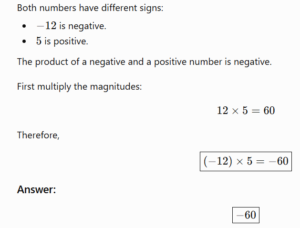
3. Calculate the following using Brahmagupta’s laws:

(i) (–12) × 5 

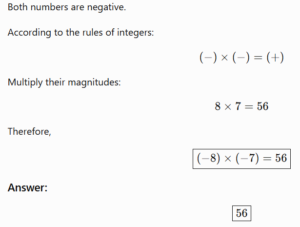
(ii) (–8) × (–7) 

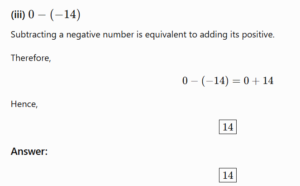
(iii) 0 – (–14) 

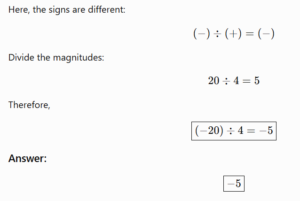
(iv) (–20) ÷ 4

4. Explain, using a real-world example of debt, why subtracting a negative number is the same as adding a positive number (e.g., 10 – (–5) = 15).

Think of a negative number as a debt.

Suppose you have a financial balance of:

Rs. 10

Now suppose a debt of ₹5 is removed.

A debt of ₹5 can be represented by:

– Rs. 5

Removing this debt means we are subtracting a negative amount: 10 – (– 5)

When the debt of ₹5 is cancelled, your financial position improves by ₹5.

Therefore,

10 – (– 5) = 10 + 5

= 15 

Hence,

10 – (– 5) = 15

Exercise Set :  3.3